Turku Bioscience Centre, University of Turku and Åbo Akademi University, Turku 20520, Finland.
InFLAMES Research Flagship Center, University of Turku, Turku 20520, Finland.
Nucleic Acids Res. 2022 May 20;50(9):4938-4958. doi: 10.1093/nar/gkac256.
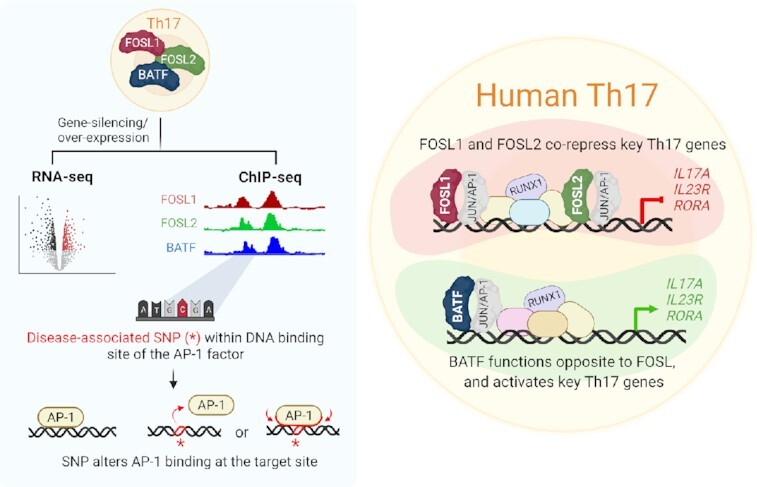
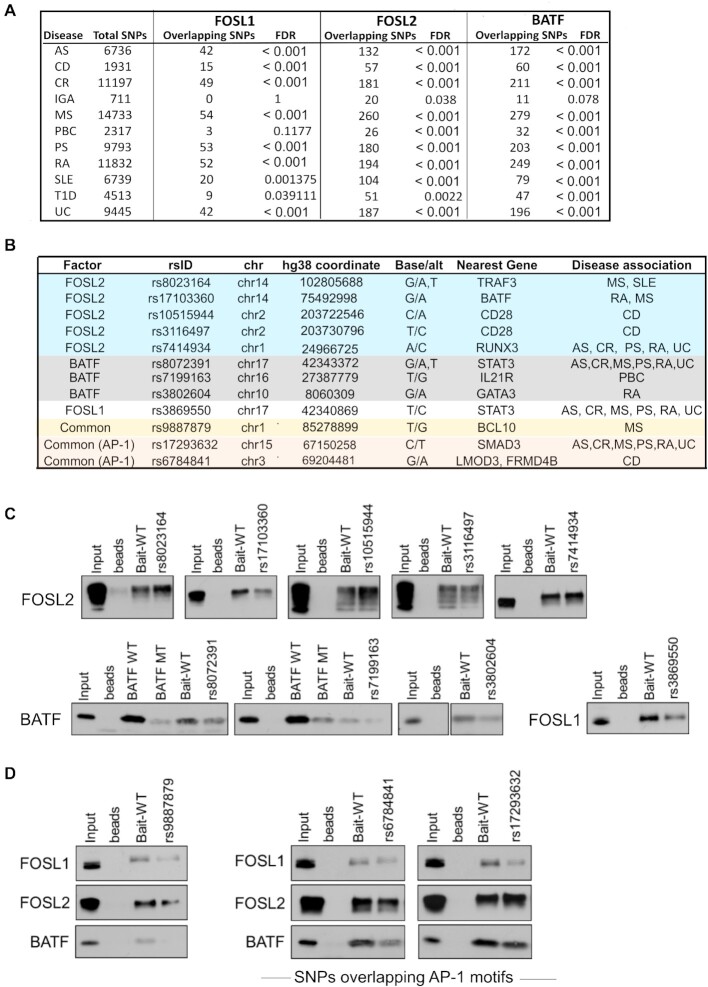
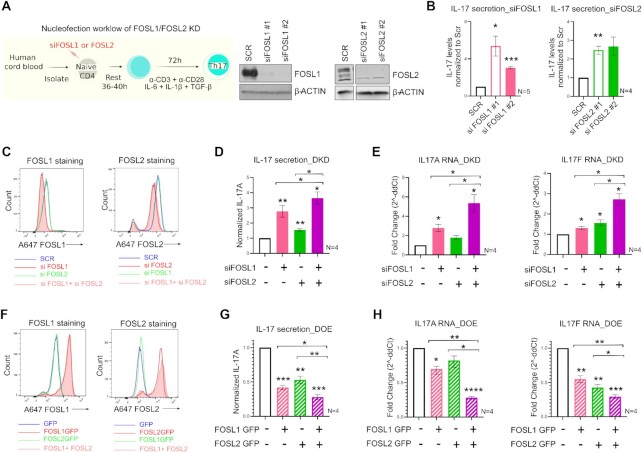
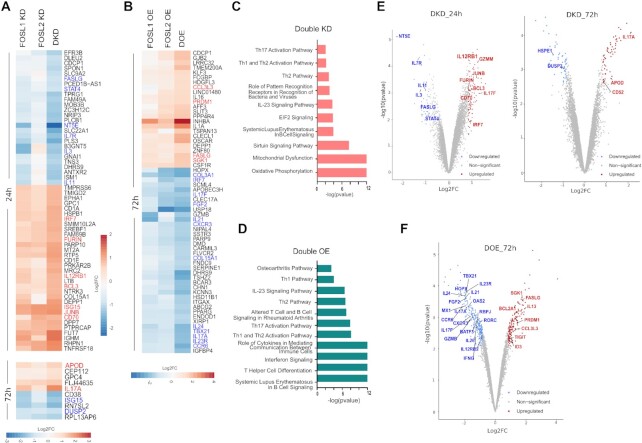
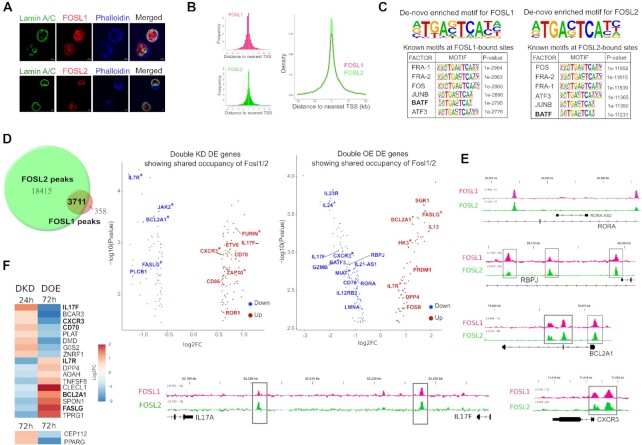
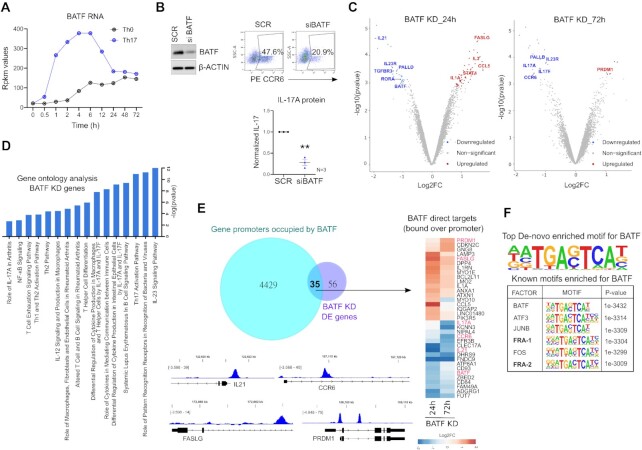
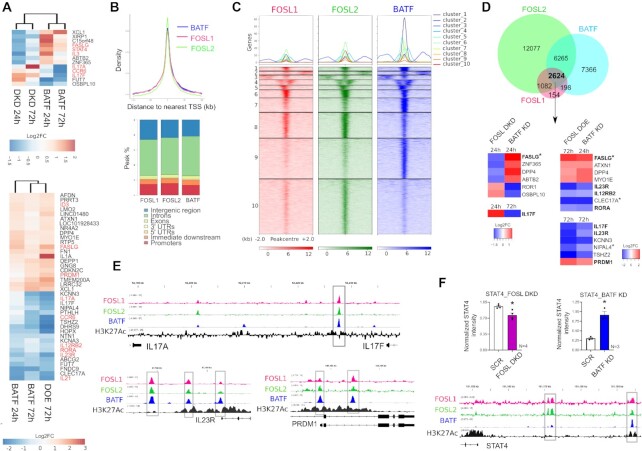
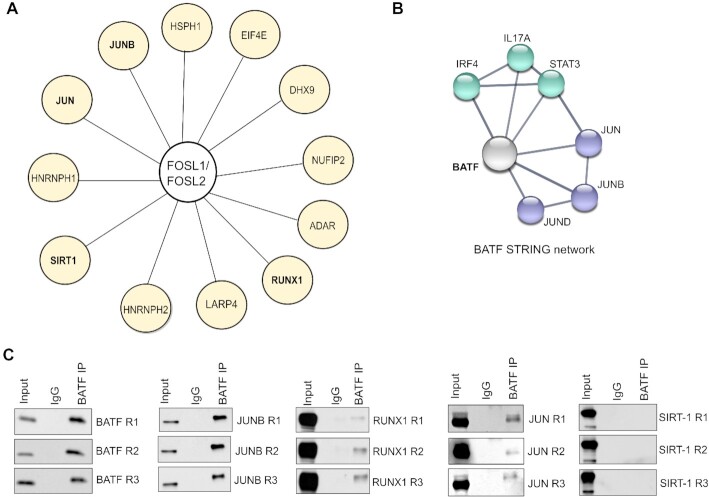
Th17 cells are essential for protection against extracellular pathogens, but their aberrant activity can cause autoimmunity. Molecular mechanisms that dictate Th17 cell-differentiation have been extensively studied using mouse models. However, species-specific differences underscore the need to validate these findings in human. Here, we characterized the human-specific roles of three AP-1 transcription factors, FOSL1, FOSL2 and BATF, during early stages of Th17 differentiation. Our results demonstrate that FOSL1 and FOSL2 co-repress Th17 fate-specification, whereas BATF promotes the Th17 lineage. Strikingly, FOSL1 was found to play different roles in human and mouse. Genome-wide binding analysis indicated that FOSL1, FOSL2 and BATF share occupancy over regulatory regions of genes involved in Th17 lineage commitment. These AP-1 factors also share their protein interacting partners, which suggests mechanisms for their functional interplay. Our study further reveals that the genomic binding sites of FOSL1, FOSL2 and BATF harbour hundreds of autoimmune disease-linked SNPs. We show that many of these SNPs alter the ability of these transcription factors to bind DNA. Our findings thus provide critical insights into AP-1-mediated regulation of human Th17-fate and associated pathologies.
Th17 细胞对于抵抗细胞外病原体至关重要,但它们的异常活性可导致自身免疫。使用小鼠模型对指导 Th17 细胞分化的分子机制进行了广泛研究。然而,物种特异性差异突出表明需要在人类中验证这些发现。在这里,我们描述了三个 AP-1 转录因子 FOSL1、FOSL2 和 BATF 在 Th17 分化早期阶段的人类特异性作用。我们的结果表明,FOSL1 和 FOSL2 共同抑制 Th17 命运的特化,而 BATF 则促进 Th17 谱系。引人注目的是,发现 FOSL1 在人类和小鼠中的作用不同。全基因组结合分析表明,FOSL1、FOSL2 和 BATF 在涉及 Th17 谱系承诺的基因的调控区域上具有共同的占有率。这些 AP-1 因子还共享其蛋白质相互作用伙伴,这表明它们功能相互作用的机制。我们的研究进一步揭示了 FOSL1、FOSL2 和 BATF 的基因组结合位点含有数百个与自身免疫性疾病相关的 SNP。我们表明,这些 SNP 中的许多改变了这些转录因子结合 DNA 的能力。因此,我们的研究结果为 AP-1 介导的人类 Th17 命运及其相关病理提供了关键的见解。