Department of Intestinal Failure and Liver Diseases, Rigshospitalet, Copenhagen, Denmark.
Department of Biomedical Sciences, The Panum Institute, University of Copenhagen, Copenhagen, Denmark.
JPEN J Parenter Enteral Nutr. 2023 Jan;47(1):140-150. doi: 10.1002/jpen.2389. Epub 2022 May 31.
The proadaptive effects of glucagon-like peptide-2 (GLP-2) include stimulation of intestinal mucosal growth as well as intestinal blood flow and angiogenesis. We have recently reported that daily subcutaneous injections of glepaglutide, a long-acting GLP-2 analog, improved intestinal absorptive function in patients with short bowel syndrome (SBS). As secondary and exploratory end points, the effects of glepaglutide on intestinal morphology and perfusion are reported.
The following assessments were done in 18 patients with SBS in a randomized, crossover, dose-finding, phase 2 trial before and after three weeks of treatment with glepaglutide: plasma citrulline and mucosa biopsies to assess changes in (1) intestinal morphology by immunohistochemistry and (2) gene expressions associated with absorption, proliferation, and markers of tight-junction integrity by quantitative polymerase chain reaction. Intestinal perfusion was assessed in stoma nipples by laser speckle contrast imaging and quantitative fluorescence angiography with indocyanine green.
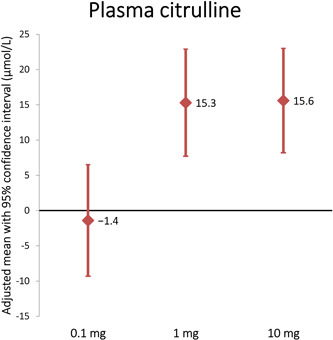
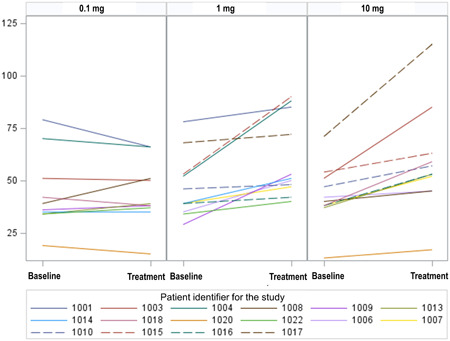
In the 1- and 10-mg dose groups, glepaglutide significantly increased plasma citrulline by 15.3 µmol/L (P = 0.001) and 15.6 µmol/L (P = 0.001), respectively. Trends toward an increase in villus height, crypt depth, and epithelium height were seen in the same groups. No significant changes were seen in gene expressions or intestinal perfusion.
The increase in plasma citrulline and the morphological improvements may partly account for improvement in the intestinal absorptive function. However, the finding of a stability in perfusion after three weeks of treatment with glepaglutide may have been preceded by a more profound acute-phase increase in intestinal perfusion at treatment initiation.
胰高血糖素样肽-2(GLP-2)的促适应作用包括刺激肠黏膜生长以及肠血流和血管生成。我们最近报道,每天皮下注射长效 GLP-2 类似物 glepaglutide 可改善短肠综合征(SBS)患者的肠吸收功能。作为次要和探索性终点,报告了 glepaglutide 对肠形态和灌注的影响。
在一项随机、交叉、剂量发现、2 期试验中,18 例 SBS 患者在接受 glepaglutide 治疗 3 周前后进行了以下评估:血浆瓜氨酸和黏膜活检,以评估(1)通过免疫组织化学评估肠形态的变化,(2)与吸收、增殖和紧密连接完整性标志物相关的基因表达通过定量聚合酶链反应。通过激光散斑对比成像和吲哚菁绿定量荧光血管造影评估肠灌注在造口乳头。
在 1 毫克和 10 毫克剂量组中,glepaglutide 分别显著增加了 15.3µmol/L(P=0.001)和 15.6µmol/L(P=0.001)的血浆瓜氨酸。在同一组中,观察到绒毛高度、隐窝深度和上皮高度增加的趋势。基因表达或肠灌注没有明显变化。
血浆瓜氨酸的增加和形态学的改善可能部分解释了肠吸收功能的改善。然而,在 glepaglutide 治疗 3 周后灌注稳定的发现可能是在治疗开始时肠灌注更明显的急性期增加之前发生的。