Division of Endocrinology and Metabolism, Department of Internal Medicine, Carver College of Medicine, University of Iowa, Iowa City, Iowa.
Centre for Muscle Research (CMR), Department of Anatomy and Physiology, The University of Melbourne, Melbourne, Victoria, Australia.
J Appl Physiol (1985). 2022 Jul 1;133(1):41-59. doi: 10.1152/japplphysiol.00088.2022. Epub 2022 May 5.
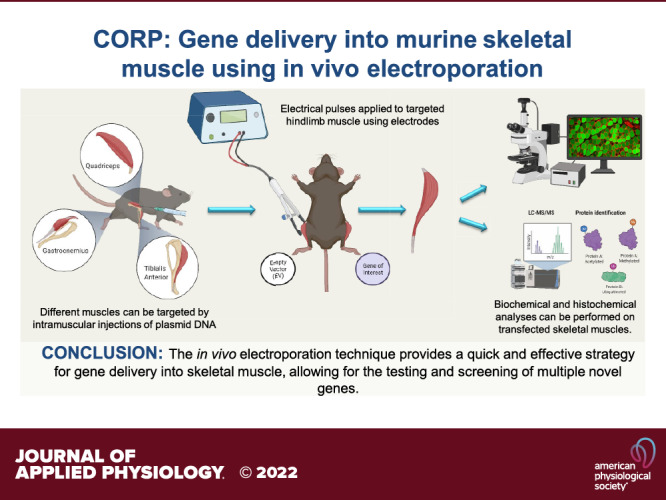
The strategy of gene delivery into skeletal muscles has provided exciting avenues in identifying new potential therapeutics toward muscular disorders and addressing basic research questions in muscle physiology through overexpression and knockdown studies. In vivo electroporation methodology offers a simple, rapidly effective technique for the delivery of plasmid DNA into postmitotic skeletal muscle fibers and the ability to easily explore the molecular mechanisms of skeletal muscle plasticity. The purpose of this review is to describe how to robustly electroporate plasmid DNA into different hindlimb muscles of rodent models. Furthermore, key parameters (e.g., voltage, hyaluronidase, and plasmid concentration) that contribute to the successful introduction of plasmid DNA into skeletal muscle fibers will be discussed. In addition, details on processing tissue for immunohistochemistry and fiber cross-sectional area (CSA) analysis will be outlined. The overall goal of this review is to provide the basic and necessary information needed for successful implementation of in vivo electroporation of plasmid DNA and thus open new avenues of discovery research in skeletal muscle physiology.
将基因递送到骨骼肌的策略为鉴定肌肉疾病的新潜在治疗方法以及通过过表达和敲低研究解决肌肉生理学的基础研究问题提供了令人兴奋的途径。体内电穿孔方法为将质粒 DNA 递送到有丝分裂后骨骼肌纤维中提供了一种简单、快速有效的技术,并且能够轻松探索骨骼肌可塑性的分子机制。本综述的目的是描述如何将质粒 DNA 有效地递送到啮齿动物模型的不同后肢肌肉中。此外,还将讨论有助于质粒 DNA 成功导入骨骼肌纤维的关键参数(例如电压、透明质酸酶和质粒浓度)。此外,还将概述用于免疫组织化学和纤维横截面积(CSA)分析的组织处理细节。本综述的总体目标是提供成功实施体内质粒 DNA 电穿孔所需的基本和必要信息,从而为骨骼肌生理学的发现研究开辟新途径。