Loma Linda University Eye Institute, 11370 Anderson Street, Suite 1800, Loma Linda, CA, 92354, USA.
Sci Rep. 2022 May 5;12(1):7357. doi: 10.1038/s41598-022-11462-8.
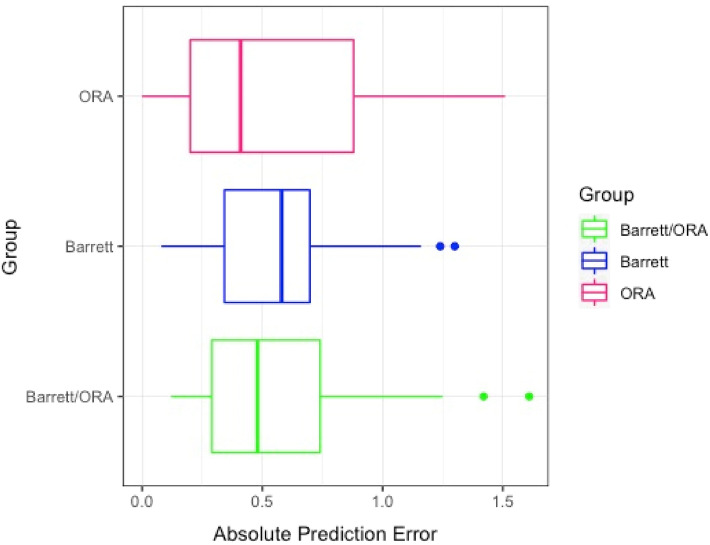
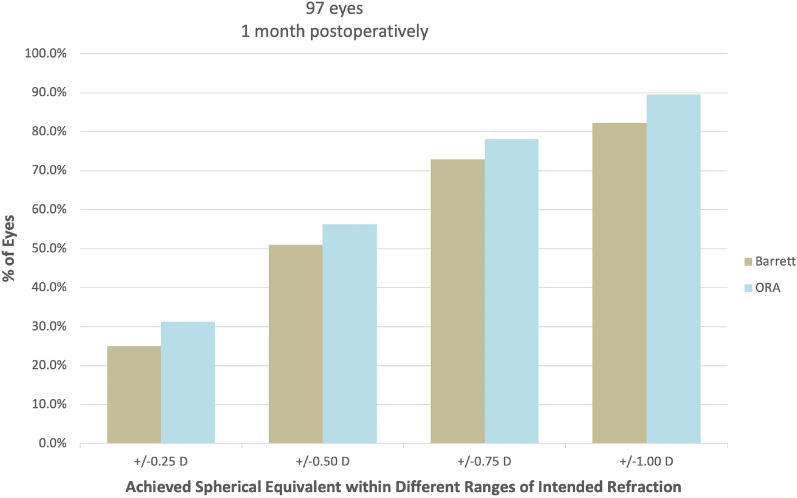
To compare the predictive refractive accuracy of intraoperative aberrometry (ORA) to the preoperative Barrett True-K formula in the calculation of intraocular lens (IOL) power in eyes with prior refractive surgery undergoing cataract surgery at the Loma Linda University Eye Institute, Loma Linda, California, USA. We conducted a retrospective chart review of patients with a history of post-myopic or hyperopic LASIK/PRK who underwent uncomplicated cataract surgery between October 2016 and March 2020. Pre-operative measurements were performed utilizing the Barrett True-K formula. Intraoperative aberrometry (ORA) was used for aphakic refraction and IOL power calculation during surgery. Predictive refractive accuracy of the two methods was compared based on the difference between achieved and intended target spherical equivalent. A total of 97 eyes (69 patients) were included in the study. Of these, 81 eyes (83.5%) had previous myopic LASIK/PRK and 16 eyes (16.5%) had previous hyperopic LASIK/PRK. Median (MedAE)/mean (MAE) absolute prediction errors for preoperative as compared to intraoperative methods were 0.49 D/0.58 D compared to 0.42 D/0.51 D, respectively (P = 0.001/0.002). Over all, ORA led to a statistically significant lower median and mean absolute error compared to the Barrett True-K formula in post-refractive eyes. Percentage of eyes within ± 1.00 D of intended target refraction as predicted by the preoperative versus the intraoperative method was 82.3% and 89.6%, respectively (P = 0.04). Although ORA led to a statistically significant lower median absolute error compared to the Barrett True-K formula, the two methods are clinically comparable in predictive refractive accuracy in patients with prior refractive surgery.
在美国加利福尼亚州洛马林达的洛马林达大学眼科研究所,比较了白内障手术中眼前节分析仪(ORA)与术前巴雷特真凯公式在预测屈光不正准确性方面的差异,这些患者既往有过近视或远视激光角膜屈光手术(LASIK/PRK)史。我们对 2016 年 10 月至 2020 年 3 月期间行单纯白内障手术的既往行过近视或远视 LASIK/PRK 术的患者进行了回顾性图表审查。术前测量采用巴雷特真凯公式。白内障手术中使用眼像差分析仪(ORA)进行无晶状体眼的屈光矫正和人工晶状体(IOL)度数计算。两种方法的预测屈光准确性是基于实际和目标等效球镜之间的差异来比较的。本研究共纳入 97 只眼(69 例患者)。其中,81 只眼(83.5%)有既往近视性 LASIK/PRK 史,16 只眼(16.5%)有既往远视性 LASIK/PRK 史。与术中方法相比,术前方法的中位数(MedAE)/平均值(MAE)绝对预测误差分别为 0.49 D/0.58 D 和 0.42 D/0.51 D(P=0.001/0.002)。总体而言,在屈光手术后的眼中,ORA 导致的中位数和平均绝对误差均显著低于巴雷特真凯公式。术前和术中方法预测的目标屈光值的等效球镜在±1.00 D 以内的眼百分比分别为 82.3%和 89.6%(P=0.04)。虽然 ORA 与巴雷特真凯公式相比,其平均绝对误差有统计学意义,但在既往屈光手术患者中,两种方法的预测屈光准确性具有临床可比性。