Guo Yongmei, Xiao Ling, Jin Long, Yan Sumei, Niu Dongyan, Yang Wenzhu
Inner Mongolia Key Laboratory of Animal Nutrition and Feed Science, College of Animal Science, Inner Mongolia Agricultural University, Hohhot, 010018, Inner Mongolia, China.
Agriculture and Agri-Food of Canada, Lethbridge Research and Development Centre, Lethbridge, AB, T1J 4B1, Canada.
J Anim Sci Biotechnol. 2022 May 6;13(1):56. doi: 10.1186/s40104-022-00700-8.
The objectives of this study were to determine the effect of commercial slow-release urea (SRU) on in vitro fermentation characteristics, nutrient digestibility, gas production, microbial protein synthesis and bacterial community using a rumen simulation technique (RUSITEC). The experiment was a completely randomized design with four treatments and four replications of each treatment. Treatments were: control diet (no SRU addition), control diet plus 0.28% SRU (U28), or plus 0.56% SRU (U56), and control diet that was modified substituting a part of soybean meal equivalent to 0.35% SRU (MU35; dry matter [DM] basis). The experiment consisted of 8 d of adaptation and 7 d of data and sample collection. Rumen inoculum was obtained from three ruminally fistulated Angus cows fed the same diet to the substrate incubated.
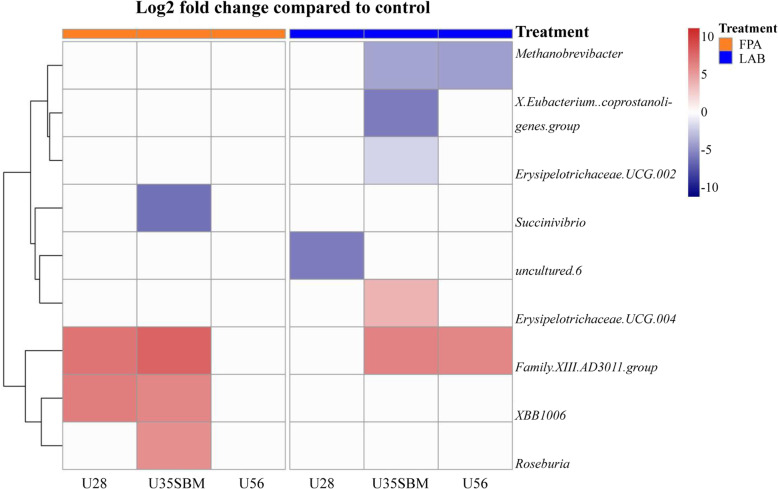
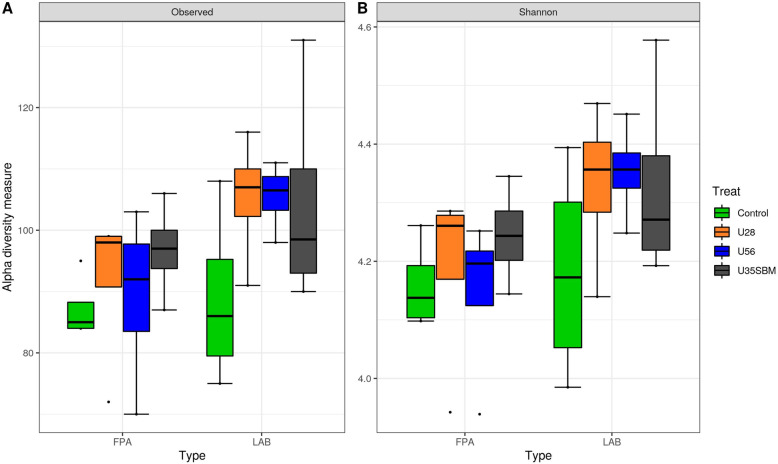
Digestibility of DM, organic matter (OM), crude protein (CP), fibre and starch was not affected, but daily production of gas (P < 0.07) and methane (P < 0.05) was quadratically increased with increasing SRU supplementation. The increase of SRU addition did not affect fermentation pH and total volatile fatty acid (VFA) production, whereas linearly (P < 0.01) decreased proportion of propionate, and linearly (P < 0.01) increased acetate to propionate ratio and ammonia nitrogen (N) concentration. The microbial N efficiency was also linearly (P < 0.03) improved with increasing supplementation of SRU. In comparison with control diet, the dietary substitution of SRU for part of soybean meal increased (P < 0.05) the digestibility of DM, OM and CP and decreased (P < 0.02) the total gas production. The total VFA production and acetate to propionate ratio did not differ between control and MU35, whereas the proportion of butyrate was lower (P < 0.05) and that of branched-chain VFA was greater (P < 0.05) with MU35 than control diet. Total and liquid-associated microbial N production as well as ammonia N concentration were greater (P < 0.03) with MU35 than control diet. Observed operational taxonomic units (OTUs), Shannon diversity index, and beta diversity of the microbial community did not differ among treatments. Taxonomic analysis revealed no effect of adding SRU on the relative abundance of bacteria at the phylum level, while at the genus level, the beneficial impact of SRU on relative abundance of Rikenellaceae and Prevotellaceae in feed particle-associated bacteria, and the abundance of Roseburia in liquid associate bacteria was greater (P < 0.05) with MU35.
Supplementation of a dairy cow diet with SRU showed potential of increase in ammonia N concentration and microbial protein production, and change fermentation pattern to more acetate production. Adding SRU in dairy cow diet also showed beneficial effect on improving digestibility of OM and fibre. The results suggest that SRU can partially substitute soybean meal in dairy cow diet to increase microbial protein production without impairing rumen fermentation.
本研究的目的是使用瘤胃模拟技术(RUSITEC)来确定商业缓释尿素(SRU)对体外发酵特性、养分消化率、气体产生、微生物蛋白合成和细菌群落的影响。本试验采用完全随机设计,有4种处理,每种处理4个重复。处理方式为:对照日粮(不添加SRU)、对照日粮加0.28% SRU(U28)、或加0.56% SRU(U56),以及用相当于0.35% SRU的部分豆粕替代的对照日粮(MU35;以干物质[DM]计)。试验包括8天的适应期和7天的数据及样本采集期。瘤胃接种物取自3头安装了瘤胃瘘管的安格斯奶牛,这些奶牛饲喂与用于培养底物相同的日粮。
干物质(DM)、有机物(OM)、粗蛋白(CP)、纤维和淀粉的消化率不受影响,但随着SRU添加量的增加,气体(P<0.07)和甲烷(P<0.05)的日产量呈二次增加。SRU添加量的增加不影响发酵pH值和总挥发性脂肪酸(VFA)产量,而丙酸比例呈线性下降(P<0.01),乙酸与丙酸比例和氨氮(N)浓度呈线性增加(P<0.01)。随着SRU添加量的增加,微生物氮效率也呈线性提高(P<0.03)。与对照日粮相比,用SRU替代部分豆粕提高了(P<0.05)DM、OM和CP的消化率,并降低了(P<0.02)总气体产量。对照和MU35之间的总VFA产量以及乙酸与丙酸比例没有差异,而MU35组的丁酸比例低于(P<0.05)对照日粮,支链VFA比例高于(P<0.05)对照日粮。MU35组的总微生物氮产量和与液体相关的微生物氮产量以及氨氮浓度均高于(P<0.03)对照日粮。各处理间观察到的可操作分类单元(OTU)、香农多样性指数和微生物群落的β多样性没有差异。分类学分析表明,添加SRU对门水平细菌的相对丰度没有影响,而在属水平上,MU35组中SRU对与饲料颗粒相关细菌中理研菌科和普雷沃氏菌科相对丰度的有益影响以及对液体相关细菌中罗氏菌属丰度的有益影响更大(P<0.05)。
在奶牛日粮中添加SRU显示出增加氨氮浓度和微生物蛋白产量的潜力,并使发酵模式转变为更多地产生乙酸。在奶牛日粮中添加SRU对提高OM和纤维的消化率也有有益作用。结果表明,SRU可以部分替代奶牛日粮中的豆粕,以增加微生物蛋白产量而不损害瘤胃发酵。