Institute for Pediatric Regenerative Medicine of Shriners Hospitals for Children-Northern California, Department of Biochemistry and Molecular Medicine, University of California, Davis School of Medicine, Sacramento, CA 95817, USA.
Dis Model Mech. 2022 Jun 1;15(6). doi: 10.1242/dmm.049517. Epub 2022 Jun 10.
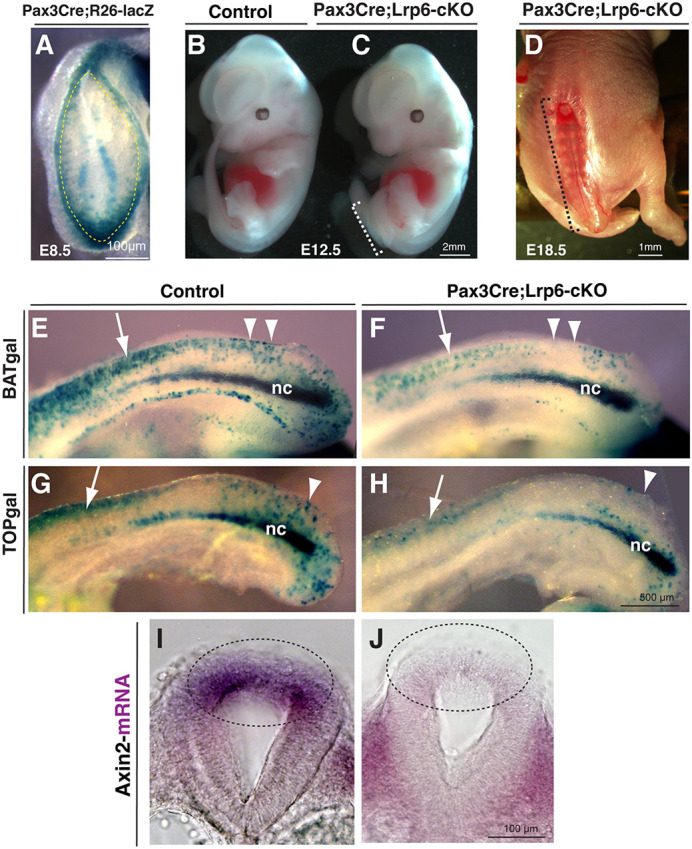
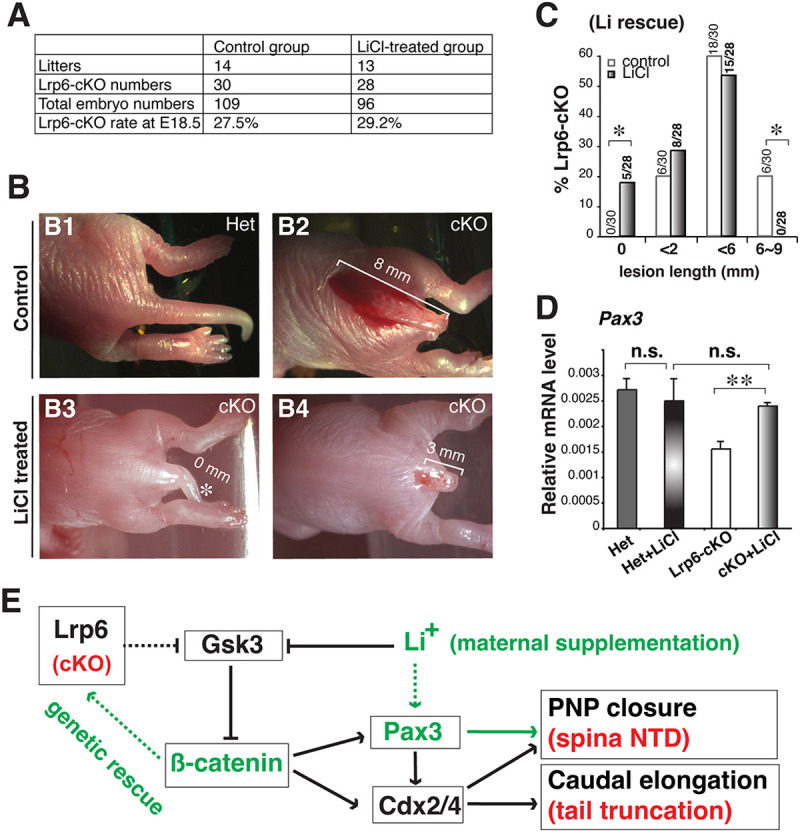
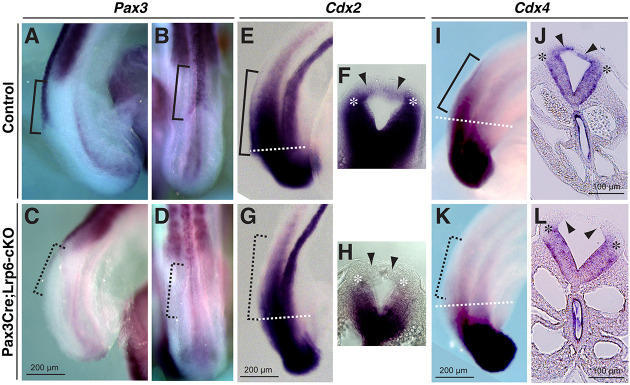
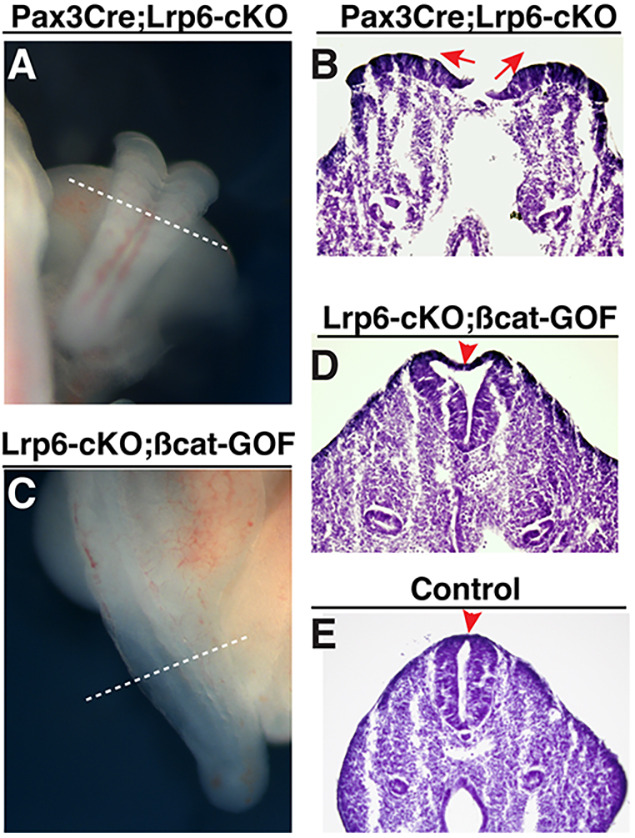
Neural tube defects (NTDs) are among the common and severe birth defects with poorly understood etiology. Mutations in the Wnt co-receptor LRP6 are associated with NTDs in humans. Either gain-of-function (GOF) or loss-of-function (LOF) mutations of Lrp6 can cause NTDs in mice. NTDs in Lrp6-GOF mutants may be attributed to altered β-catenin-independent noncanonical Wnt signaling. However, the mechanisms underlying NTDs in Lrp6-LOF mutants and the role of Lrp6-mediated canonical Wnt/β-catenin signaling in neural tube closure remain unresolved. We previously demonstrated that β-catenin signaling is required for posterior neuropore (PNP) closure. In the current study, conditional ablation of Lrp6 in dorsal PNP caused spinal NTDs with diminished activities of Wnt/β-catenin signaling and its downstream target gene Pax3, which is required for PNP closure. β-catenin-GOF rescued NTDs in Lrp6-LOF mutants. Moreover, maternal supplementation of a Wnt/β-catenin signaling agonist reduced the frequency and severity of spinal NTDs in Lrp6-LOF mutants by restoring Pax3 expression. Together, these results demonstrate the essential role of Lrp6-mediated Wnt/β-catenin signaling in PNP closure, which could also provide a therapeutic target for NTD intervention through manipulation of canonical Wnt/β-catenin signaling activities.
神经管缺陷(NTDs)是常见且严重的出生缺陷之一,其病因尚未完全阐明。Wnt 共受体 LRP6 的突变与人类 NTDs 有关。Lrp6 的获得功能(GOF)或丧失功能(LOF)突变均可导致小鼠发生 NTDs。Lrp6-GOF 突变体中的 NTDs 可能归因于 β-连环蛋白非依赖性非经典 Wnt 信号的改变。然而,Lrp6-LOF 突变体中 NTDs 的机制以及 Lrp6 介导的经典 Wnt/β-连环蛋白信号在神经管闭合中的作用仍未解决。我们之前证明了β-连环蛋白信号对于后神经孔(PNP)闭合是必需的。在本研究中,条件性敲除背侧 PNP 中的 Lrp6 导致脊柱 NTDs,同时伴随着 Wnt/β-连环蛋白信号及其下游靶基因 Pax3 的活性降低,后者对于 PNP 闭合是必需的。β-连环蛋白 GOF 挽救了 Lrp6-LOF 突变体中的 NTDs。此外,通过恢复 Pax3 的表达,母体补充 Wnt/β-连环蛋白信号激动剂可减少 Lrp6-LOF 突变体中脊柱 NTDs 的频率和严重程度。综上所述,这些结果表明 Lrp6 介导的 Wnt/β-连环蛋白信号在 PNP 闭合中起着至关重要的作用,这也为通过操纵经典 Wnt/β-连环蛋白信号活性来干预 NTD 提供了一个治疗靶点。