Ruperez C, Blasco-Roset A, Kular D, Cairo M, Ferrer-Curriu G, Villarroya J, Zamora M, Crispi F, Villarroya F, Planavila A
Departament de Bioquímica i Biologia Molecular, Institut de Biomedicina (IBUB), Universitat de Barcelona and CIBER Fisiopatología de la Obesidad y Nutrición, Barcelona, Spain.
Fetal Medicine Research Center, BCNatal -Barcelona Center for Maternal-Fetal and Neonatal Medicine (Hospital Clinic and Hospital San Juan de Deu), Institut Clinic de Ginecologia, Obstetricia i Neonatalogia, Institut d'Investigacions Biomediques August Pi i Sunyer, University of Barcelona, Barcelona, Spain.
Front Physiol. 2022 Apr 19;13:864427. doi: 10.3389/fphys.2022.864427. eCollection 2022.
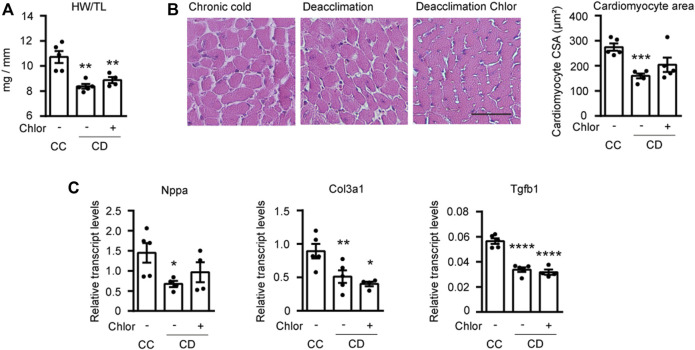
To study the reversibility of cold-induced cardiac hypertrophy and the role of autophagy in this process. Chronic exposure to cold is known to cause cardiac hypertrophy independent of blood pressure elevation. The reversibility of this process and the molecular mechanisms involved are unknown. Studies were performed in two-month-old mice exposed to cold (4°C) for 24 h or 10 days. After exposure, the animals were returned to room temperature (21°C) for 24 h or 1 week. We found that chronic cold exposure significantly increased the heart weight/tibia length (HW/TL) ratio, the mean area of cardiomyocytes, and the expression of hypertrophy markers, but significantly decreased the expression of genes involved in fatty acid oxidation Echocardiographic measurements confirmed hypertrophy development after chronic cold exposure One week of deacclimation for cold-exposed mice fully reverted the morphological, functional, and gene expression indicators of cardiac hypertrophy. Experiments involving injection of leupeptin at 1 h before sacrifice (to block autophagic flux) indicated that cardiac autophagy was repressed under cold exposure and re-activated during the first 24 h after mice were returned to room temperature. Pharmacological blockage of autophagy for 1 week using chloroquine in mice subjected to deacclimation from cold significantly inhibited the reversion of cardiac hypertrophy. Our data indicate that mice exposed to cold develop a marked cardiac hypertrophy that is reversed after 1 week of deacclimation. We propose that autophagy is a major mechanism underlying the heart remodeling seen in response to cold exposure and its posterior reversion after deacclimation.
研究冷诱导的心脏肥大的可逆性以及自噬在此过程中的作用。已知长期暴露于寒冷环境会导致心脏肥大,且与血压升高无关。这一过程的可逆性及相关分子机制尚不清楚。对两个月大的小鼠进行实验,将其暴露于4°C的寒冷环境中24小时或10天。暴露后,让动物回到室温(21°C)24小时或1周。我们发现,长期冷暴露显著增加了心脏重量/胫骨长度(HW/TL)比值、心肌细胞平均面积以及肥大标志物的表达,但显著降低了参与脂肪酸氧化的基因的表达。超声心动图测量证实了长期冷暴露后心脏肥大的发展。对冷暴露小鼠进行1周的脱适应处理后,心脏肥大的形态、功能和基因表达指标完全恢复。在处死前1小时注射亮肽素(以阻断自噬流)的实验表明,冷暴露时心脏自噬受到抑制,而在小鼠回到室温后的最初24小时内重新激活。在经历冷脱适应的小鼠中,使用氯喹对自噬进行1周的药理学阻断显著抑制了心脏肥大的逆转。我们的数据表明,暴露于寒冷环境的小鼠会出现明显的心脏肥大,在脱适应1周后可逆转。我们提出,自噬是冷暴露后心脏重塑及其脱适应后逆转的主要潜在机制。