Sun Liyuan, Pan Xueqin, Li Hongwei, Zhang Xinyang, Zhao Xincheng, Zhang Liwei, Zhang Long
Department of Entomology, China Agricultural University, Beijing, China.
Institute of Plant Inspection and Quarantine, Chinese Academy of Inspection and Quarantine, Beijing, China.
Front Physiol. 2022 Apr 20;13:855522. doi: 10.3389/fphys.2022.855522. eCollection 2022.
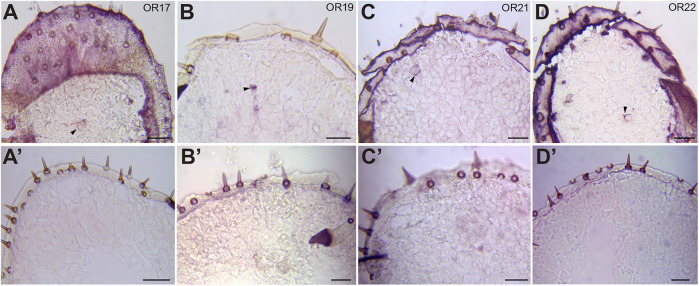
Although vomiting is commonly recognized as a protective reaction in response to toxic stimuli, the elaborate sensory processes and necessary molecular components are not fully clear, which is due to a lack of appropriate experimental animal models. Vomiting reflex to volatile chemicals renders locust one candidate for vomiting model. Here, we identified a panel of chemical cues that evoked evident vomiting in locust nymphs and demonstrated the selected combinatorial coding strategy that palps but not antennae olfactory receptor neurons (ORNs) employed. Specifically, knocking down individual palp odorant receptors (ORs) such as OR17, OR21, and OR22 attenuated the vomiting intensity evoked by E-2-hexenal and hexanal, while suppression of OR12 and OR22 augmented vomiting to E-2-hexenal and 2-hexanone, respectively. Furthermore, dual-RNAi treatment against OR17 or OR21 together with OR22 resulted in a much lower response intensity than that of individual OR suppression. Furthermore, OR12 was revealed in palp sensilla basiconica (pb) subtype 3 to tune the neuronal decaying activity to E-2-hexenal. Finally, anterograde labeling indicated that palp ORNs primarily projected into the lobus glomerulatus (LG), and the projection neurons (PNs) in the LG further projected into the accessary calyx (ACA). Together, the establishment of an olfaction-inducible vomiting model in locusts deepens the understanding of olfactory coding logics and provides an opportunity to clarify the neural basis underlying animal vomiting.
尽管呕吐通常被认为是对有毒刺激的一种保护反应,但其精细的感觉过程和必要的分子成分尚不完全清楚,这是由于缺乏合适的实验动物模型。对挥发性化学物质的呕吐反射使蝗虫成为呕吐模型的候选者。在这里,我们确定了一组能引起蝗虫若虫明显呕吐的化学线索,并展示了所选择的组合编码策略,即下颚须而非触角嗅觉受体神经元(ORN)所采用的策略。具体而言,敲低单个下颚须气味受体(OR),如OR17、OR21和OR22,会减弱由反-2-己烯醛和己醛诱发的呕吐强度,而抑制OR12和OR22则分别增强了对反-2-己烯醛和2-己酮的呕吐反应。此外,针对OR17或OR21与OR22的双RNA干扰处理导致的反应强度比单个OR抑制时要低得多。此外,在3型锥形下颚须感器(pb)中发现OR12可调节对反-2-己烯醛的神经元衰减活动。最后,顺行标记表明下颚须ORN主要投射到小球叶(LG),LG中的投射神经元(PN)进一步投射到副萼(ACA)。总之,蝗虫嗅觉诱导呕吐模型的建立加深了对嗅觉编码逻辑的理解,并为阐明动物呕吐的神经基础提供了机会。