Oonsiri Sornjarod, Kitpanit Sarin, Kannarunimit Danita, Chakkabat Chakkapong, Lertbutsayanukul Chawalit, Prayongrat Anussara
Division of Radiation Oncology, Department of Radiology, Faculty of Medicine, Chulalongkorn University, King Chulalongkorn Memorial Hospital, Bangkok, Thailand.
Phys Imaging Radiat Oncol. 2022 Apr 28;22:51-56. doi: 10.1016/j.phro.2022.04.005. eCollection 2022 Apr.
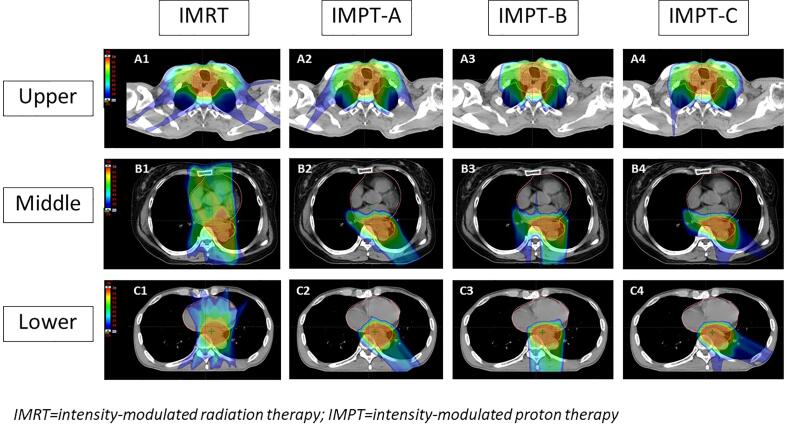
Specific proton-beam configurations are needed to spare organs at risk (OARs), including lungs, heart, and spinal cord, when treating esophageal squamous cell carcinoma (ESCC) in the thoracic region. This study aimed to propose new intensity-modulated proton therapy (IMPT) beam configurations and to demonstrate the benefit of IMPT compared with intensity-modulated x-ray therapy (IMXT) for treating ESCC.
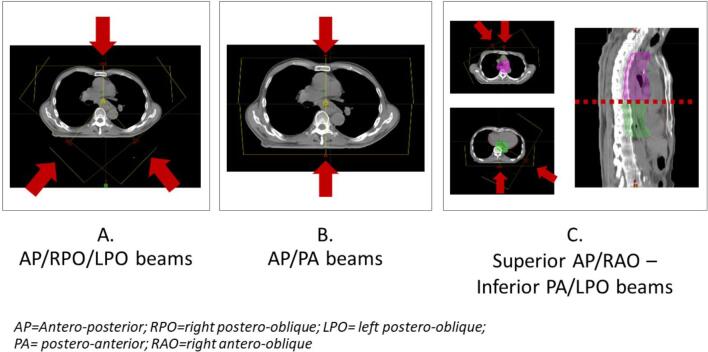
IMPT plans with three different beam angle configurations were generated on CT datasets of 25 ESCC patients that were treated with IMXT. The IMPT beam designs were two commonly-used beam configurations (anteroposterior and posterior oblique) and a recently proposed beam configuration (anterosuperior with posteroinferior). The target doses were 50-54 Gy(RBE) and 60-64 Gy(RBE) to the low-risk and high-risk target volumes, respectively. Robust optimization was applied for the IMPT plans. The differences in the dose-volume parameters between the IMXT and IMPT plans were compared.
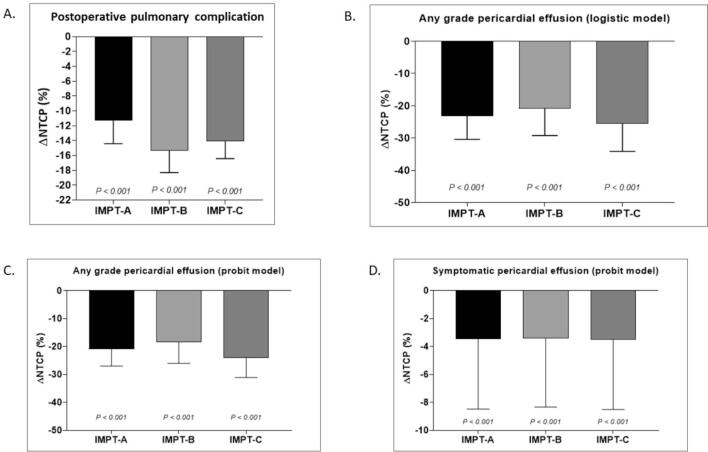
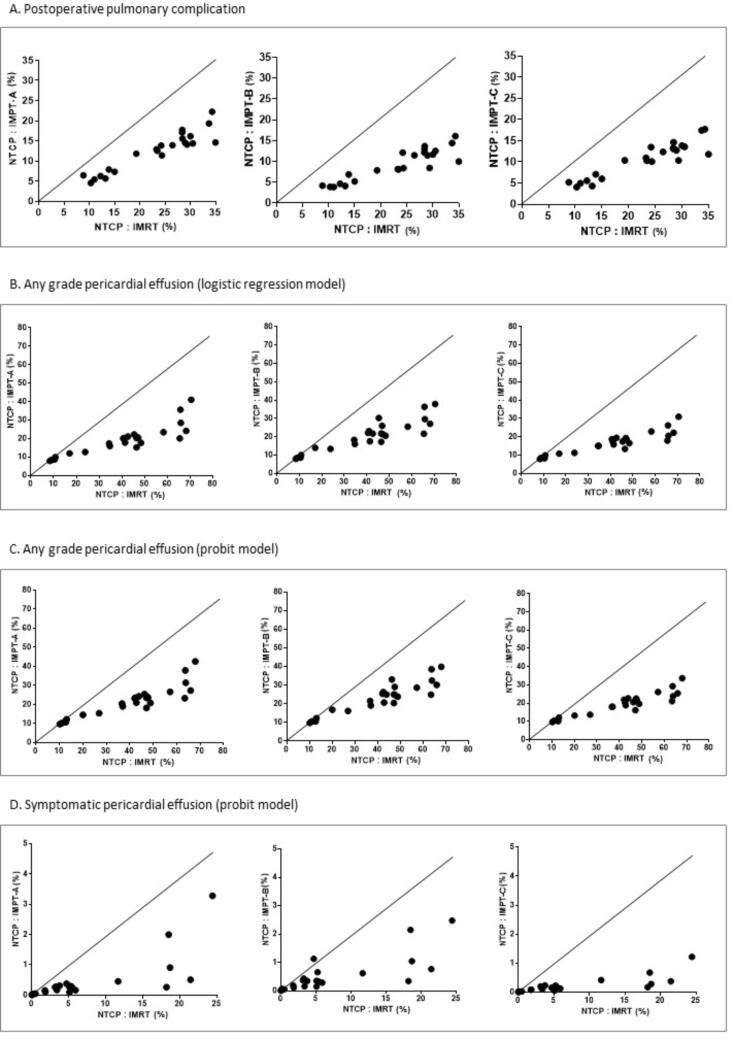
With target coverage comparable to standard IMXT, IMPT had significantly lower mean doses to the OARs. IMPT with an anteroposterior opposing beam generated the lowest lung dose (mean = 7.1 Gy(RBE), V = 14.1%) and the anterosuperior with posteroinferior beam resulted in the lowest heart dose (mean = 12.8 Gy(RBE), V = 15.7%) and liver dose (mean = 3.9 Gy(RBE), V = 5.9%). For the subgroup of patients with an inferior tumor location (PTVs overlapping a part of the contoured heart), the novel beam demonstrated the optimal OARs sparing.
Compared with IMXT, the IMPT plans significantly reduced the radiation dose to the surrounding organs when treating ESCC. IMPT beam configuration selection depends on the tumor location relative to the heart.
在治疗胸段食管鳞状细胞癌(ESCC)时,需要特定的质子束配置来保护包括肺、心脏和脊髓在内的危及器官(OARs)。本研究旨在提出新的调强质子治疗(IMPT)束配置,并证明IMPT相较于调强X线治疗(IMXT)在治疗ESCC方面的优势。
在25例接受IMXT治疗的ESCC患者的CT数据集上生成了具有三种不同束角配置的IMPT计划。IMPT束设计为两种常用束配置(前后向和后斜向)以及一种最近提出的束配置(前上向后下)。低危和高危靶区的靶剂量分别为50 - 54 Gy(RBE)和60 - 64 Gy(RBE)。对IMPT计划应用稳健优化。比较了IMXT和IMPT计划之间剂量体积参数的差异。
在靶区覆盖与标准IMXT相当的情况下,IMPT对危及器官的平均剂量显著更低。前后对置束的IMPT产生的肺剂量最低(平均 = 7.1 Gy(RBE),V = 14.1%),前上向后下束导致心脏剂量最低(平均 = 12.8 Gy(RBE),V = 15.7%)和肝脏剂量最低(平均 = 3.9 Gy(RBE),V = 5.9%)。对于肿瘤位于下方(计划靶体积(PTV)与勾勒出的心脏部分重叠)的患者亚组,新束显示出最佳的危及器官 sparing。
与IMXT相比,IMPT计划在治疗ESCC时显著降低了对周围器官的辐射剂量。IMPT束配置的选择取决于肿瘤相对于心脏的位置。