Department of Oncology, Changde Hospital, Xiangya School of Medicine, Central South University, Changde, China.
The Second People's Hospital of Yibin, Yibin, China.
JAMA Netw Open. 2023 Aug 1;6(8):e2328136. doi: 10.1001/jamanetworkopen.2023.28136.
Radiotherapy plays an important role in the treatment of esophageal cancer. Proton therapy has unique physical properties and higher relative biological effectiveness. However, whether proton therapy has greater benefit than photon therapy is still unclear.
To evaluate whether proton was associated with better efficacy and safety outcomes, including dosimetric, prognosis, and toxic effects outcomes, compared with photon therapy and to evaluate the efficacy and safety of proton therapy singly.
A systematic search of PubMed, Embase, the Cochrane Library, Web of Science, SinoMed, and China National Knowledge Infrastructure databases was conducted for articles published through November 25, 2021, and updated to March 25, 2023.
For the comparison of proton and photon therapy, studies including dosimetric, prognosis, and associated toxic effects outcomes were included. The separate evaluation of proton therapy evaluated the same metrics.
Data on study design, individual characteristics, and outcomes were extracted. If I2 was greater than 50%, the random-effects model was selected. This meta-analysis is reported following the Preferred Reporting Items for Systematic Reviews and Meta-analyses (PRISMA) reporting guideline.
The main outcomes were organs at risk (OARs) dosimetric outcomes, prognosis (overall survival [OS], progression-free survival [PFS], and objective response rate [ORR]), and radiation-related toxic effects.
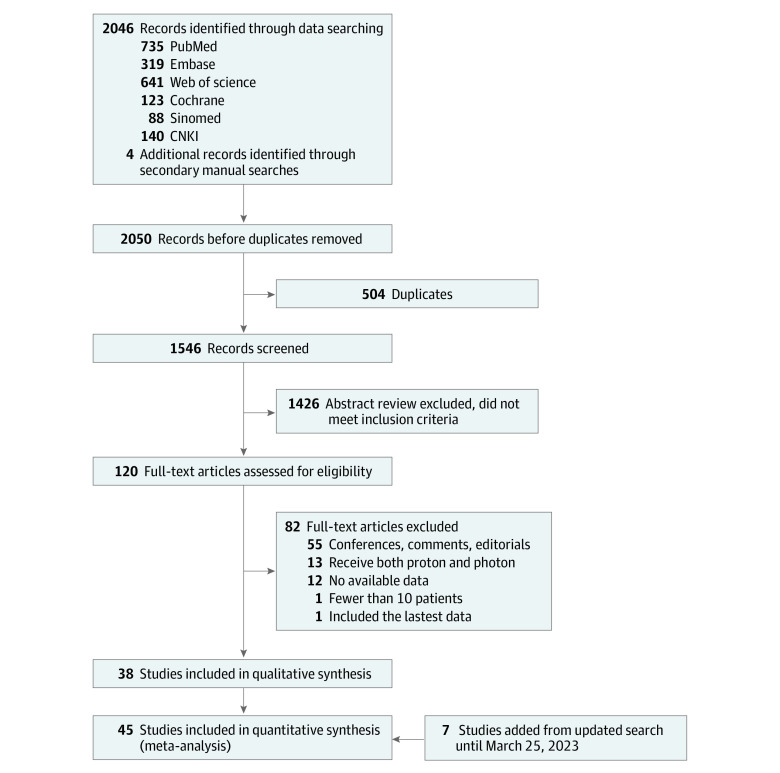
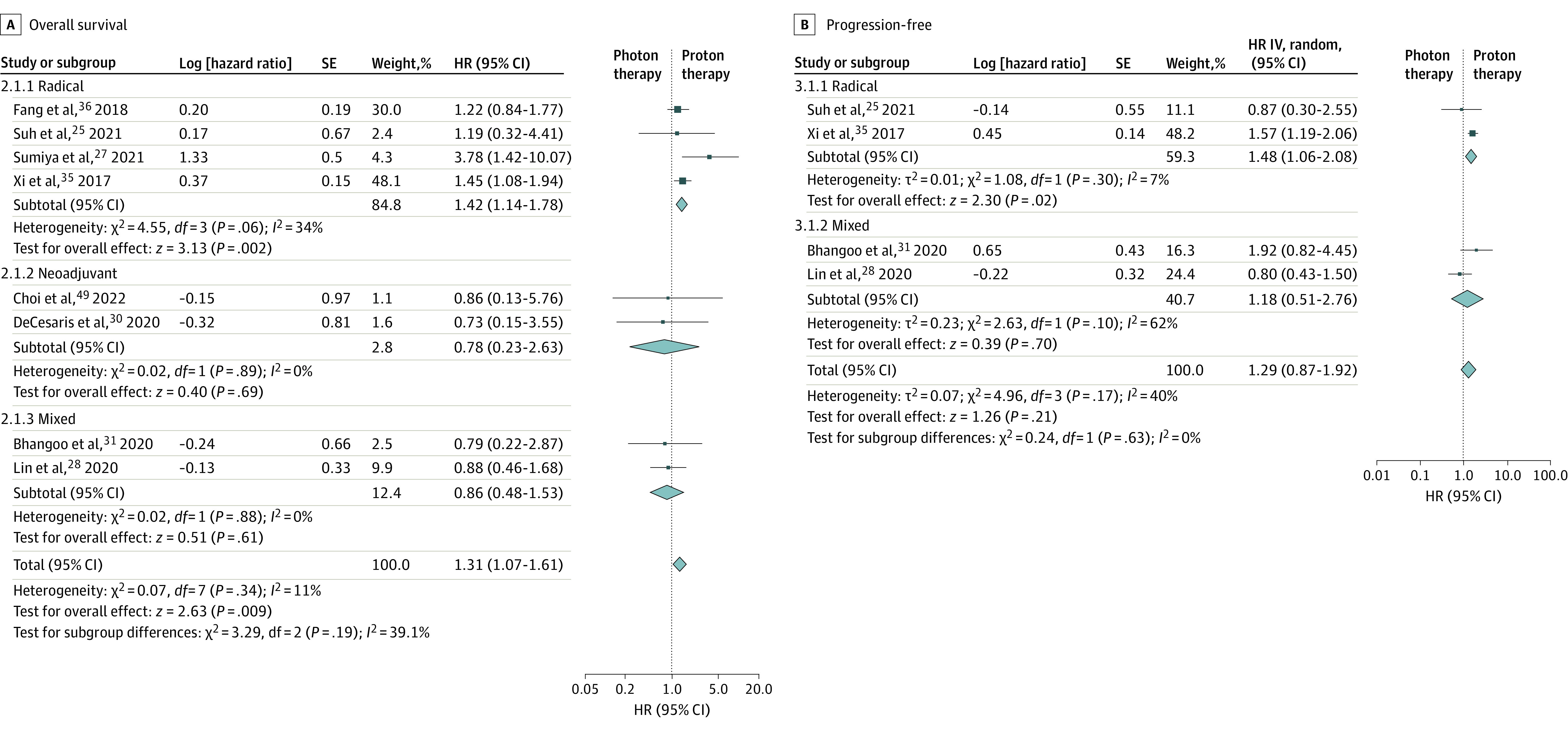
A total of 45 studies were included in the meta-analysis. For dosimetric analysis, proton therapy was associated with significantly reduced OARs dose. Meta-analysis showed that photon therapy was associated with poor OS (hazard ratio [HR], 1.31; 95% CI, 1.07-1.61; I2 = 11%), but no difference in PFS was observed. Subgroup analysis showed worse OS (HR, 1.42; 95% CI, 1.14-1.78; I2 = 34%) and PFS (HR, 1.48; 95% CI, 1.06-2.08; I2 = 7%) in the radical therapy group with photon therapy. The pathological complete response rate was similar between groups. Proton therapy was associated with significantly decreased grade 2 or higher radiation pneumonitis and pericardial effusion, and grade 4 or higher lymphocytopenia. Single-rate analysis of proton therapy found 89% OS and 65% PFS at 1 year, 71% OS and 56% PFS at 2 years, 63% OS and 48% PFS at 3 years, and 56% OS and 42% PFS at 5 years. The incidence of grade 2 or higher radiation esophagitis was 50%, grade 2 or higher radiation pneumonitis was 2%, grade 2 or higher pleural effusion was 4%, grade 2 or higher pericardial effusion was 3%, grade 3 or higher radiation esophagitis was 8%, and grade 4 or higher lymphocytopenia was 17%.
In this meta-analysis, proton therapy was associated with reduced OARs doses and toxic effects and improved prognosis compared with photon therapy for esophageal cancer, but caution is warranted. In the future, these findings should be further validated in randomized clinical trials.
重要性:放射治疗在食管癌的治疗中起着重要作用。质子治疗具有独特的物理特性和更高的相对生物学效应。然而,质子治疗是否比光子治疗更有效仍不清楚。
目的:评估与光子治疗相比,质子治疗是否在剂量学、预后和毒性效应等结局方面具有更好的疗效和安全性,并且单独评估质子治疗的疗效和安全性。
数据来源:系统检索了 PubMed、Embase、Cochrane 图书馆、Web of Science、SinoMed 和中国国家知识基础设施数据库,检索时间截至 2021 年 11 月 25 日,并更新至 2023 年 3 月 25 日。
研究选择:对于质子和光子治疗的比较,纳入了剂量学、预后和相关毒性效应结局的研究。质子治疗的单独评估评估了相同的指标。
数据提取和合成:提取了研究设计、个体特征和结局的数据。如果 I²大于 50%,则选择随机效应模型。本荟萃分析按照系统评价和荟萃分析的首选报告项目(PRISMA)报告指南进行报告。
主要结局和测量:主要结局为危及器官(OARs)剂量学结局、预后(总生存期[OS]、无进展生存期[PFS]和客观缓解率[ORR])和放射性相关毒性效应。
结果:共有 45 项研究纳入荟萃分析。在剂量学分析中,质子治疗与 OARs 剂量显著降低相关。荟萃分析显示,光子治疗与较差的 OS 相关(风险比[HR],1.31;95%CI,1.07-1.61;I²=11%),但 PFS 无差异。亚组分析显示,光子治疗的 OS(HR,1.42;95%CI,1.14-1.78;I²=34%)和 PFS(HR,1.48;95%CI,1.06-2.08;I²=7%)更差。两组病理完全缓解率相似。质子治疗与 2 级或更高级别的放射性肺炎和心包积液以及 4 级或更高级别的淋巴细胞减少症显著减少相关。质子治疗的单因素分析发现,1 年时的 OS 为 89%,PFS 为 65%;2 年时的 OS 为 71%,PFS 为 56%;3 年时的 OS 为 63%,PFS 为 48%;5 年时的 OS 为 56%,PFS 为 42%。2 级或更高级别的放射性食管炎发生率为 50%,2 级或更高级别的放射性肺炎发生率为 2%,2 级或更高级别的胸腔积液发生率为 4%,2 级或更高级别的心包积液发生率为 3%,3 级或更高级别的放射性食管炎发生率为 8%,4 级或更高级别的淋巴细胞减少症发生率为 17%。
结论和相关性:在这项荟萃分析中,与光子治疗相比,质子治疗在食管癌患者中与降低 OARs 剂量和毒性效应以及改善预后相关,但需要谨慎。未来,这些发现应在随机临床试验中进一步验证。