Kempf Carrie L, Sammani Saad, Bermudez Tadeo, Song Jin H, Hernon Vivian Reyes, Hufford Matthew K, Burt Jessica, Camp Sara M, Dudek Steven M, Garcia Joe G N
Department of Medicine University of Arizona Health Sciences Tucson Arizona USA.
Department of Medicine University of Illinois at Chicago Chicago Illinois USA.
Pulm Circ. 2022 Apr 7;12(2):e12061. doi: 10.1002/pul2.12061. eCollection 2022 Apr.
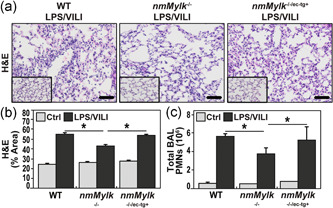
Global knockout of the nonmuscle isoform of myosin light-chain kinase (nmMLCK), a primary cellular regulator of cytoskeletal machinery, is strongly protective in preclinical murine models of inflammatory lung injury. The current study was designed to assess the specific contribution of endothelial cell (EC) nmMLCK to the severity of murine inflammatory lung injury produced by lipopolysaccharide (LPS) and mechanical ventilation ventilator-induced lung injury or ventilation (VILI). Responses to combined LPS/VILI exposure were assessed in: (i) wild-type (WT) C57BL/6J mice; (ii) transgenic mice with global deletion of nmMLCK ( ); (iii) transgenic nm mice with overexpression of nmMLCK restricted to the endothelium ( ). Lung inflammation indices included lung histology, bronchoalveolar lavage (BAL) polymorphonuclear leukocytes (PMNs), lung protein biochemistry, tissue albumin levels, Evans blue dye (EBD) lung extravasation, and plasma cytokines (interleukin-6 [IL-6], keratinocyte chemoattractant [KC]/IL-8, IL-1bβ, extracellular nicotinamide phosphoribosyltransferase, tumor necrosis factor-α). Compared to WT C57BL/6J mice, the severity of LPS/VILI-induced lung injury was markedly reduced in mice with global nmMLCK deletion reflected by reductions in histologic inflammatory lung injury, BAL PMN counts, mitogen-activated protein kinase, and NF-kB pathway activation in lung homogenates, plasma cytokine levels, and parameters of lung permeability (increased BAL protein, tissue albumin levels, EBD lung extravasation). In contrast, mice with restricted overexpression of nmMLCK in EC ( ) showed significant persistence of LPS/VILI-induced lung injury severity compared to WT mice. In conclusion, these studies strongly endorse the role of EC nmMLCK in driving the severity of preclinical inflammatory lung injury. Precise targeting of EC nmMLCK may represent an attractive therapeutic strategy to reduce lung inflammation and both lung and systemic vascular permeability.
肌球蛋白轻链激酶(nmMLCK)的非肌肉异构体是细胞骨架机制的主要细胞调节因子,在炎症性肺损伤的临床前小鼠模型中,全身性敲除该异构体具有很强的保护作用。本研究旨在评估内皮细胞(EC)nmMLCK对脂多糖(LPS)和机械通气诱导的肺损伤或通气相关性肺损伤(VILI)所致小鼠炎症性肺损伤严重程度的具体作用。在以下小鼠中评估对联合LPS/VILI暴露的反应:(i)野生型(WT)C57BL/6J小鼠;(ii)全身性缺失nmMLCK的转基因小鼠( );(iii)nmMLCK过表达仅限于内皮细胞的转基因小鼠( )。肺部炎症指标包括肺组织学、支气管肺泡灌洗(BAL)多形核白细胞(PMN)、肺蛋白生化、组织白蛋白水平、伊文思蓝染料(EBD)肺外渗以及血浆细胞因子(白细胞介素-6 [IL-6]、角质形成细胞趋化因子[KC]/IL-8、IL-1β、细胞外烟酰胺磷酸核糖基转移酶、肿瘤坏死因子-α)。与WT C57BL/6J小鼠相比,全身性nmMLCK缺失的小鼠中,LPS/VILI诱导的肺损伤严重程度明显降低,表现为组织学炎症性肺损伤减轻、BAL PMN计数减少、肺匀浆中丝裂原活化蛋白激酶和NF-κB途径激活减少、血浆细胞因子水平降低以及肺通透性参数(BAL蛋白增加、组织白蛋白水平、EBD肺外渗)改善。相比之下,与WT小鼠相比,EC中nmMLCK过表达受限的小鼠( )中,LPS/VILI诱导的肺损伤严重程度显著持续存在。总之,这些研究有力地支持了EC nmMLCK在加剧临床前炎症性肺损伤严重程度中的作用。精准靶向EC nmMLCK可能是一种有吸引力的治疗策略,可减轻肺部炎症以及肺和全身血管通透性。