
聚乙二醇(PEG)浸渍针叶材的变温固态核磁共振光谱与弛豫分析
Variable temperature solid-state NMR spectral and relaxation analyses of the impregnation of polyethylene glycol (PEG) into coniferous wood.
作者信息
Nishida Masakazu, Tanaka Tomoko, Miki Tsunehisa, Shigematsu Ichinori, Kanayama Kozo
机构信息
National Institute of Advanced Industrial Science and Technology (AIST) 2266-98 Shimoshidami, Moriyama-ku Nagoya 463-8560 Japan
Research Institute for Sustainable Humanosphere, Kyoto University Gokanosho Uji Kyoto 611-0011 Japan.
出版信息
RSC Adv. 2019 May 20;9(27):15657-15667. doi: 10.1039/c9ra01848d. eCollection 2019 May 14.
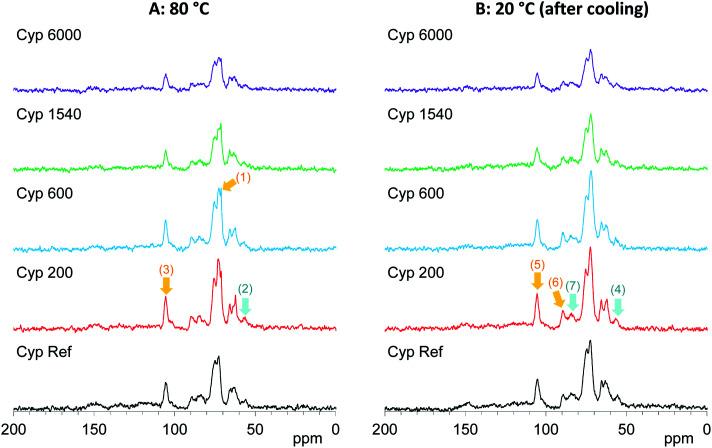
To investigate the behaviours of polyethylene glycol (PEG) and its interaction with biomass constituents in coniferous wood (Japanese cypress), variable temperature solid-state NMR spectra and relaxation times were measured from 20-80 °C. Signal intensities in the H and C PST-MAS NMR spectra changed depending on both the measurement temperature and the melting point of the impregnated PEG. In the C CP-MAS NMR spectra with increasing temperature, although the signal intensities of biomass constituents slightly decreased, signal intensities of PEG molecules in the cypress maximized at 80 °C. PEG impregnation into cypress decreased the H values at 80 °C for short to medium chain PEG in the liquid phase while it decreased H values at ambient temperature for long chain PEG in the solid phase because the interactions of PEG molecules and the biomass constituents of coniferous wood were different for different chain lengths of the PEG. These variable temperature measurements of both solid-state NMR spectra and relaxation time indicated that impregnation of longer chain PEG molecules produced higher hydrophobicity because of the increased steric hinderance of PEG attached to carbohydrates. The variable temperature measurements also showed that long chain PEG molecules were restricted to the lumen while short to medium chain length PEG molecules infiltrated into the intercellular region of the cell wall in addition to the lumen. These results obtained from the variable temperature NMR measurements were also supported by ATR-IR spectroscopy analyses.
为了研究聚乙二醇(PEG)的行为及其与针叶材(日本扁柏)中生物质成分的相互作用,在20 - 80°C范围内测量了变温固态核磁共振谱和弛豫时间。H和C PST - MAS核磁共振谱中的信号强度随测量温度和浸渍PEG的熔点而变化。在C CP - MAS核磁共振谱中,随着温度升高,尽管生物质成分的信号强度略有下降,但扁柏中PEG分子的信号强度在80°C时达到最大值。对于短至中链PEG在液相中,PEG浸渍到扁柏中会降低80°C时的H值,而对于长链PEG在固相中,它会降低室温下的H值,因为PEG分子与针叶材生物质成分的相互作用因PEG链长不同而有所差异。固态核磁共振谱和弛豫时间的这些变温测量表明,由于连接到碳水化合物上的PEG空间位阻增加,较长链PEG分子的浸渍产生了更高的疏水性。变温测量还表明,长链PEG分子被限制在细胞腔中,而短至中链长度的PEG分子除了渗入细胞腔外,还渗入细胞壁的细胞间区域。变温核磁共振测量得到的这些结果也得到了ATR - IR光谱分析的支持。




 Zotero 插件