HIV Virology Section, Centre for HIV and STIs, National Institute for Communicable Diseases of The National Health Laboratory Services, Johannesburg, South Africa.
South African Medical Research Council Antibody Immunity Research Unit, Faculty of Health Sciences, University of the Witwatersrand, Johannesburg, South Africa.
Front Immunol. 2022 Apr 19;13:873191. doi: 10.3389/fimmu.2022.873191. eCollection 2022.
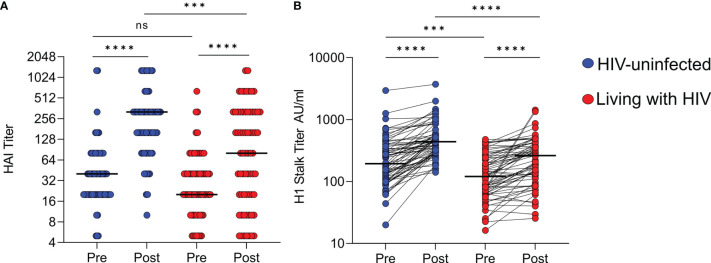
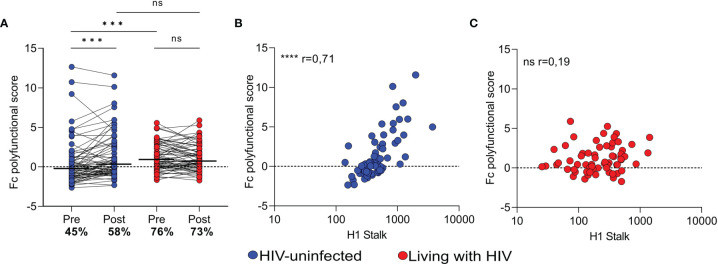
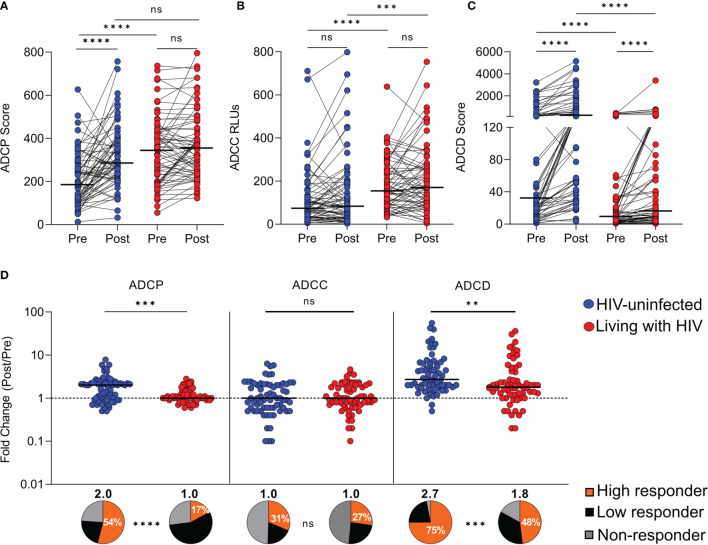
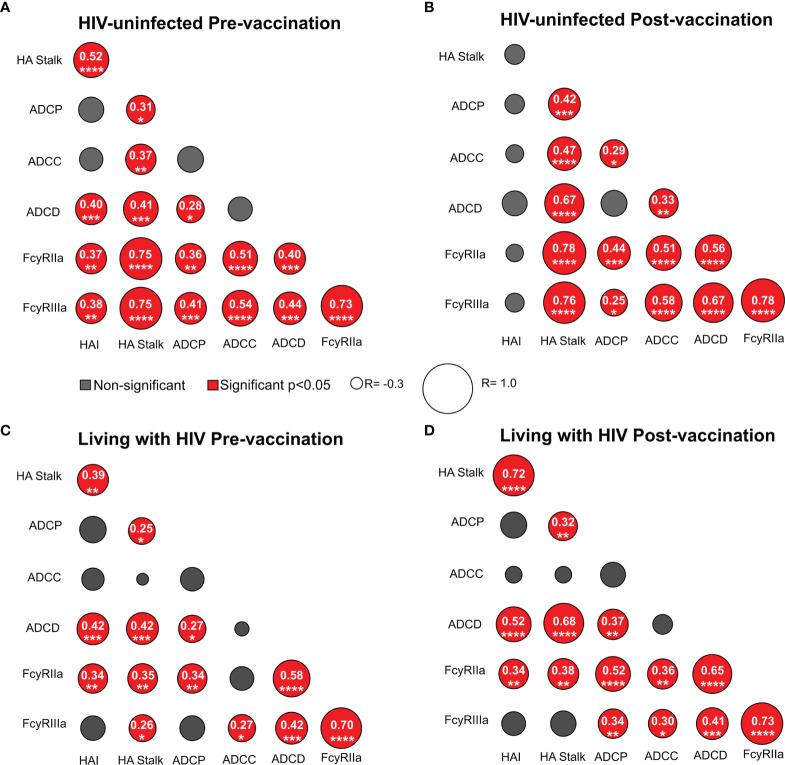
Influenza virus hemagglutinin (HA) stalk-specific antibodies have been shown to potently induce Fc-mediated effector functions which are important in protection from disease. In placebo-controlled maternal influenza (MatFlu) vaccination trials of pregnant women living with or without HIV, reduced risk of influenza illness was associated with high HA stalk antibody titers following trivalent inactivated vaccination (TIV). However, the mechanisms of immunity conferred by the HA stalk antibodies were not well understood. Here, we investigated HA stalk-specific Fc effector functions including antibody-dependent cellular phagocytosis (ADCP), antibody-dependent cellular cytotoxicity (ADCC), antibody-dependent complement deposition (ADCD), and FcγRIIa and FcγRIIIa binding in response to seasonal influenza vaccination. These were measured pre- and 1-month post-vaccination in 141 HIV-uninfected women (67 TIV and 74 placebo recipients) and 119 women living with HIV (WLWH; 66 TIV and 53 placebo recipients). In contrast to HIV-uninfected women, where HA stalk-specific ADCP and FcγRIIa binding were significantly boosted, WLWH showed no increase in response to vaccination. HA stalk-specific ADCC potential and FcγRIIIa binding were not boosted regardless of HIV status but were higher in WLWH compared with HIV-uninfected women prior to vaccination. HA stalk-specific ADCD was significantly increased by vaccination in all women, but was significantly lower in the WLWH both pre- and post- vaccination. Co-ordination between HA stalk-specific ADCP and ADCD in WLWH was improved by vaccination. Fc polyfunctionality was enhanced by vaccination in HIV-uninfected women and driven by the HA stalk antibody titers. However, in the WLWH, higher pre-vaccination Fc polyfunctionality was maintained post-vaccination but was decoupled from titer. Overall, we showed differential regulation of Fc effector HA stalk responses, suggesting that HIV infection results in unique humoral immunity in response to influenza vaccination, with relevance for future strategies that aim to target the HA stalk in this population.
流感病毒血凝素 (HA) 茎特异性抗体已被证明能够有效地诱导 Fc 介导的效应功能,这对于预防疾病非常重要。在针对伴有或不伴有 HIV 的孕妇的安慰剂对照母亲流感 (MatFlu) 疫苗接种试验中,三价灭活疫苗 (TIV) 接种后 HA 茎抗体滴度高与流感疾病风险降低相关。然而,HA 茎抗体赋予的免疫机制尚不清楚。在这里,我们研究了 HA 茎特异性 Fc 效应功能,包括抗体依赖性细胞吞噬作用 (ADCP)、抗体依赖性细胞细胞毒性 (ADCC)、抗体依赖性补体沉积 (ADCD) 以及 FcγRIIa 和 FcγRIIIa 结合,以响应季节性流感疫苗接种。在 141 名未感染 HIV 的女性(67 名 TIV 和 74 名安慰剂接受者)和 119 名 HIV 感染者中(66 名 TIV 和 53 名安慰剂接受者),在接种疫苗前和接种疫苗后 1 个月测量了这些功能。与 HIV 未感染者不同,HA 茎特异性 ADCP 和 FcγRIIa 结合显著增强,而 HIV 感染者对疫苗接种没有反应。HA 茎特异性 ADCC 潜能和 FcγRIIIa 结合不受 HIV 状态影响,但在接种疫苗前 HIV 感染者高于 HIV 未感染者。HA 茎特异性 ADCD 在所有女性中均因疫苗接种而显著增加,但在接种疫苗前后 HIV 感染者均显著降低。在 HIV 感染者中,疫苗接种后 HA 茎特异性 ADCP 和 ADCD 的协调性得到改善。在 HIV 未感染者中,疫苗接种增强了 Fc 多功能性,这是由 HA 茎抗体滴度驱动的。然而,在 HIV 感染者中,较高的接种前 Fc 多功能性在接种后得以维持,但与滴度脱钩。总体而言,我们发现 Fc 效应 HA 茎反应的调节存在差异,这表明 HIV 感染导致针对流感疫苗接种产生独特的体液免疫,这与未来旨在针对该人群的 HA 茎的策略相关。