Riebe Steffen, Zimmermann Alexander, Koch Johannes, Vallet Cecilia, Knauer Shirley K, Sowa Andrea, Wölper Christoph, Voskuhl Jens
Institute for Organic Chemistry and CENIDE, University of Duisburg-Essen Universitätsstrasse 7 45141 Essen Germany
ICCE, Center of Medical Biotechnology (ZMB), University of Duisburg-Essen Universitätsstrasse 2 45141 Essen Germany.
RSC Adv. 2020 May 27;10(33):19643-19647. doi: 10.1039/d0ra03608k. eCollection 2020 May 20.
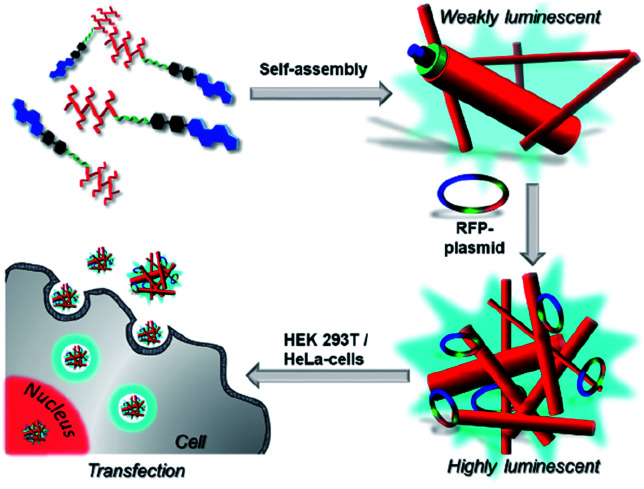
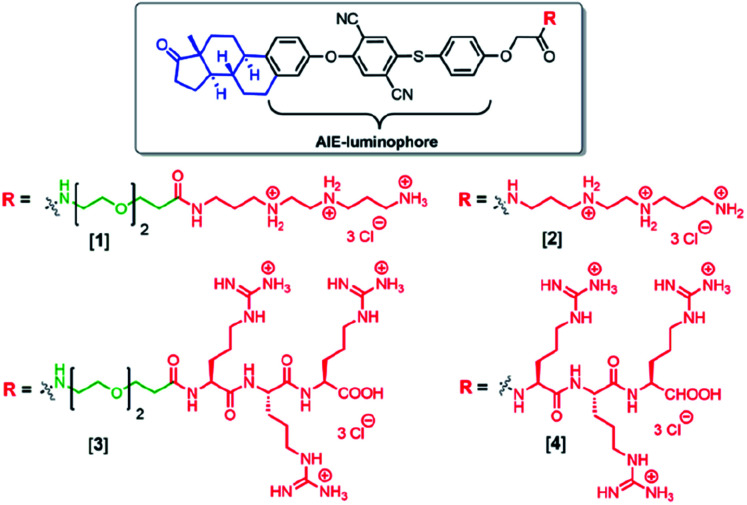
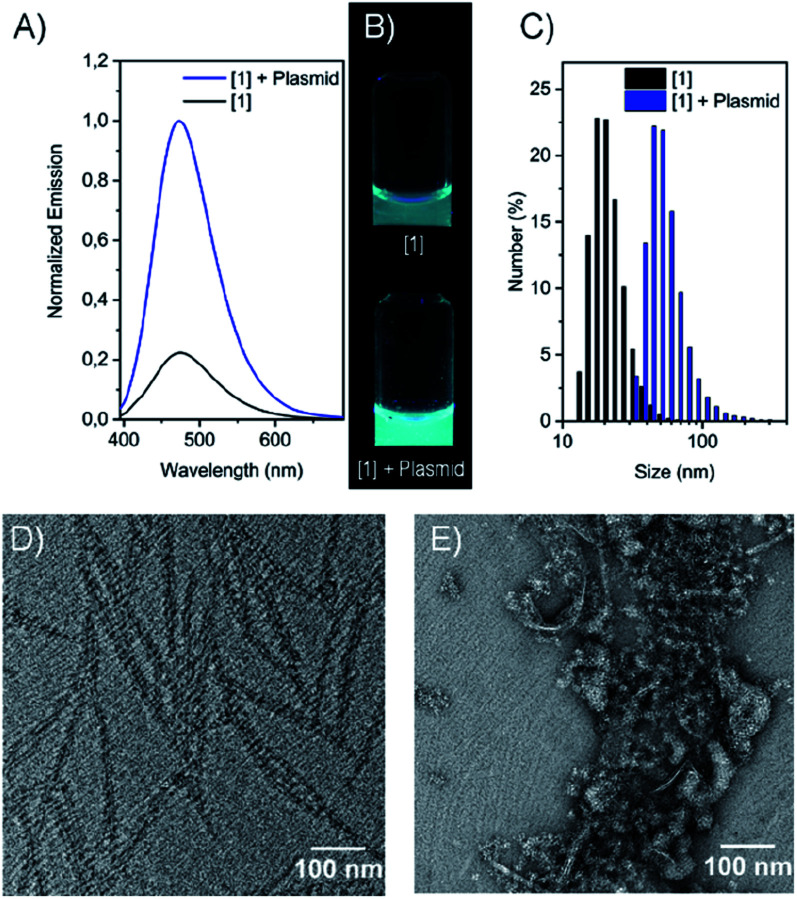
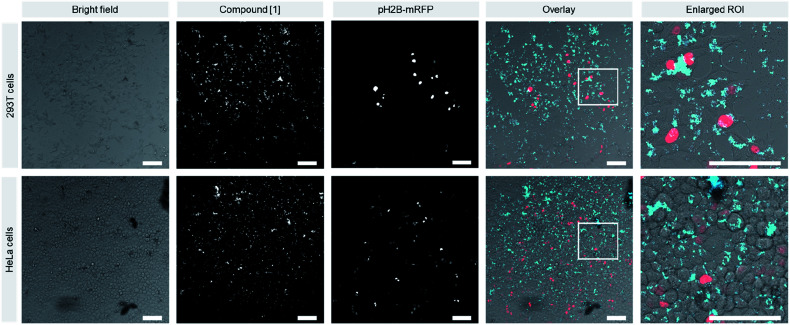
In this communication we present the use of a novel class of luminophores with aggregation-induced emission (AIE) properties based on the steroid estrone. These molecules were equipped with cationic residues yielding amphiphiles suitable for lipofection. To this end, self-assembled luminescent structures were formed in aqueous media and mixed with a red-fluorescent protein expressing plasmid, yielding lipoplexes with increased emission intensity. These luminescent lipoplexes were able to efficiently transfect HeLa and HEK 293T cells and were able to be tracked due to the aggregation induced-emission properties.
在本通讯中,我们展示了一类基于甾体雌激素酮的具有聚集诱导发光(AIE)特性的新型发光体的应用。这些分子带有阳离子残基,产生适用于脂质转染的两亲性分子。为此,在水性介质中形成了自组装发光结构,并与表达红色荧光蛋白的质粒混合,产生了发射强度增加的脂质体复合物。这些发光脂质体复合物能够有效地转染HeLa和HEK 293T细胞,并且由于聚集诱导发光特性而能够被追踪。