Qian Saibo, Yan Zhilin, Xu Yongjie, Tan Huaping, Chen Yong, Ling Zhonghua, Niu Xiaohong
School of Materials Science and Engineering, Nanjing University of Science and Technology Nanjing 210094 China
Department of Orthopaedics, Jinling Hospital Nanjing 210002 China.
RSC Adv. 2019 Apr 16;9(21):12001-12009. doi: 10.1039/c9ra00370c. eCollection 2019 Apr 12.
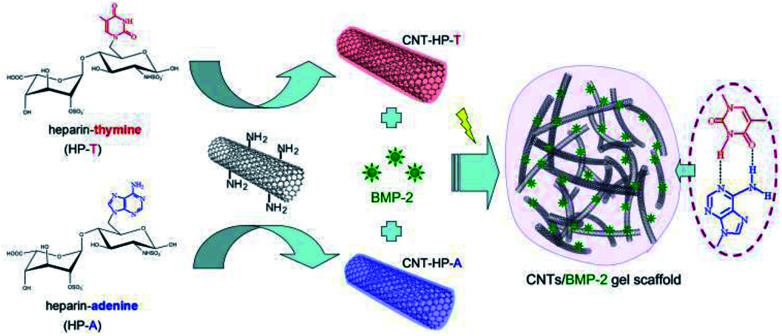
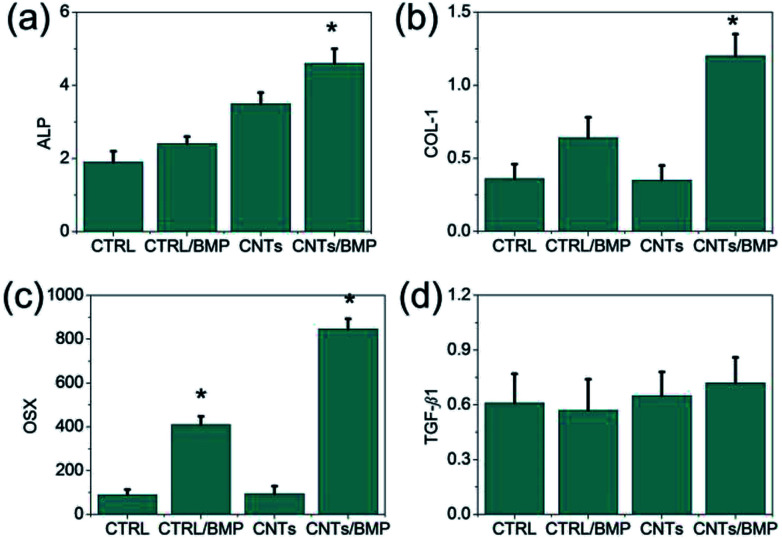
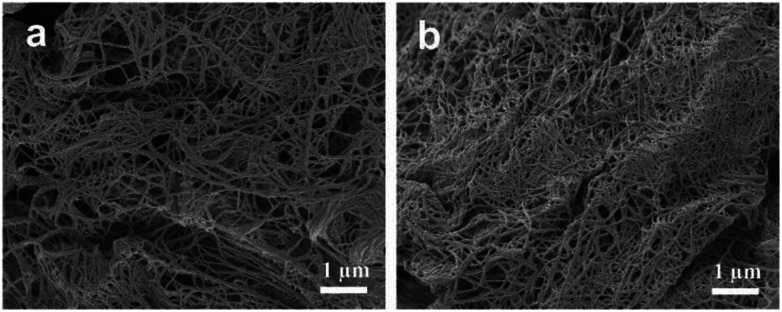
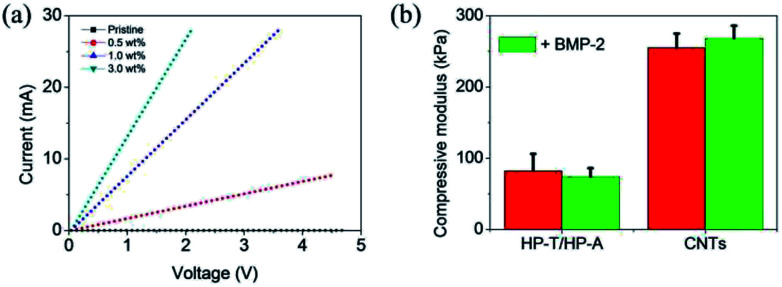
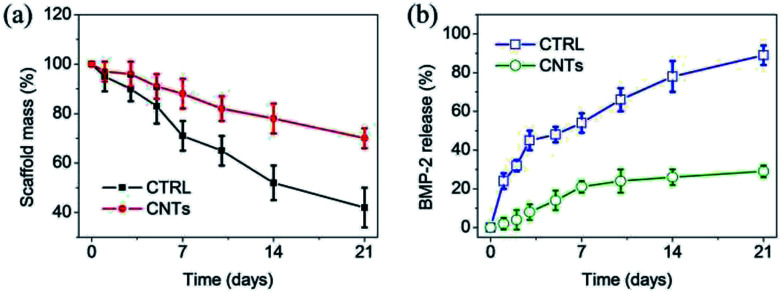
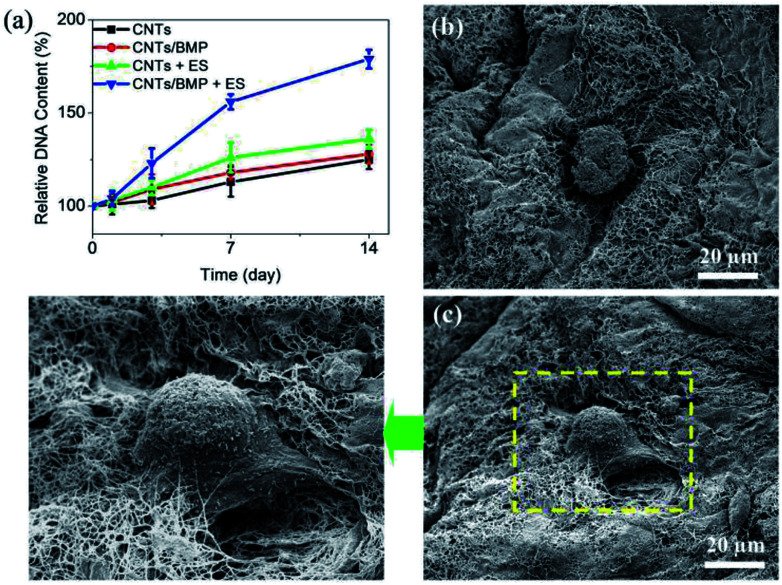
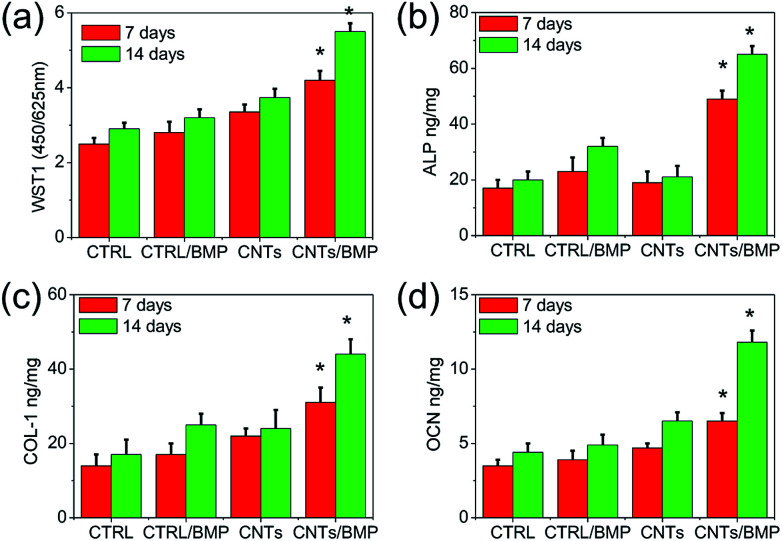
Bio-functional cell scaffolds have great potential in the field of tissue regenerative medicine. In this work, a carbon nanotube (CNT) gel scaffold specific pairing of functionalized nucleobases was developed for specifically targeted drug delivery and osteogenesis. The CNT gel scaffold with nano-fibrous architectures was established by Watson-Crick base pairing between thymine and adenine of low molecular weight heparin, respectively. As scaffold precursors, adenine and thymine functionalized heparin derivatives could additionally bind cell growth factors by the affinity interaction. The resulting nano-fibrous gel scaffolds showed excellent mechanical integrity and advanced electro-physiological functions. Potential application of the electrophysiological CNT gel scaffold in bone tissue engineering was confirmed by encapsulation of human adipose-derived stem cells (ASCs). Our results indicate that the electrically conductive networks formed by CNTs within the nano-fibrous framework are the key characteristics of cell scaffolds leading to improved ASC organization and differentiation by an extra electrical stimulus (ES). Specifically, ASCs cultured in bio-electrical gel scaffolds showed ∼4 times higher spontaneous osteogenesis in combination with bone morphogenetic protein 2 (BMP-2), compared to those cultured on pristine hydrogels. This electrophysiological CNT gel scaffold containing BMP-2 exhibited beneficial effects on ASC activity and osteogenetic differentiation, which suggested a promising future for local treatment of bone regeneration.
生物功能细胞支架在组织再生医学领域具有巨大潜力。在这项工作中,开发了一种用于特异性靶向药物递送和成骨的碳纳米管(CNT)凝胶支架,其通过功能化核碱基的特异性配对实现。具有纳米纤维结构的CNT凝胶支架是分别通过低分子量肝素的胸腺嘧啶和腺嘌呤之间的沃森 - 克里克碱基配对建立的。作为支架前体,腺嘌呤和胸腺嘧啶功能化的肝素衍生物可通过亲和相互作用额外结合细胞生长因子。所得的纳米纤维凝胶支架表现出优异的机械完整性和先进的电生理功能。通过封装人脂肪干细胞(ASC)证实了电生理CNT凝胶支架在骨组织工程中的潜在应用。我们的结果表明,纳米纤维框架内由CNT形成的导电网络是细胞支架的关键特征,通过额外的电刺激(ES)导致ASC组织和分化得到改善。具体而言,与在原始水凝胶上培养的细胞相比,在生物电凝胶支架中培养的ASC与骨形态发生蛋白2(BMP-2)联合时自发成骨高出约4倍。这种含有BMP-2的电生理CNT凝胶支架对ASC活性和成骨分化具有有益作用,这表明其在骨再生局部治疗方面具有广阔前景。