
可回收的MFeO(M = Mn、Zn、Cu、Ni、Co)耦合微纳米气泡用于同时催化氧化去除烟气中的NO和SO。
Recyclable MFeO (M = Mn, Zn, Cu, Ni, Co) coupled micro-nano bubbles for simultaneous catalytic oxidation to remove NO and SO in flue gas.
作者信息
Sun Hongrui, Li Dengxin
机构信息
School of Environmental Science and Engineering, Donghua University 2999 North Renmin Road Shanghai 201620 China
出版信息
RSC Adv. 2020 Jul 2;10(42):25155-25164. doi: 10.1039/d0ra04392c. eCollection 2020 Jun 29.
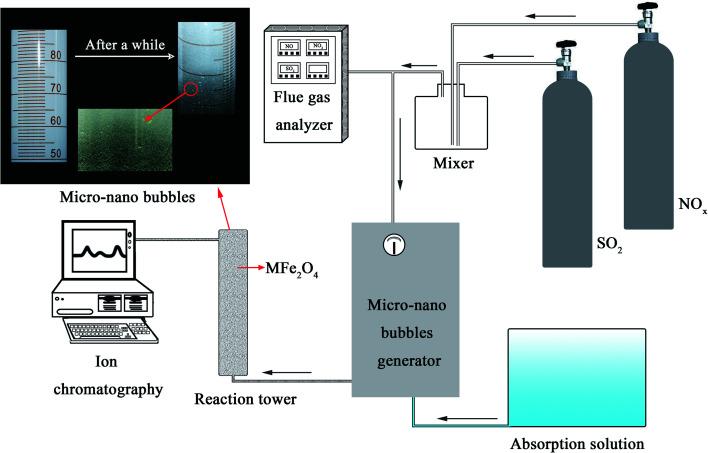
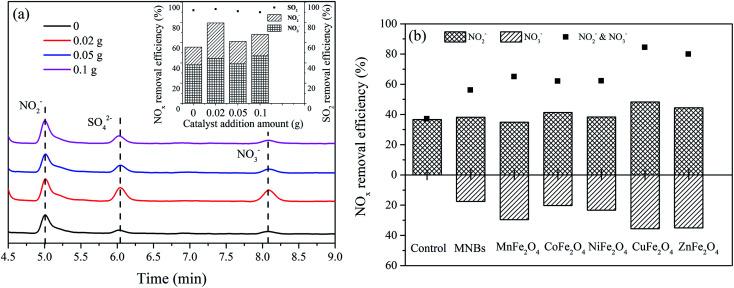
NO can be efficiently removed by micro-nano bubbles coupling with Fe and Mn, but the catalyst cannot be reused and the adsorption wastewater should be treated. This work developed a new technology that uses micro-nano bubbles and recyclable MFeO to simultaneously remove NO and SO from flue gas, and clarified the effectiveness and reaction mechanism. MFeO (M = Mn, Zn, Cu, Ni and Co) prepared by a hydrothermal method was characterized. The results show that MFeO can be activated to produce ˙OH which can accelerate the oxidation absorption of NO . Compared with no catalyst, the NO conversion rate increased from 32.85% to 83.88% in the NO -SO-MFeO-micro-nano bubble system, while the removal rate of SO can reach 100% at room temperature. The catalytic activities of MFeO showed the following trend: CuFeO > ZnFeO > MnFeO > CoFeO > NiFeO. The results provide a new idea for the application of advanced oxidation processes in flue gas treatment.
通过与铁和锰耦合的微纳米气泡可以有效地去除一氧化氮,但催化剂不能重复使用,且吸附废水需要处理。这项工作开发了一种利用微纳米气泡和可回收的MFeO同时去除烟气中一氧化氮和二氧化硫的新技术,并阐明了其有效性和反应机理。对通过水热法制备的MFeO(M = 锰、锌、铜、镍和钴)进行了表征。结果表明,MFeO可以被激活产生羟基自由基,从而加速一氧化氮的氧化吸收。与无催化剂相比,在一氧化氮-二氧化硫-MFeO-微纳米气泡体系中,一氧化氮的转化率从32.85%提高到了83.88%,而二氧化硫在室温下的去除率可达100%。MFeO的催化活性呈现以下趋势:铜铁氧体>锌铁氧体>锰铁氧体>钴铁氧体>镍铁氧体。这些结果为高级氧化工艺在烟气处理中的应用提供了新思路。




 Zotero 插件