Yang Bin, Wang Kaiyuan, Zhang Dong, Ji Bin, Zhao Dongyang, Wang Xin, Zhang Haotian, Kan Qiming, He Zhonggui, Sun Jin
Department of Pharmaceutics, Wuya College of Innovation, Shenyang Pharmaceutical University Mailbox 59#, No. 103 Wenhua Road Shenyang Liaoning 110016 China
Department of Laboratory Medicine, The First Affiliated Hospital, China Medical University Shenyang Liaoning 110001 China.
RSC Adv. 2019 Mar 21;9(16):9260-9269. doi: 10.1039/c9ra01230c. eCollection 2019 Mar 15.
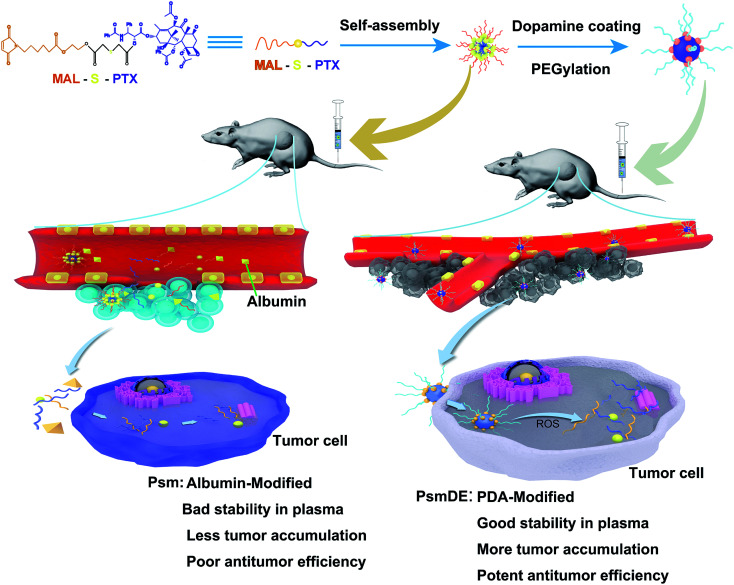
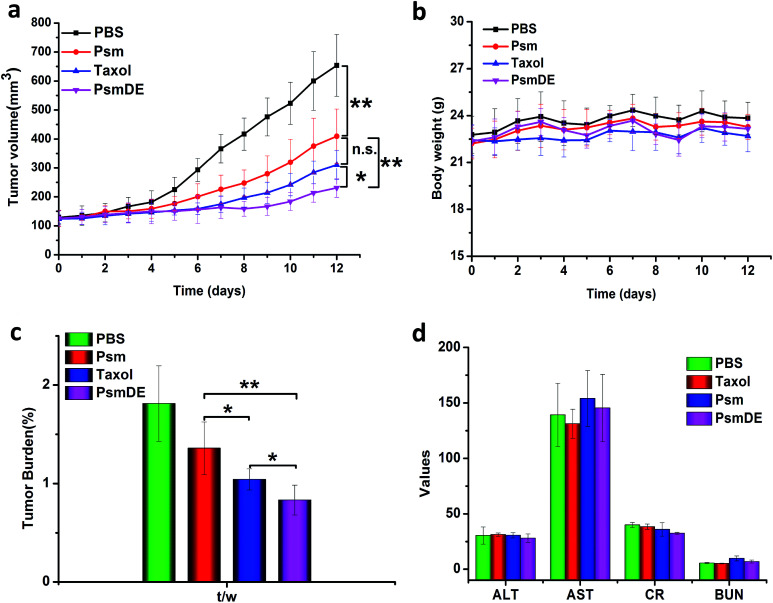
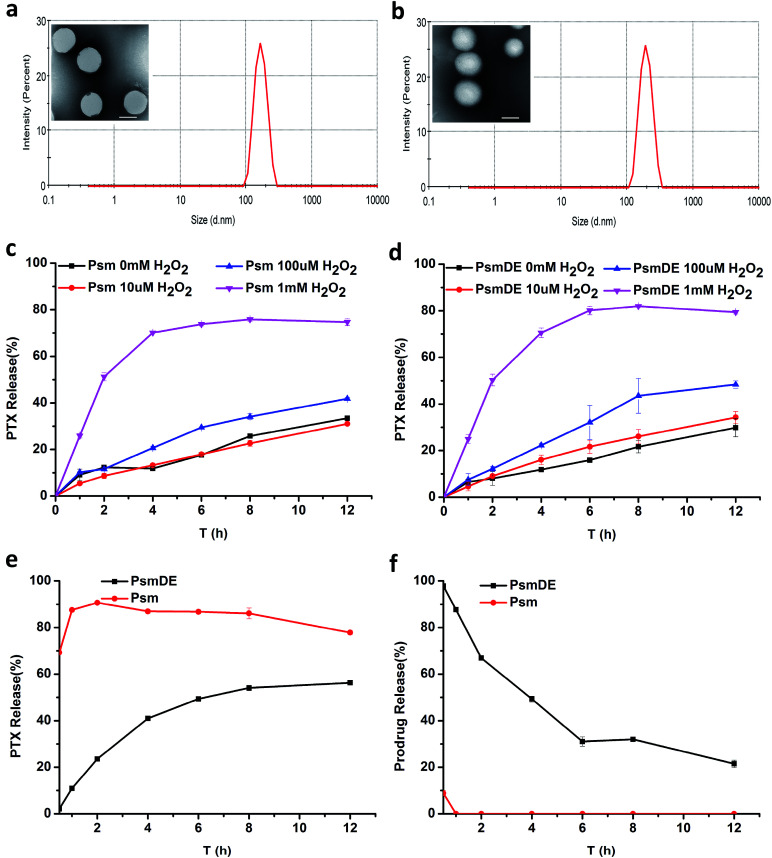
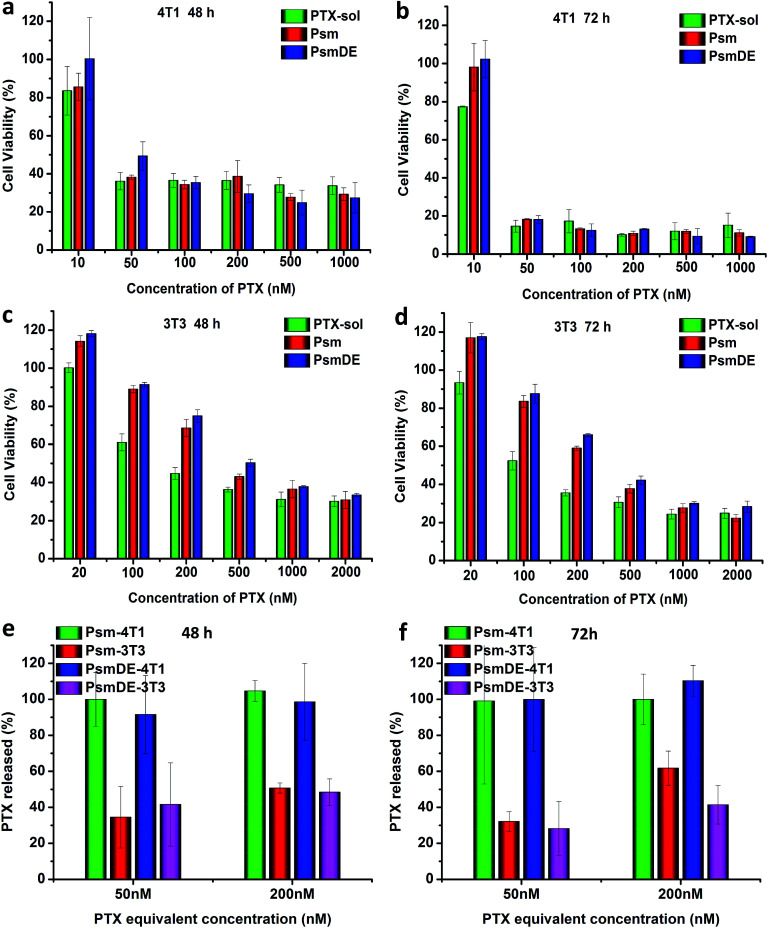
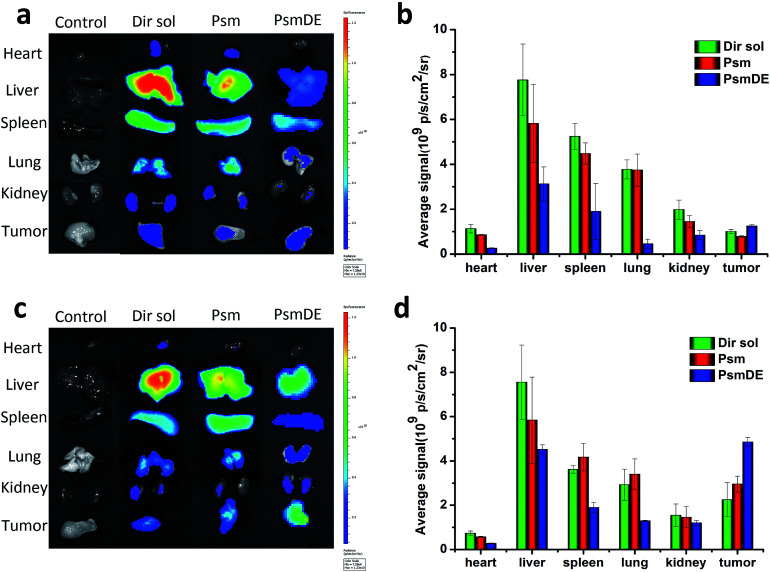
Development of smart stimuli-responsive prodrug nanomaterials for fast drug release and efficient antitumor therapy has attracted great attention in recent years. However, the inherent instability of naked prodrugs in the blood is an important challenge limiting their biomedical applications. Although a number of strategies have been taken to prevent prodrugs from hydrolyzing due to blood composition, most of these strategies are unsatisfactory. Here, we designed an extraordinary ROS-triggered prodrug nanoplatform fabricated by using a single thioether linker to conjugate PTX with 6-maleimidocaproic acid (MAL), resulting in the PTX-S-MAL prodrug self-assembling into uniform size nanoparticles; then the prodrug nanoplatform was modified with a polydopamine coating and PEGylation to confer high solubility and stability. In experiments, the polydopamine-modified ROS-responsive prodrug nanosystem showed a high sensitivity in term of various HO concentrations, and the PDA coating on the surface of the prodrug nanosystem didn't affect the drug release properties. Moreover, the excellent polydopamine-modified ROS-triggered prodrug nanoplatform selectively and rapidly releases PTX in response to the ROS overproduced in tumor cells, but showed less cytotoxicity against normal cells. In experiments, the prepared polydopamine-modified prodrug-nanosystem obviously enhances the stability and tumor accumulation of prodrug, producing a remarkably improved breast cancer treatment with minimal side effects. Our studies demonstrated that this modified nanoplatform could significantly improve chemotherapy efficiency, which will find great potential in cancer treatment.
近年来,用于快速药物释放和高效抗肿瘤治疗的智能刺激响应型前药纳米材料的开发备受关注。然而,裸前药在血液中的固有不稳定性是限制其生物医学应用的重要挑战。尽管已经采取了许多策略来防止前药因血液成分而水解,但这些策略大多不尽人意。在此,我们设计了一种特殊的ROS触发前药纳米平台,通过使用单个硫醚连接子将PTX与6-马来酰亚胺己酸(MAL)共轭,使PTX-S-MAL前药自组装成尺寸均匀的纳米颗粒;然后用聚多巴胺涂层和聚乙二醇化修饰前药纳米平台,以赋予其高溶解性和稳定性。实验中,聚多巴胺修饰的ROS响应前药纳米系统在不同HO浓度下表现出高灵敏度,且前药纳米系统表面的PDA涂层不影响药物释放性能。此外,优异的聚多巴胺修饰的ROS触发前药纳米平台能响应肿瘤细胞中过量产生的ROS选择性且快速地释放PTX,但对正常细胞的细胞毒性较小。实验中,制备的聚多巴胺修饰的前药纳米系统明显提高了前药的稳定性和肿瘤蓄积性,以最小的副作用显著改善了乳腺癌治疗效果。我们的研究表明,这种修饰的纳米平台可显著提高化疗效率,在癌症治疗中具有巨大潜力。