Herrmann Franziska Elena, Hesslinger Christian, Wollin Lutz, Nickolaus Peter
Boehringer Ingelheim Pharma GmbH & Co. KG, Biberach an der Riss, Germany.
Front Pharmacol. 2022 Apr 20;13:838449. doi: 10.3389/fphar.2022.838449. eCollection 2022.
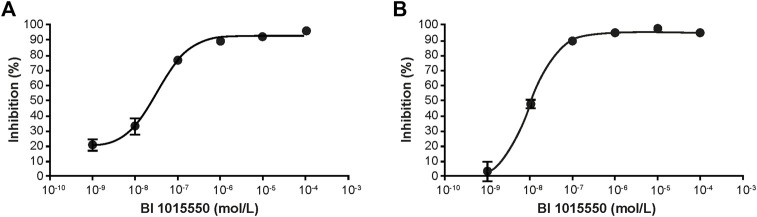
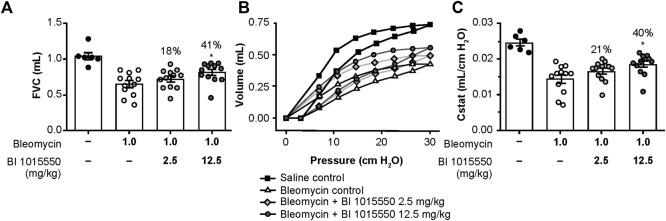
The anti-inflammatory and immunomodulatory abilities of oral selective phosphodiesterase 4 (PDE4) inhibitors enabled the approval of roflumilast and apremilast for use in chronic obstructive pulmonary disease and psoriasis/psoriatic arthritis, respectively. However, the antifibrotic potential of PDE4 inhibitors has not yet been explored clinically. BI 1015550 is a novel PDE4 inhibitor showing a preferential enzymatic inhibition of PDE4B. , BI 1015550 inhibits lipopolysaccharide (LPS)-induced tumor necrosis factor-α (TNF-α) and phytohemagglutinin-induced interleukin-2 synthesis in human peripheral blood mononuclear cells, as well as LPS-induced TNF-α synthesis in human and rat whole blood. , oral BI 1015550 shows potent anti-inflammatory activity in mice by inhibiting LPS-induced TNF-α synthesis and in Suncus murinus by inhibiting neutrophil influx into bronchoalveolar lavage fluid stimulated by nebulized LPS. In Suncus murinus, PDE4 inhibitors induce emesis, a well-known gastrointestinal side effect limiting the use of PDE4 inhibitors in humans, and the therapeutic ratio of BI 1015550 appeared to be substantially improved compared with roflumilast. Oral BI 1015550 was also tested in two well-known mouse models of lung fibrosis (induced by either bleomycin or silica) under therapeutic conditions, and appeared to be effective by modulating various model-specific parameters. To better understand the antifibrotic potential of BI 1015550 , its direct effect on human fibroblasts from patients with idiopathic pulmonary fibrosis (IPF) was investigated . BI 1015550 inhibited transforming growth factor-β-stimulated myofibroblast transformation and the mRNA expression of various extracellular matrix proteins, as well as basic fibroblast growth factor plus interleukin-1β-induced cell proliferation. Nintedanib overall was unremarkable in these assays, but interestingly, the inhibition of proliferation was synergistic when it was combined with BI 1015550, leading to a roughly 10-fold shift of the concentration-response curve to the left. In summary, the unique preferential inhibition of PDE4B by BI 1015550 and its anticipated improved tolerability in humans, plus its anti-inflammatory and antifibrotic potential, suggest BI 1015550 to be a promising oral clinical candidate for the treatment of IPF and other fibro-proliferative diseases.
口服选择性磷酸二酯酶4(PDE4)抑制剂的抗炎和免疫调节能力使得罗氟司特和阿普司特分别获批用于治疗慢性阻塞性肺疾病和银屑病/银屑病关节炎。然而,PDE4抑制剂的抗纤维化潜力尚未得到临床研究。BI 1015550是一种新型PDE4抑制剂,对PDE4B具有优先酶抑制作用。BI 1015550可抑制脂多糖(LPS)诱导的人外周血单个核细胞中肿瘤坏死因子-α(TNF-α)的产生以及植物血凝素诱导的白细胞介素-2的合成,还可抑制LPS诱导的人全血和大鼠全血中TNF-α的合成。口服BI 1015550在小鼠中通过抑制LPS诱导的TNF-α合成显示出强大的抗炎活性,在麝香鼩中通过抑制雾化LPS刺激引起的中性粒细胞流入支气管肺泡灌洗液也显示出抗炎活性。在麝香鼩中,PDE4抑制剂会引起呕吐,这是一种限制PDE4抑制剂在人类中使用的众所周知的胃肠道副作用,与罗氟司特相比,BI 1015550的治疗指数似乎有显著提高。口服BI 1015550还在两种著名的肺纤维化小鼠模型(博来霉素或二氧化硅诱导)中进行了治疗条件下的测试,并且通过调节各种模型特异性参数显示出有效。为了更好地了解BI 1015550的抗纤维化潜力,研究了其对特发性肺纤维化(IPF)患者人成纤维细胞的直接作用。BI 1015550可抑制转化生长因子-β刺激的肌成纤维细胞转化以及各种细胞外基质蛋白的mRNA表达,还可抑制碱性成纤维细胞生长因子加白细胞介素-1β诱导的细胞增殖。尼达尼布在这些试验中总体表现不明显,但有趣的是,当它与BI 1015550联合使用时,对增殖的抑制具有协同作用,导致浓度-反应曲线向左大致移动10倍。总之,BI 1015550对PDE4B的独特优先抑制作用及其预期的在人类中的更好耐受性,加上其抗炎和抗纤维化潜力,表明BI 1015550是治疗IPF和其他纤维增生性疾病的有前景的口服临床候选药物。