Jia Mengmeng, Zhang Qiwen, Qin Zifei, Wang Dao, Liu Peng, Yang Jing, Zhang Xiaojian
Department of Pharmacy, The First Affiliated Hospital of Zhengzhou University, Zhengzhou, China.
Henan Key Laboratory of Precision Clinical Pharmacy, Zhengzhou University, Zhengzhou, China.
Front Pharmacol. 2022 Apr 19;13:833303. doi: 10.3389/fphar.2022.833303. eCollection 2022.
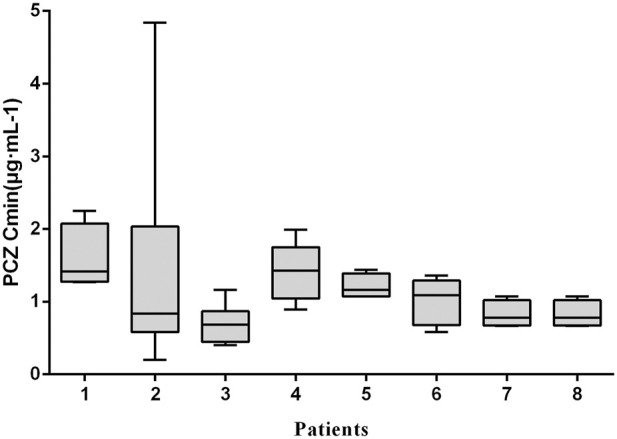
Experience in the clinical use of posaconazole (PCZ) in pediatric patients is limited, and no specific dose recommendations exist. This study aimed to investigate an appropriate dosing regimen, and assess the exposure-response relationships of PCZ in children. We reviewed the medical records of inpatients aged <18 years who subjected to PCZ concentrations monitoring. Clinical data, PCZ dosing and monitoring data were collected. A total of 375 PCZ trough concentrations ( ) from 105 pediatric patients were included. For children receiving PCZ for prophylaxis, the median doses required to achieve the therapeutic range at the ages of <6, 6-12 and >12 years were 14.80, 14.52 and 12.90 mg/kg/day, respectively ( = 0.001); and for those receiving PCZ for treatment, the median doses were 23.50, 20.96 and 15.38 mg/kg/day, respectively ( = 0.001). Among children taking PCZ for prophylaxis, 12% developed a proven or probable breakthrough IFIs; the median PCZ concentrations were significantly lower than those children with successful treatment response (0.43 versus 1.20 μg mL; < 0.001). 79.2% patients taking PCZ for treatment had a positive clinical response, and the median PCZ concentrations were significantly higher than those children with disease progression (1.06 versus 0.53 μg mL; = 0.024). No association between values and hepatotoxicity was observed. Factors such as age, CRP, ALT and co-administration with proton pump inhibitors exhibited significant effects on PCZ . It is necessary to adjust the dosing regimens based on PCZ to individualize antifungal therapy and provide guidelines for dose adjustment in children.
泊沙康唑(PCZ)在儿科患者中的临床应用经验有限,且尚无具体的剂量推荐。本研究旨在探讨合适的给药方案,并评估PCZ在儿童中的暴露-反应关系。我们回顾了年龄<18岁接受PCZ血药浓度监测的住院患者的病历。收集了临床数据、PCZ给药及监测数据。共纳入105例儿科患者的375次PCZ谷浓度( )。对于接受PCZ预防的儿童,年龄<6岁、6 - 12岁和>12岁达到治疗范围所需的中位剂量分别为14.80、14.52和12.90mg/kg/天( = 0.001);对于接受PCZ治疗的儿童,中位剂量分别为23.50、20.96和15.38mg/kg/天( = 0.001)。在接受PCZ预防的儿童中,12%发生了确诊或可能的突破性侵袭性真菌感染(IFI);其PCZ浓度中位数显著低于治疗反应成功的儿童(0.43对1.20μg/mL; < 0.001)。79.2%接受PCZ治疗的患者有阳性临床反应,其PCZ浓度中位数显著高于疾病进展的儿童(1.06对0.53μg/mL; = 0.024)。未观察到 值与肝毒性之间的关联。年龄、CRP、ALT以及与质子泵抑制剂合用等因素对PCZ 有显著影响。有必要根据PCZ 调整给药方案,以实现抗真菌治疗个体化,并为儿童剂量调整提供指导。