Zhao Fanrong, Zhang Lei, Zhang Menglin, Huang Jincan, Zhang Jun, Chang Yongsheng
Key Laboratory of Immune Microenvironment and Disease (Ministry of Education), Tianjin Key of Cellular Homeostasis and Disease, Department of Physiology and Pathophysiology, Tianjin Medical University, Tianjin, China.
Department of Basic Medicine, School of Medicine, Shihezi University, Shihezi, China.
Front Pharmacol. 2022 Apr 20;13:850128. doi: 10.3389/fphar.2022.850128. eCollection 2022.
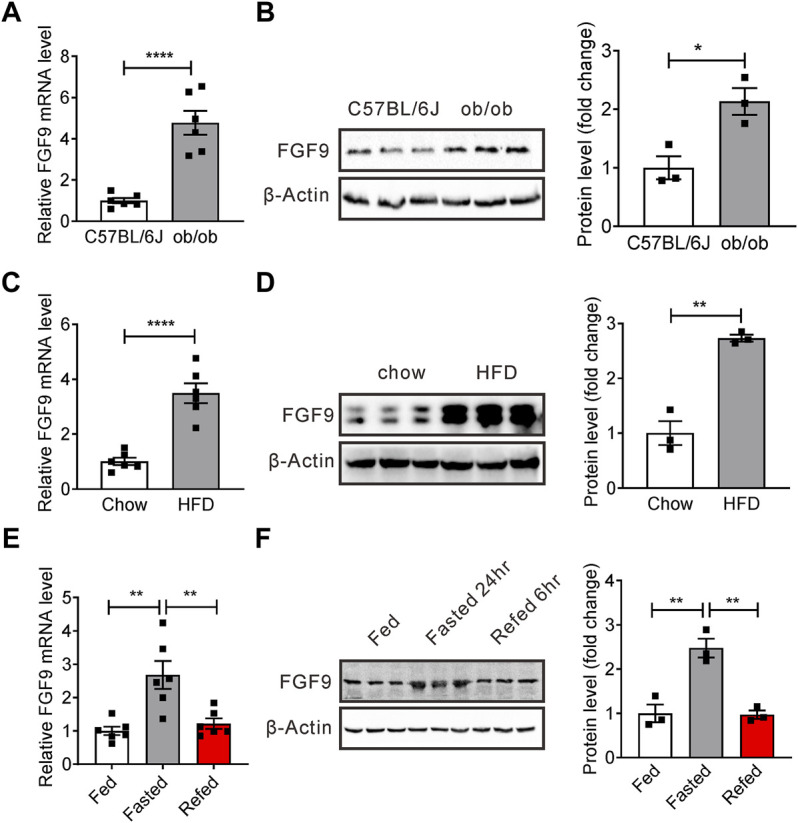
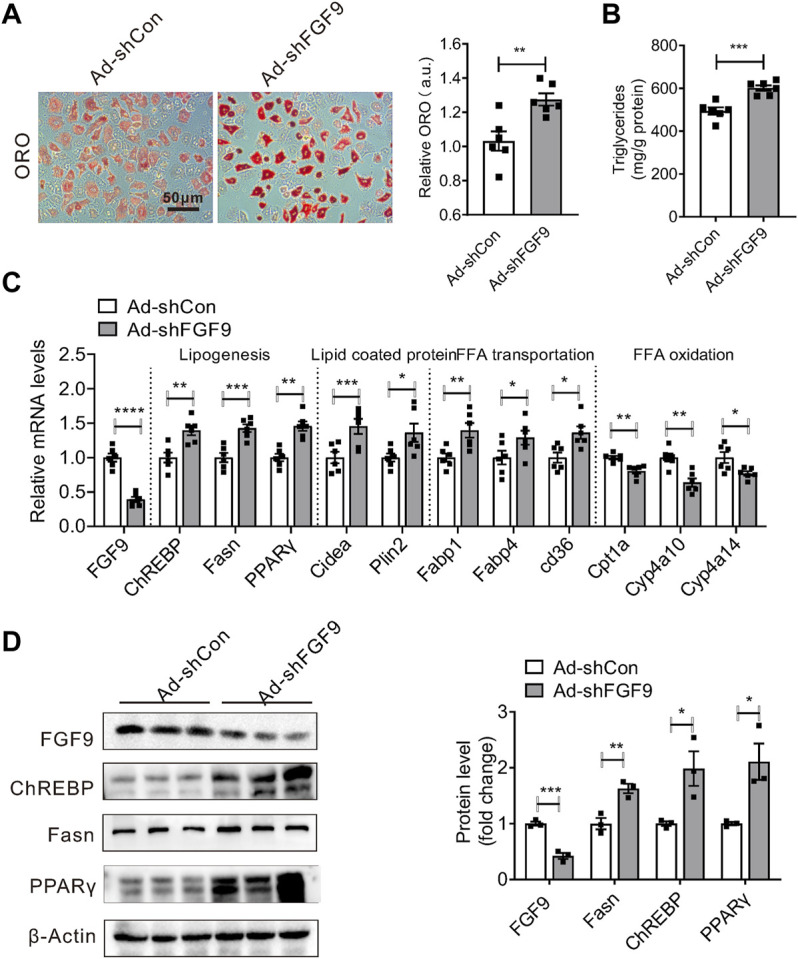
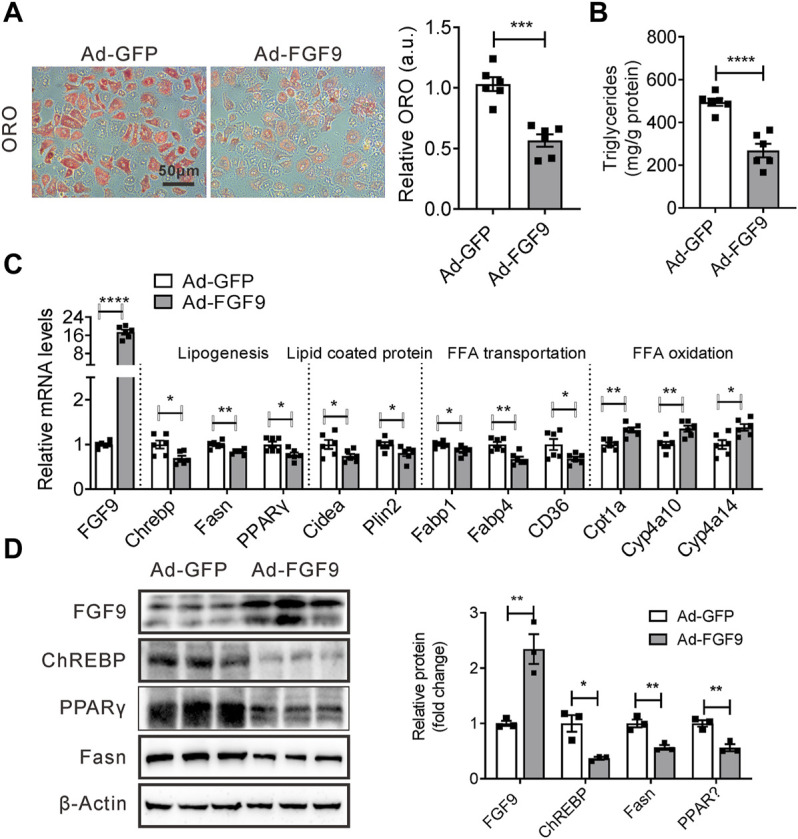
Although the fatty liver has been linked to numerous impairments of energy homeostasis, the molecular mechanism responsible for fatty liver development remains largely unknown. In the present study, we show that fibroblast growth factors 9 (FGF9) expression is increased in the liver of diet-induced obese (DIO), db/db, and ob/ob mice relative to their respective controls. The long-term knockdown of hepatic FGF9 expression mediated by adeno-associated virus expressing FGF9-specific short hairpin RNA (AAV-shFGF9) aggravated the fatty liver phenotype of DIO mice. Consistently, downregulation of FGF9 expression mediated by adenovirus expressing FGF9-specific shRNA (Ad-shFGF9) in the primary hepatocyte promoted the cellular lipid accumulation, suggesting that FGF9 exerts its effects in an autocrine manner. In contrast, adenoviruses expressing FGF9 (Ad-FGF9) mediated FGF9 overexpression in the liver of DIO mice alleviated hepatic steatosis and improved the insulin sensitivity and glucose intolerance. Moreover, the liver-specific FGF9 transgenic mice phenocopied the Ad-FGF9-infected mice. Mechanistically, FGF9 inhibited the expression of genes involved in lipogenesis and increased the expression of genes involved in fatty acid oxidation, thereby reducing cellular lipid accumulation. Thus, targeting FGF9 might be exploited to treat nonalcoholic fatty liver disease (NAFLD) and metabolic syndrome.
尽管脂肪肝与能量稳态的多种损害有关,但导致脂肪肝发展的分子机制仍 largely 未知。在本研究中,我们发现与各自的对照相比,饮食诱导肥胖(DIO)、db/db 和 ob/ob 小鼠肝脏中纤维母细胞生长因子 9(FGF9)的表达增加。由表达 FGF9 特异性短发夹 RNA 的腺相关病毒(AAV-shFGF9)介导的肝脏 FGF9 表达的长期敲低加剧了 DIO 小鼠的脂肪肝表型。一致地,在原代肝细胞中由表达 FGF9 特异性 shRNA 的腺病毒(Ad-shFGF9)介导的 FGF9 表达下调促进了细胞脂质积累,表明 FGF9 以自分泌方式发挥其作用。相反,在 DIO 小鼠肝脏中表达 FGF9 的腺病毒(Ad-FGF9)介导的 FGF9 过表达减轻了肝脂肪变性并改善了胰岛素敏感性和葡萄糖不耐受。此外,肝脏特异性 FGF9 转基因小鼠表现出与 Ad-FGF9 感染小鼠相似的表型。从机制上讲,FGF9 抑制参与脂肪生成的基因的表达并增加参与脂肪酸氧化的基因的表达,从而减少细胞脂质积累。因此,可以利用靶向 FGF9 来治疗非酒精性脂肪性肝病(NAFLD)和代谢综合征。