Aimé Abdala Kingwengwe, Etienne Shindano Mwamba, Mbongi Destin, Nsonso Didier, Serrao Erik, Léon Tshilolo Muepu Malaika, Oscar Luboya Numbi, Stanis Wembonyama Okitotsho
Département de Pédiatrie, Faculté de Médecine, Université de Kindu, Kindu, République Démocratique du Congo.
Unité de Prévention et Contrôle des Maladies, Faculté de Médecine, Université de Kindu, Kindu, République Démocratique du Congo.
Pan Afr Med J. 2022 Feb 16;41:134. doi: 10.11604/pamj.2022.41.134.30187. eCollection 2022.
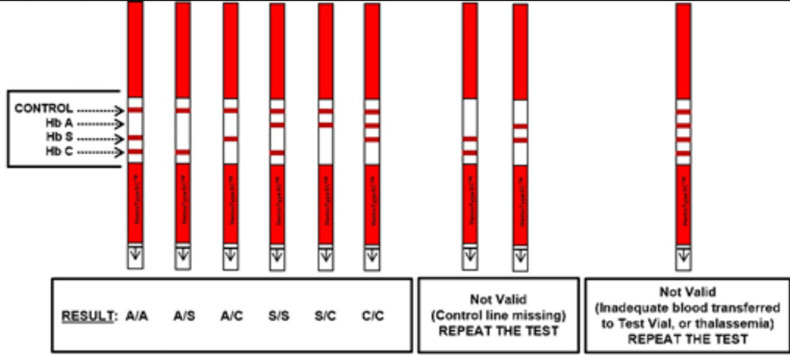
Early detection of sickle cell disease is crucial to improve people's survival. Both financial and geographic accessibility to sickle cell disease tools are barriers to universal screening in developing countries. The purpose of this study was to determine the hospital prevalence of sickle cell disease and to assess the reliability of a rapid diagnostic tool, HemoTypeSC, in a resource-limited environment. We conducted a prospective cross-sectional descriptive study in the Department of Pediatrics of 5 health facilities in the city of Kindu, Maniema province, DRC, over a period of 10 months. The study consisted of HemoType SC rapid test screening for sickle cell disease and then diagnostic confirmation by hemoglobin electrophoresis. A total of 448 children less than 5 years of age were enrolled in the study. The overall hospital prevalence of patients with sickle cell disease was 31.9%, of whom 12.7% were homozygous (SS) and 19.2% trait carriers; the level of suspicion for sickle cell disease in hospitals was 6%; the clinical presumption regarding sickle cell disease was 8%; HemoType SC rapid test had good indicators of validity for the detection of hemoglobins A and S. The study shows that the hospital prevalence of major sickle cell disease is higher in children under 5 years of age with respect to clinical suspicion in the absence of laboratory tests. HemoTypeSC rapid test seems to be a reliable tool for the screening of the disease in the city of Kindu, a resource-limited environment.
早期发现镰状细胞病对于提高患者生存率至关重要。在发展中国家,获取镰状细胞病检测工具的资金和地理可达性都是普及筛查的障碍。本研究旨在确定镰状细胞病在医院中的患病率,并评估一种快速诊断工具HemoTypeSC在资源有限环境中的可靠性。我们在刚果民主共和国马涅马省金杜市的5家医疗机构的儿科部门进行了一项为期10个月的前瞻性横断面描述性研究。该研究包括使用HemoType SC快速检测法筛查镰状细胞病,然后通过血红蛋白电泳进行诊断确认。共有448名5岁以下儿童参与了该研究。镰状细胞病患者的总体医院患病率为31.9%,其中12.7%为纯合子(SS),19.2%为性状携带者;医院对镰状细胞病的怀疑水平为6%;对镰状细胞病的临床推测为8%;HemoType SC快速检测法在检测血红蛋白A和S方面具有良好的有效性指标。该研究表明,在没有实验室检测的情况下,5岁以下儿童中主要镰状细胞病的医院患病率高于临床怀疑水平。在资源有限的金杜市,HemoTypeSC快速检测法似乎是一种可靠的疾病筛查工具。