Zhao Danhui, Lin Kui, Wang Lanhui, Qiu Zhigang, Zhao Xin, Du Kunze, Han Lifeng, Tian Fei, Chang Yanxu
Tianjin Key Laboratory of TCM Chemistry and Analysis, Tianjin University of Traditional Chinese Medicine Tianjin 301617 P. R. China
Analytical Instrumentation Centre, Tianjin University Tianjin 300072 P. R. China.
RSC Adv. 2020 May 27;10(34):20028-20037. doi: 10.1039/d0ra03019h. eCollection 2020 May 26.
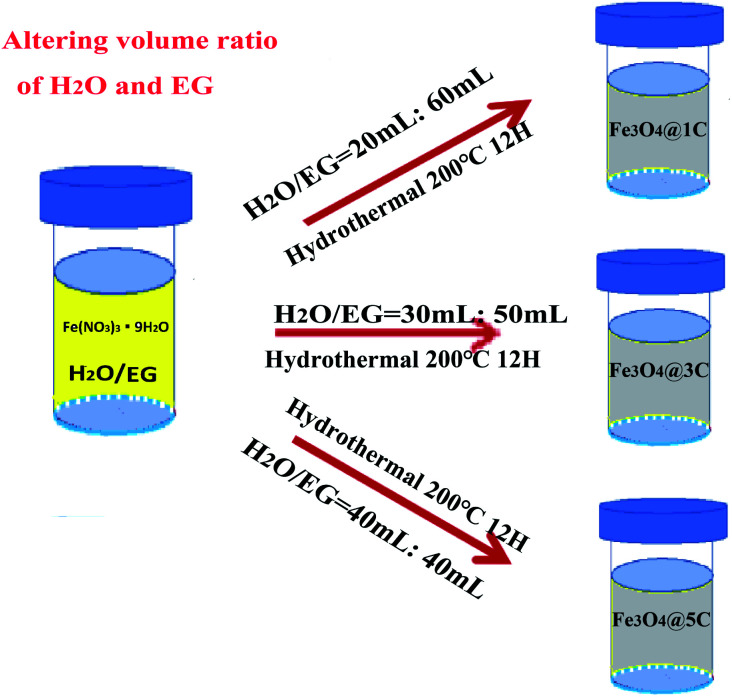
The controllable synthesis of nanosized FeO (10-20 nm) encapsulated in different numbers of graphene layers (1-5 layers) (FeO@DGL NPs) was realized through a facile and green hydrothermal reaction at a temperature as low as 200 °C. The competitive reduction-oxidation between reducing ethylene glycol (EG) and oxidizing HO under hydrothermal conditions resulted in the emergence of a magnetic FeO core. Then, the pyrolytic reaction of the polyvinyl alcohol (PVA) molecules attached to the surface of the FeO core with different surface densities led to the formation of graphene with a controlled number of layers. These FeO@DGL NPs exhibited fast adsorption and sensitive SERS detection for rhodamine B (RhB). A physical and mathematical model was proposed for the estimation of the enhancement factor (EF) by combining the adsorption efficiency and SERS of RhB. This approach and model are applicable for the adsorption, sensitive SERS detection and determination of SERS EF when using functional magnetic nanoparticles as the adsorbent. The FeO@1G NPs were also used as a novel nano-adsorbent for the fast removal of () from an aqueous solution. The FeO@1G NPs regenerated after 3 cycles also showed high efficiency in the adsorption and separation of RhB and .
通过在低至200℃的温度下进行简便且绿色的水热反应,实现了不同层数(1 - 5层)石墨烯包裹的纳米尺寸FeO(10 - 20纳米)(FeO@DGL纳米颗粒)的可控合成。水热条件下乙二醇(EG)的还原与HO的氧化之间的竞争还原氧化反应导致了磁性FeO核的出现。然后,附着在具有不同表面密度的FeO核表面的聚乙烯醇(PVA)分子发生热解反应,形成了具有可控层数的石墨烯。这些FeO@DGL纳米颗粒对罗丹明B(RhB)表现出快速吸附和灵敏的表面增强拉曼散射(SERS)检测性能。通过结合RhB的吸附效率和SERS,提出了一种用于估算增强因子(EF)的物理和数学模型。当使用功能磁性纳米颗粒作为吸附剂时,这种方法和模型适用于吸附、灵敏的SERS检测以及SERS EF的测定。FeO@1G纳米颗粒还被用作一种新型纳米吸附剂,用于从水溶液中快速去除(此处原文缺失具体物质)。经过3个循环再生后的FeO@1G纳米颗粒在RhB和(此处原文缺失具体物质)的吸附和分离中也表现出高效性能。