Zhang Daxia, Zhang Xianpeng, Jing Tongfang, Cao Haichao, Li Beixing, Liu Feng
Key Laboratory of Pesticide Toxicology and Application Technique, College of Plant Protection, Shandong Agricultural University Tai'an Shandong 271018 P. R. China
Research Center of Pesticide Environmental Toxicology, Shandong Agricultural University Tai'an Shandong 271018 P. R. China.
RSC Adv. 2019 Mar 28;9(17):9820-9827. doi: 10.1039/c9ra00069k. eCollection 2019 Mar 22.
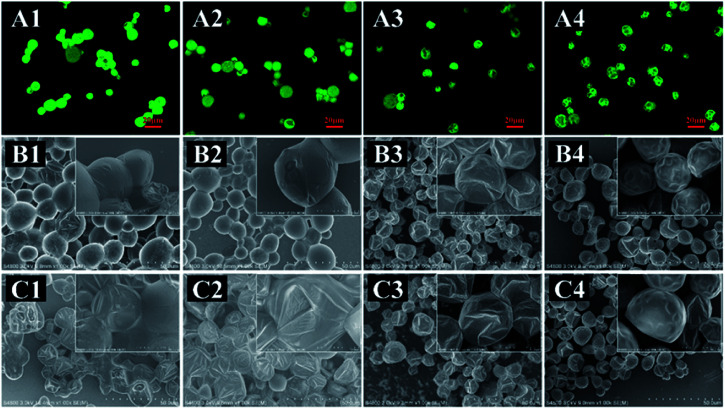
Diverse shell structures can endow microcapsules (MCs) with a variety of properties. In this study, four kinds of MCs encapsulated with epoxy phenolic novolac resin (EPN) were obtained using diamines as crosslinkers. The FTIR and CLSM confirmed that the EPN-shell was successfully synthesized. SEM results suggested that all four of the MCs possessed smooth and imporous surfaces, and they displayed uniform size distribution, with the average size ranging from 11.2 to 14.8 μm. Specifically, the MCs synthesized with the crosslinkers of hexamethylene diamine (HAD) and isophorone diamine (IPDA) were more stable and could maintain their spherical shapes in a dry environment, while those synthesized with ethylene diamine (EDA) and triethylene tetramine (TETA) exhibited poorer thermal stabilities and faster release profiles. Lipophilic diamines can form thicker shell thickness, and have smaller -space values and higher Young's modulus values. Therefore, the lipophilicity of the diamine agents is the key factor that influences the specific properties of the MCs. The hybrid approach was validated as a flexible strategy to meet diverse requirements. The present study can provide a comprehensive understanding of diamine crosslinkers in the synthesis of EPN-MCs, and such MCs can be extended to a wide range of fields because of their broad tunable performance.
多样的壳结构可赋予微胶囊(MCs)多种性能。在本研究中,以二胺为交联剂制备了四种包裹有环氧酚醛清漆树脂(EPN)的微胶囊。傅里叶变换红外光谱(FTIR)和共聚焦激光扫描显微镜(CLSM)证实成功合成了EPN壳。扫描电子显微镜(SEM)结果表明,所有四种微胶囊均具有光滑且无孔的表面,并且它们呈现出均匀的尺寸分布,平均尺寸范围为11.2至14.8μm。具体而言,用六亚甲基二胺(HAD)和异佛尔酮二胺(IPDA)作为交联剂合成的微胶囊更稳定,在干燥环境中能保持其球形,而用乙二胺(EDA)和三乙烯四胺(TETA)合成的微胶囊热稳定性较差且释放曲线更快。亲脂性二胺可形成更厚的壳层厚度,具有更小的间距值和更高的杨氏模量值。因此,二胺试剂的亲脂性是影响微胶囊特定性能的关键因素。这种混合方法被验证为一种满足多样需求的灵活策略。本研究能够全面了解二胺交联剂在EPN微胶囊合成中的作用,并且由于其广泛的可调性能,此类微胶囊可扩展到广泛的领域。