Yang Yan-Hong, Li Xiang-Zhou, Zhang Sheng
School of Materials Science and Engineering, Central South University of Forestry and Technology Changsha Hunan P. R. China
State Key Laboratory of Ecological Applied Technology in Forest Area of South China Changsha Hunan P. R. China.
RSC Adv. 2018 Aug 24;8(52):29980-29987. doi: 10.1039/c8ra05769a. eCollection 2018 Aug 20.
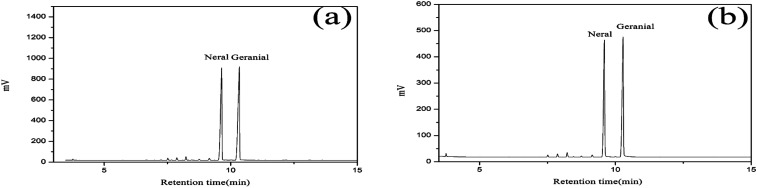
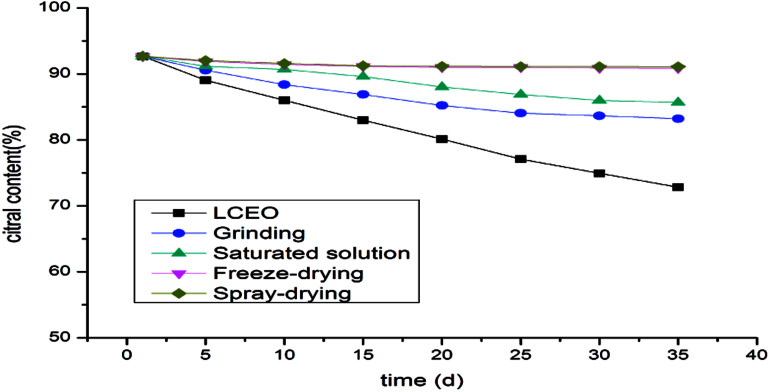
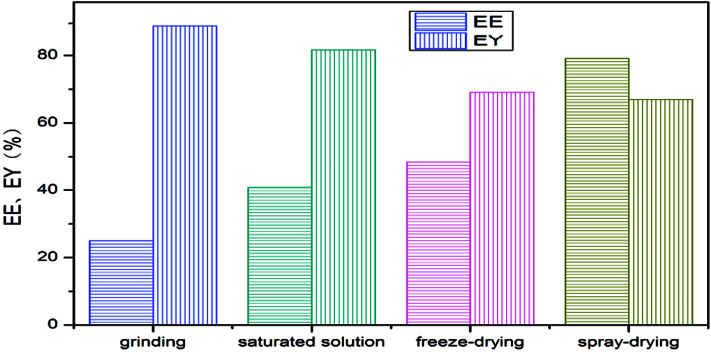
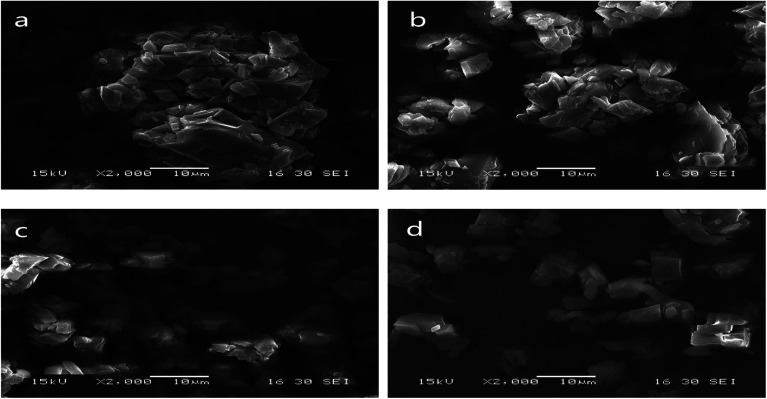
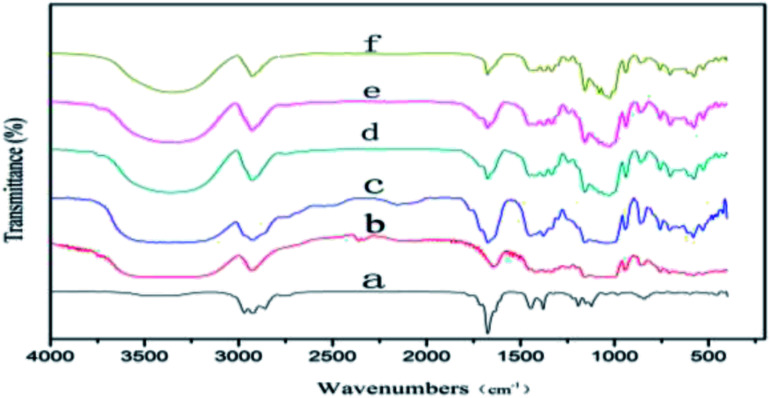
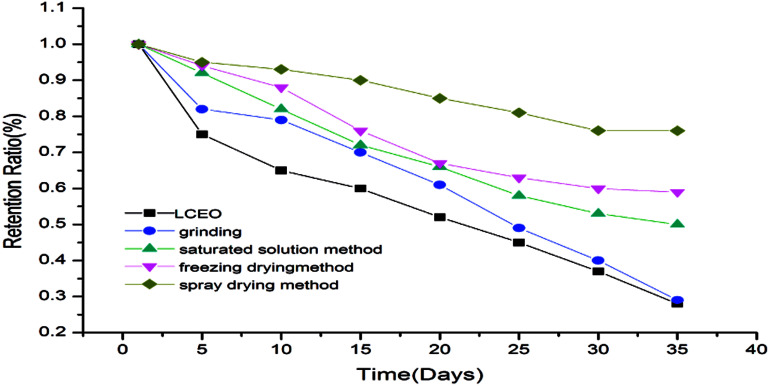
In this paper, using β-cyclodextrin (β-CD) as the shell material, LCEO ( essential oil) microcapsules were prepared by various preparation methods, such as grinding, saturated solution, freeze-drying and spray-drying. The encapsulation yield, encapsulation efficiency, retention rate of the microcapsules and the citral content of the microcapsules were investigated. The surface morphologies of the microcapsules were observed using SEM (Scanning Electronic Microscopy); the entrapment efficiencies of the microcapsules were detected using IR (Infrared Spectrum) analysis; the citral contents of microcapsules were detected by GC (Gas Chromatography) analysis. The highest encapsulation efficiency for the microcapsules was obtained using spray-drying, followed by freeze-drying, saturated aqueous solution and grinding, while the encapsulation yield followed the opposite sequence to the encapsulation efficiency. At a specific storage temperature (15 °C) and humidity (60%), spray-drying had the most satisfactory protective effect on citral in LCEO, followed by freeze-drying and saturated aqueous solution, while the grinding method appeared to provide the worst protective effect. Avrami's model was used to simulate the release rates of the four kinds of microcapsules. The release mechanism parameters of microcapsules prepared by grinding, saturated aqueous solution, freeze-drying and spray-drying were 0.961, 1.096, 1.156 and 0.945, respectively. The release rate constants of microcapsules prepared by grinding, saturated aqueous solution, freeze-drying and spray-drying were 2.53 × 10, 2.22 × 10, 1.84 × 10, and 7.27 × 10 d, respectively. It was concluded that the release reactions of the microcapsules prepared by grinding or spray-drying lay between the diffusion limiting kinetics and the first-order release kinetics, and the release reactions of the microcapsules prepared by saturated aqueous solution or freeze-drying were larger than the first-order release kinetics.
在本文中,以β-环糊精(β-CD)为壁材,通过研磨法、饱和溶液法、冷冻干燥法和喷雾干燥法等多种制备方法制备了柠檬香脂冷榨提取物(LCEO,香精油)微胶囊。研究了微胶囊的包封率、包封效率、保留率以及微胶囊中的柠檬醛含量。使用扫描电子显微镜(SEM)观察微胶囊的表面形态;使用红外光谱(IR)分析检测微胶囊的包封效率;通过气相色谱(GC)分析检测微胶囊中的柠檬醛含量。微胶囊的最高包封效率是通过喷雾干燥获得的,其次是冷冻干燥、饱和水溶液法和研磨法,而包封率与包封效率的顺序相反。在特定的储存温度(15℃)和湿度(60%)下,喷雾干燥对LCEO中的柠檬醛具有最令人满意的保护作用,其次是冷冻干燥和饱和水溶液法,而研磨法似乎提供了最差的保护作用。采用阿弗拉米模型模拟四种微胶囊的释放速率。通过研磨法、饱和水溶液法、冷冻干燥法和喷雾干燥法制备的微胶囊的释放机制参数分别为0.961、1.096、1.156和0.945。通过研磨法、饱和水溶液法、冷冻干燥法和喷雾干燥法制备的微胶囊的释放速率常数分别为2.53×10、2.22×10、1.84×10和7.27×10 d。得出的结论是,通过研磨或喷雾干燥制备的微胶囊的释放反应介于扩散限制动力学和一级释放动力学之间,而通过饱和水溶液或冷冻干燥制备的微胶囊的释放反应大于一级释放动力学。