El-Sheikh Sawsan M A, Bahaa Hadeer M, Galal Azza A A, Metwally Mohamed M M, Said Mahmoud A, Alattar Reham H, Fahmy Esraa M
Department of Pharmacology, Faculty of Veterinary Medicine, Zagazig University, Zagazig 44511, Egypt.
Health Administration, Zagazig 44519, Egypt.
Saudi J Biol Sci. 2022 Jun;29(6):103289. doi: 10.1016/j.sjbs.2022.103289. Epub 2022 Apr 21.
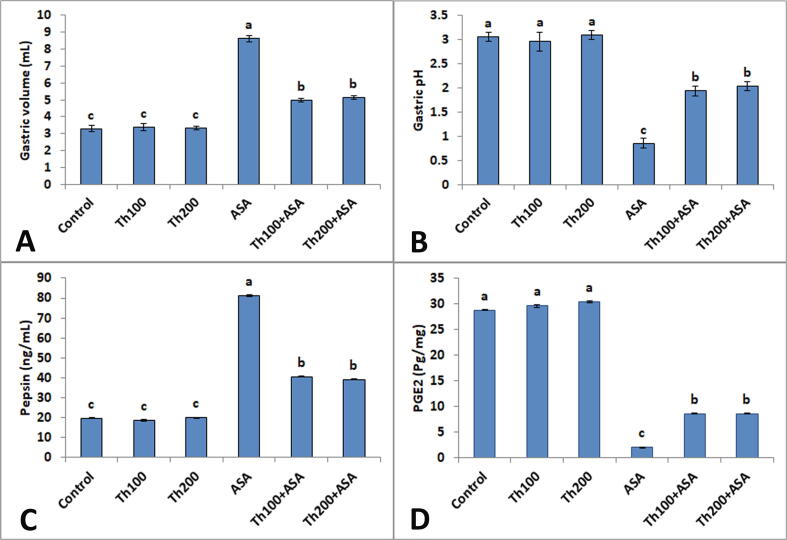
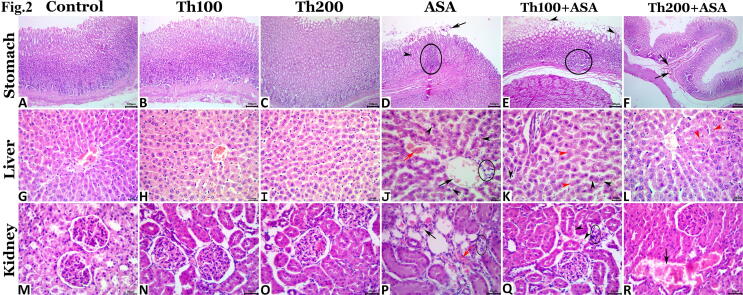
Acetylsalicylic acid (Aspirin) has been used for a long time as an antipyretic and analgesic. Nevertheless, aspirin use is associated with severe morbidity and death because of its detrimental impacts on several organs, including the liver, kidneys, and stomach. The current investigation sought to ascertain the influence of thymol in mitigating aspirin-mediated gastric and hepato-renal injury. This was done by 1) evaluating gastric juice volume and pH as well as pepsin and prostaglandin E2 level; 2) measuring serum biochemical parameters and proinflammatory cytokines; 3) determining tissue oxidant/antioxidant status, and 4) identifying a link with gastric, hepatic and renal histopathological changes. Forty-eight rats were segregated to six groups: normal control, Th100, Th200, ASA, Th100 + ASA, Th200 + ASA. Daily administration of aspirin (ASA, 150 mg/kg body weight) for 3 successive days induced a significant increase in gastric juice volume, pepsin activity, serum transaminases, alkaline phosphatase, urea, creatinine, tumor necrosis factor-α, myeloperoxidase, and tissue malondialdehyde levels. In contrast, a significant reduction in gastric pH, prostaglandin E2, tissue non-enzymatic antioxidant (glutathione), and enzymatic antioxidant (superoxide dismutase, glutathione peroxidase, and catalase) levels. These biochemical changes were accompanied by histological modifications that included changes to the normal gastric, hepatic, and renal architectures. Pretreatment and simultaneous oral treatment with thymol (100 or 200 mg/kg body weight) plus ASA significantly improved all biochemical and histological changes in a dose-dependent way. Thymol's antiinflammatory and antioxidative properties may contribute to its protective action. As a result, thymol may represent a promising medication for preventing aspirin-induced gastric, liver, and renal damage.
乙酰水杨酸(阿司匹林)长期以来一直用作解热镇痛药。然而,由于阿司匹林对包括肝脏、肾脏和胃在内的多个器官有有害影响,其使用与严重的发病率和死亡率相关。当前的研究旨在确定百里香酚在减轻阿司匹林介导的胃和肝肾损伤方面的影响。这是通过以下方式完成的:1)评估胃液体积和pH值以及胃蛋白酶和前列腺素E2水平;2)测量血清生化参数和促炎细胞因子;3)确定组织氧化/抗氧化状态,以及4)确定与胃、肝和肾组织病理学变化的关联。48只大鼠被分为六组:正常对照组、百里香酚100组、百里香酚200组、阿司匹林组、百里香酚100 + 阿司匹林组、百里香酚200 + 阿司匹林组。连续3天每天给予阿司匹林(150毫克/千克体重)导致胃液体积、胃蛋白酶活性、血清转氨酶、碱性磷酸酶、尿素、肌酐、肿瘤坏死因子-α、髓过氧化物酶和组织丙二醛水平显著增加。相比之下,胃pH值、前列腺素E2、组织非酶抗氧化剂(谷胱甘肽)和酶抗氧化剂(超氧化物歧化酶、谷胱甘肽过氧化物酶和过氧化氢酶)水平显著降低。这些生化变化伴随着组织学改变,包括正常胃、肝和肾结构的变化。用百里香酚(100或200毫克/千克体重)预处理并同时口服给药加阿司匹林以剂量依赖的方式显著改善了所有生化和组织学变化。百里香酚的抗炎和抗氧化特性可能有助于其保护作用。因此,百里香酚可能是一种有前途的预防阿司匹林引起的胃、肝和肾损伤的药物。