Duan Lian, Zhang Han-Yu, Lv Min, Zhang Han, Chen Yao, Wang Ting, Li Yan, Wu Yan, Li Junfeng, Li Kefeng
Department of Nuclear Medicine, Heping Hospital Affiliated to Changzhi Medical College, Changzhi, Shanxi, China.
Changzhi Medical College, Changzhi, Shanxi, China.
Endocr Connect. 2022 May 27;11(5):e220119. doi: 10.1530/EC-22-0119.
Radioiodine therapy (RAI) is one of the most common treatment solutions for Graves' disease (GD). However, many patients will develop hypothyroidism as early as 6 months after RAI. This study aimed to implement machine learning (ML) algorithms for the early prediction of post-RAI hypothyroidism.
Four hundred and seventy-one GD patients who underwent RAI between January 2016 and June 2019 were retrospectively recruited and randomly split into the training set (310 patients) and the validation set (161 patients). These patients were followed for 6 months after RAI. A set of 138 clinical and lab test features from the electronic medical record (EMR) were extracted, and multiple ML algorithms were conducted to identify the features associated with the occurrence of hypothyroidism 6 months after RAI.
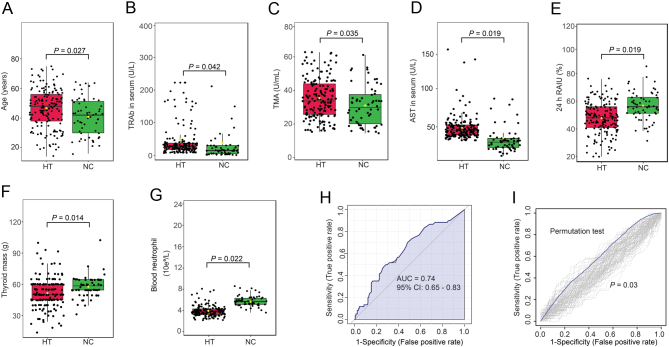
An integrated multivariate model containing patients' age, thyroid mass, 24-h radioactive iodine uptake, serum concentrations of aspartate aminotransferase, thyrotropin-receptor antibodies, thyroid microsomal antibodies, and blood neutrophil count demonstrated an area under the receiver operating curve (AUROC) of 0.72 (95% CI: 0.61-0.85), an F1 score of 0.74, and an MCC score of 0.63 in the training set. The model also performed well in the validation set with an AUROC of 0.74 (95% CI: 0.65-0.83), an F1 score of 0.74, and a MCC of 0.63. A user-friendly nomogram was then established to facilitate the clinical utility.
The developed multivariate model based on EMR data could be a valuable tool for predicting post-RAI hypothyroidism, allowing them to be treated differently before the therapy. Further study is needed to validate the developed prognostic model at independent sites.
放射性碘治疗(RAI)是格雷夫斯病(GD)最常见的治疗方法之一。然而,许多患者在接受RAI治疗后6个月内就会出现甲状腺功能减退。本研究旨在应用机器学习(ML)算法对RAI后甲状腺功能减退进行早期预测。
回顾性纳入2016年1月至2019年6月期间接受RAI治疗的471例GD患者,并随机分为训练集(310例患者)和验证集(161例患者)。这些患者在RAI治疗后随访6个月。从电子病历(EMR)中提取了一组138项临床和实验室检查特征,并采用多种ML算法来识别与RAI治疗后6个月甲状腺功能减退发生相关的特征。
一个包含患者年龄、甲状腺肿块、24小时放射性碘摄取、血清天冬氨酸转氨酶浓度、促甲状腺素受体抗体、甲状腺微粒体抗体和血液中性粒细胞计数的综合多变量模型在训练集中的受试者工作特征曲线下面积(AUROC)为0.72(95%CI:0.61-0.85),F1分数为0.74,MCC分数为0.63。该模型在验证集中也表现良好,AUROC为0.74(95%CI:0.65-0.83),F1分数为0.74,MCC为0.63。随后建立了一个用户友好的列线图以促进临床应用。
基于EMR数据开发的多变量模型可能是预测RAI后甲状腺功能减退的有价值工具,使患者在治疗前能得到不同的治疗。需要进一步研究在独立地点验证所开发的预后模型。