Department of Pathogenobiology, The Key Laboratory of Zoonosis, Chinese Ministry of Education, College of Basic Medicine, Jilin University, Changchun, China.
Cardiovascular Disease Center, The First Hospital of Jilin University, Changchun, China.
Commun Biol. 2022 May 6;5(1):425. doi: 10.1038/s42003-022-03392-y.
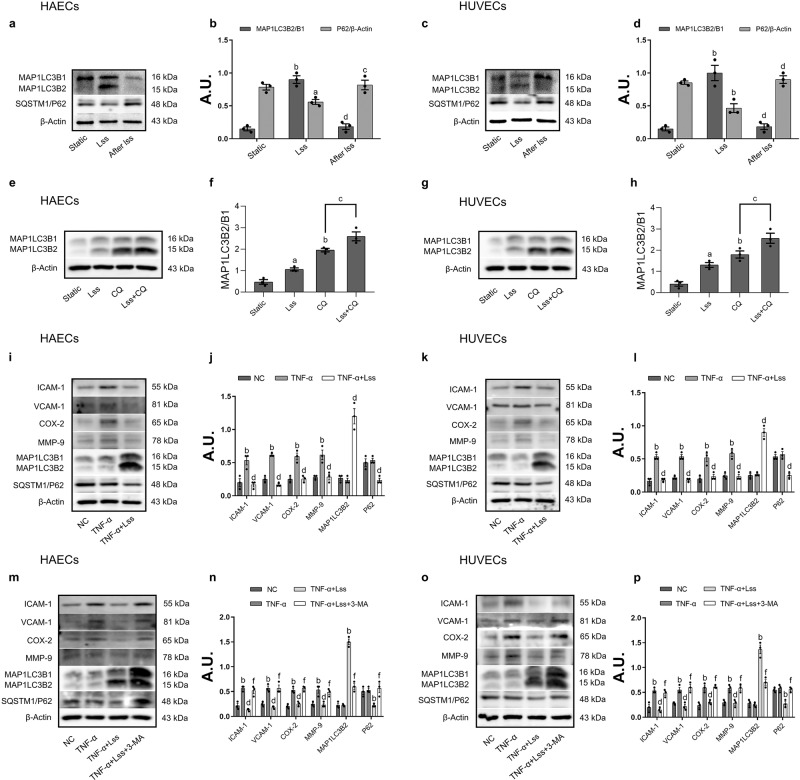
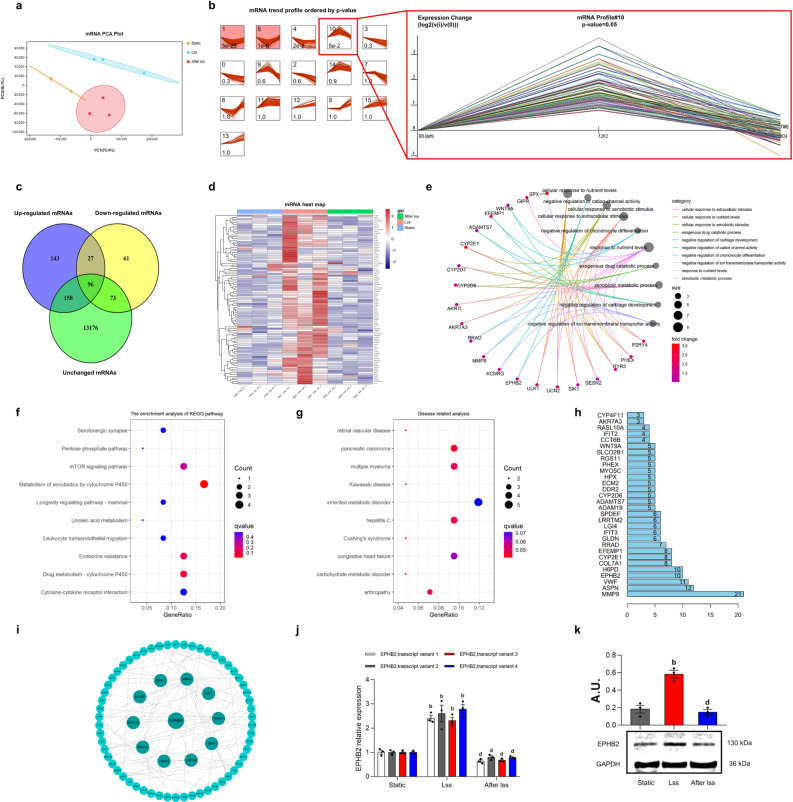
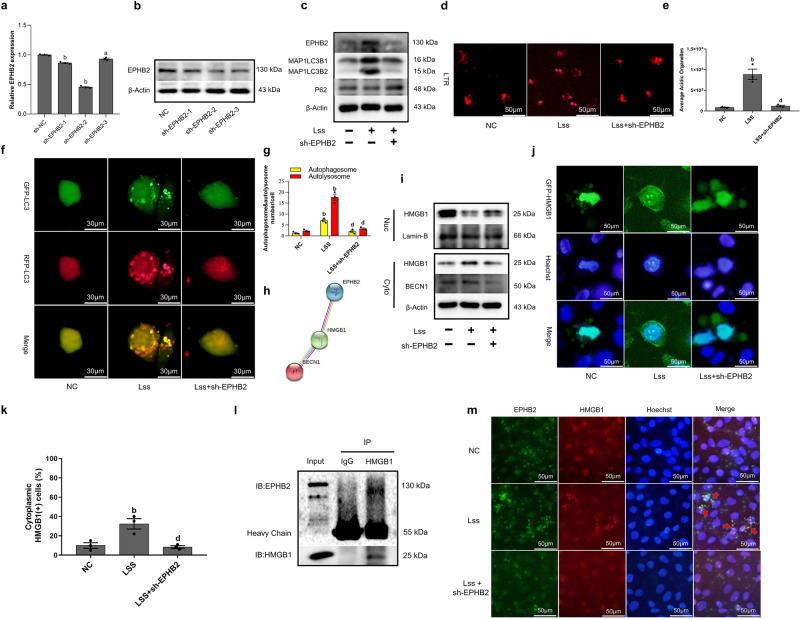
Prevention and treatment of atherosclerosis (AS) by targeting the inflammatory response in vascular endothelial cells has attracted much attention in recent years. Laminar shear stress (LSS) has well-recognized anti-AS properties, however, the exact molecular mechanism remains unclear. In this study, we found that LSS could inhibit the increased expression of intercellular adhesion molecule-1 (ICAM-1), vascular cell adhesion molecule-1 (VCAM-1), cyclooxygenase-2 (COX-2), and matrix metallopeptidase-9 (MMP-9) caused by TNF-α in an autophagy-dependent pathway in human aortic endothelial cells (HAECs) and human umbilical vein endothelial cells (HUVECs). Whole-transcriptome sequencing analysis revealed that erythropoietin-producing hepatocyte receptor B2 (EPHB2) was a key gene in response to LSS. Moreover, co-immunoprecipitation assay indicated that LSS could enhance the EPHB2-mediated nuclear translocation of high mobility group box-1 (HMGB1), which interacts with Beclin-1 (BECN1) and finally leads to autophagy. Simultaneously, we identified an LSS-sensitive long non-coding RNA (lncRNA), LOC10798635, and constructed an LSS-related LOC107986345/miR-128-3p/EPHB2 regulatory axis. Further research revealed the anti-inflammatory effect of LSS depends on autophagy activation resulting from the nuclear translocation of HMGB1 via the LOC107986345/miR-128-3p/EPHB2 axis. Our study demonstrates that LSS could regulate the expression of EPHB2 in HAECs, and the LOC107986345/miR-128-3p/EPHB2 axis plays a vital role in AS development.
近年来,针对血管内皮细胞炎症反应预防和治疗动脉粥样硬化(AS)引起了广泛关注。层流剪切力(LSS)具有公认的抗 AS 特性,但确切的分子机制尚不清楚。在这项研究中,我们发现 LSS 可以通过自噬依赖性途径抑制 TNF-α引起的人主动脉内皮细胞(HAECs)和人脐静脉内皮细胞(HUVECs)中细胞间黏附分子-1(ICAM-1)、血管细胞黏附分子-1(VCAM-1)、环氧化酶-2(COX-2)和基质金属蛋白酶-9(MMP-9)的表达增加。全转录组测序分析显示,促红细胞生成素产生肝细胞受体 B2(EPHB2)是对 LSS 反应的关键基因。此外,免疫共沉淀实验表明,LSS 可以增强 EPHB2 介导的高迁移率族蛋白 B1(HMGB1)的核转位,HMGB1 与 Beclin-1(BECN1)相互作用,最终导致自噬。同时,我们鉴定了一种 LSS 敏感的长链非编码 RNA(lncRNA),LOC10798635,并构建了一个与 LSS 相关的 LOC107986345/miR-128-3p/EPHB2 调控轴。进一步的研究表明,LSS 的抗炎作用依赖于自噬的激活,而自噬的激活则是由于 HMGB1 通过 LOC107986345/miR-128-3p/EPHB2 轴的核转位所致。我们的研究表明,LSS 可以调节 HAECs 中 EPHB2 的表达,而 LOC107986345/miR-128-3p/EPHB2 轴在 AS 发展中起着至关重要的作用。