Inflammatory Disease Section, National Human Genome Research Institute, National Institutes of Health, Bethesda, MD, USA.
Center for Human Genetics and Genomics, New York University, New York, NY, USA.
Nat Rev Rheumatol. 2022 Aug;18(8):435-447. doi: 10.1038/s41584-022-00778-4. Epub 2022 May 6.
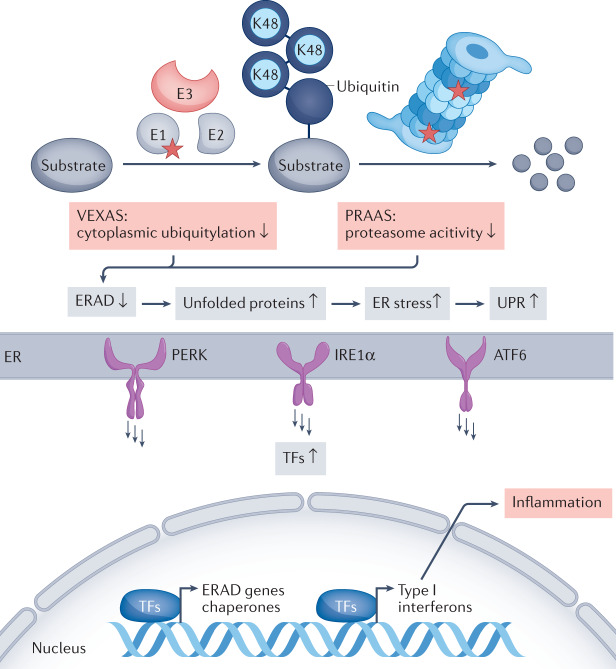
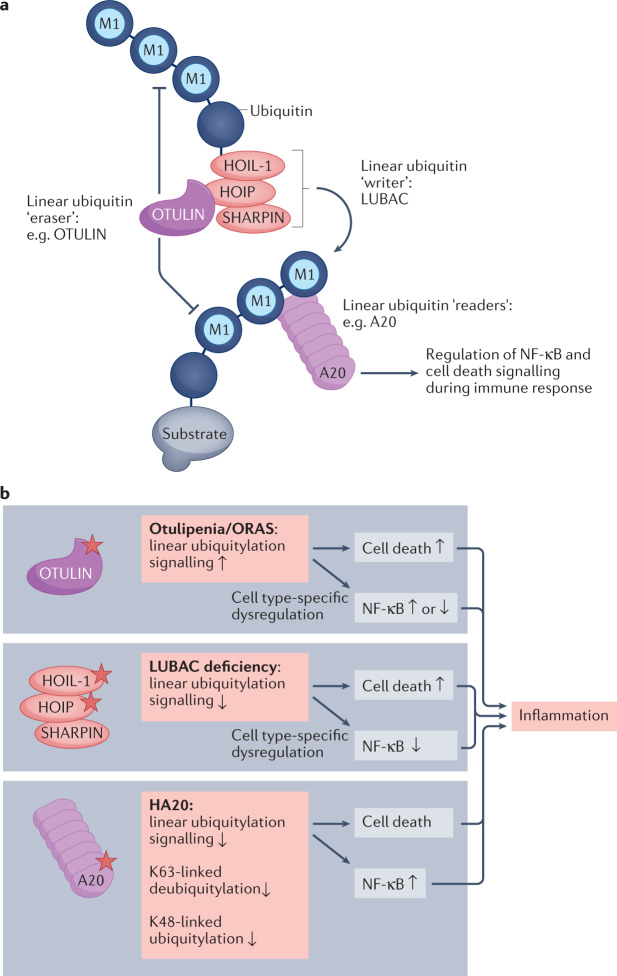
Ubiquitylation is an essential post-translational modification that regulates intracellular signalling networks by triggering proteasomal substrate degradation, changing the activity of substrates or mediating changes in proteins that interact with substrates. Hundreds of enzymes participate in reversible ubiquitylation of proteins, some acting globally and others targeting specific proteins. Ubiquitylation is essential for innate immune responses, as it facilitates rapid regulation of inflammatory pathways, thereby ensuring sufficient but not excessive responses. A growing number of inborn errors of immunity are attributed to dysregulated ubiquitylation. These genetic disorders exhibit broad clinical manifestations, ranging from susceptibility to infection to autoinflammatory and/or autoimmune features, lymphoproliferation and propensity to malignancy. Many autoinflammatory disorders result from disruption of components of the ubiquitylation machinery and lead to overactivation of innate immune cells. An understanding of the disorders of ubiquitylation in autoinflammatory diseases could enable the development of novel management strategies.
泛素化是一种重要的翻译后修饰,通过触发蛋白酶体底物降解来调节细胞内信号网络,改变底物的活性或介导与底物相互作用的蛋白质的变化。数百种酶参与蛋白质的可逆泛素化,有些酶作用于全局,而有些酶则针对特定蛋白质。泛素化对于先天免疫反应至关重要,因为它促进了炎症途径的快速调节,从而确保了足够但不过度的反应。越来越多的先天性免疫缺陷归因于泛素化的失调。这些遗传疾病表现出广泛的临床表现,从易感染到自身炎症和/或自身免疫特征、淋巴增生和恶性肿瘤倾向。许多自身炎症性疾病是由于泛素化机制成分的破坏导致先天免疫细胞过度激活引起的。对自身炎症性疾病中泛素化紊乱的认识可能会促使新的治疗策略的发展。