Service de Psychiatrie de l'Enfant et de l'Adolescent, FHU NEUROGENΨCS, Fédération de Médecine Translationnelle de Strasbourg (FMTS), University Hospital and Medical School of Strasbourg, INSERM 1114, GIS Autisme et TND, Centre d'Excellence STRAS&ND, Strasbourg, France.
GIS Autisme et TND, Centre d'Excellence STRAS&ND, Strasbourg, France.
BMC Psychiatry. 2022 May 6;22(1):323. doi: 10.1186/s12888-022-03924-0.
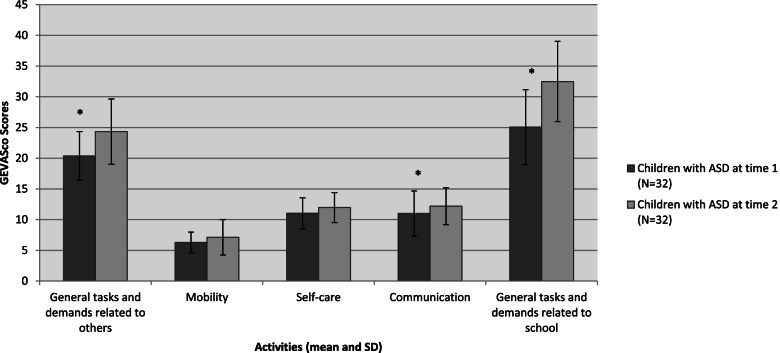
Previous studies about Quality of Life (QoL) in autistic children (ASD) have put forward the negative impact of factors such as Autism Spectrum Disorder (ASD) severity, psychiatric comorbidities and adaptive behaviour impairment. However, little is known about the relation of these factors to school adjustment, measured with the International Classification of Functions disability and health (ICF) framework (World Health Organization, 2001), and QoL evolutions. Thus, this study aimed at investigating the determinants of behaviours, school adjustment and QoL changes in 32 children in an ASD inclusion program over one academic year.
Using Bayesian methods, we studied the impact of ASD severity, psychiatric comorbidities, adaptive behaviour level and a diagnosis of Pathological Demand Avoidance (PDA) on evolutions of behaviour, school adjustment (measured with the ICF) and QoL.
As predicted, adequate adaptive behaviour levels were associated with better progress of behaviours and school adjustment whereas psychiatric comorbidities were related to worse outcome of school adjustment. Contrary to our hypotheses, severe ASD was associated to better evolution of adjustment at school. PDA was not discriminant. We did not find any association between the studied factors and the evolution of QoL over the academic year.
Our results show that the assessment of adaptive behaviour levels, psychiatric comorbidities and ASD severity level may be useful predictors to discriminate of school adjustment evolution (assessed by teachers within the ICF model) over a one-year period in autistic children. The assessment of this time course of school adjustment was sensitive to change and adapted to differentiate evolutions in an inclusive education framework. The investigation of quality of school life of autistic children as well as its determinants may therefore be relevant to improving academic adaptation. However, further research in larger groups, over longer periods and in different personalized school settings for autistic children is needed.
先前关于自闭症谱系障碍(ASD)儿童生活质量(QoL)的研究提出了自闭症严重程度、精神共病和适应行为障碍等因素的负面影响。然而,对于这些因素与学校适应的关系(使用国际功能、残疾和健康分类(ICF)框架(世界卫生组织,2001 年)和 QoL 变化)知之甚少。因此,本研究旨在调查自闭症融合项目中 32 名儿童在一个学年内行为、学校适应和 QoL 变化的决定因素。
使用贝叶斯方法,我们研究了自闭症严重程度、精神共病、适应行为水平和病理性需求回避(PDA)诊断对行为、学校适应(使用 ICF 衡量)和 QoL 变化的影响。
正如预测的那样,适当的适应行为水平与行为和学校适应的更好进展相关,而精神共病与学校适应的更差结果相关。与我们的假设相反,严重的 ASD 与更好的学校调整进展相关。PDA 没有区别。我们没有发现研究因素与学年内 QoL 的演变之间存在任何关联。
我们的研究结果表明,评估适应行为水平、精神共病和 ASD 严重程度可能是有用的预测指标,可以区分自闭症儿童在一年内学校适应的演变(由教师在 ICF 模型内评估)。对这段时间内学校适应的评估对变化敏感,并适应于在融合教育框架中区分进展。因此,对自闭症儿童的学校生活质量及其决定因素的调查可能有助于改善学业适应。然而,需要在更大的群体中、更长的时间内和在不同的自闭症儿童个性化学校环境中进行进一步的研究。