Headache Center of Southern California, Carlsbad, California, USA.
Lundbeck LLC, Deerfield, Illinois, USA.
Headache. 2022 May;62(5):558-565. doi: 10.1111/head.14302. Epub 2022 May 6.
To develop a multivariable model assessing factors predicting a second-dose response to eptinezumab treatment over weeks 13-24 in patients with migraine initially reporting a suboptimal response over weeks 1-12.
Eptinezumab is a monoclonal antibody used for migraine prevention, administered every 12 weeks. In the PROMISE-1 and PROMISE-2 studies, the first-dose response to eptinezumab treatment (≥50% monthly migraine day [MMD] reduction over weeks 1-12) occurred in ~50-60% of patients with episodic (EM) and chronic migraine (CM), respectively.
This post hoc analysis included patients with suboptimal first-dose response (<50% MMD reduction over weeks 1-12) with EM and CM, with patient-reported outcome data at weeks 12 and 24. Eptinezumab 100 and 300 mg doses were pooled.
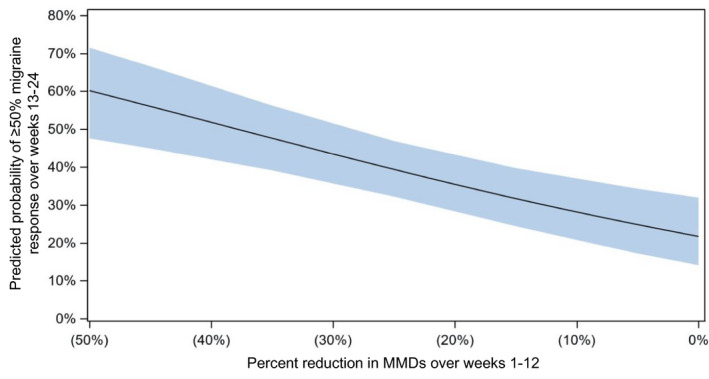
The analysis included 416/888 patients (46.8%) from PROMISE-1 and 479/1072 patients (44.7%) from PROMISE-2 with suboptimal first-dose response. The proportion of suboptimal first-dose responders who were second-dose responders was 37.0% (71/192; eptinezumab) and 33.9% (42/124; placebo) in PROMISE-1 and 28.8% (79/274) and 18.5% (38/205) in PROMISE-2. Significant first-dose predictors of second-dose response were percent change in MMDs across weeks 1-12 (PROMISE-1, odds ratio [OR]: 0.97, 95% confidence interval [CI]: 0.95, 0.98, p = 0.0001; PROMISE-2, OR: 0.94, CI: 0.92, 0.96, p < 0.0001) and change in 6-item Headache Impact Test (HIT-6) total score (PROMISE-2 only, OR: 0.92; CI: 0.87, 0.98; p = 0.027). In PROMISE-1, the probability of second-dose response ranged from 21.7% in patients with first-dose 0% MMD change to 56.0% in patients with first-dose 45% MMD reduction. In PROMISE-2, depending on HIT-6 total score, probability of second-dose response ranged from 5.9-12.1% in patients with first-dose 0% MMD change to 54.2%-72.3% in patients with first-dose 45.0% MMD reduction.
Individuals with migraine not experiencing ≥50% MMD response to their first dose of eptinezumab may benefit from a second dose.
开发一个多变量模型,评估偏头痛患者在第 1 至 12 周首次治疗反应不佳的情况下,第 13 至 24 周接受依替尼单抗治疗的第二剂反应的预测因素。
依替尼单抗是一种用于偏头痛预防的单克隆抗体,每 12 周给药一次。在 PROMISE-1 和 PROMISE-2 研究中,依替尼单抗治疗的第一剂反应(第 1 至 12 周每月偏头痛天数[MMD]减少≥50%)分别发生在约 50-60%的发作性偏头痛(EM)和慢性偏头痛(CM)患者中。
本事后分析包括首次治疗反应不佳(第 1 至 12 周 MMD 减少<50%)的 EM 和 CM 患者,以及在第 12 周和第 24 周报告患者报告结局数据的患者。依替尼单抗 100mg 和 300mg 剂量被合并。
该分析包括 PROMISE-1 中 416/888 名(46.8%)和 PROMISE-2 中 479/1072 名(44.7%)首次治疗反应不佳的患者。首次治疗反应不佳的患者中,第二次治疗反应者的比例为 37.0%(192 例中的 71 例;依替尼单抗)和 33.9%(124 例中的 42 例;安慰剂)在 PROMISE-1 中,和 28.8%(274 例中的 79 例)和 18.5%(205 例中的 38 例)在 PROMISE-2 中。第二剂反应的显著首次治疗预测因素是第 1 至 12 周 MMD 变化的百分比(PROMISE-1,优势比[OR]:0.97,95%置信区间[CI]:0.95,0.98,p=0.0001;PROMISE-2,OR:0.94,CI:0.92,0.96,p<0.0001)和 6 项头痛影响测试(HIT-6)总分的变化(仅在 PROMISE-2 中,OR:0.92;CI:0.87,0.98;p=0.027)。在 PROMISE-1 中,第二剂反应的概率范围为首次治疗 MMD 变化为 0%的患者的 21.7%至首次治疗 MMD 减少 45%的患者的 56.0%。在 PROMISE-2 中,根据 HIT-6 总分,第二剂反应的概率范围为首次治疗 MMD 变化为 0%的患者的 5.9-12.1%至首次治疗 MMD 减少 45.0%的患者的 54.2%-72.3%。
首次接受依替尼单抗治疗后 MMD 缓解率未达到≥50%的偏头痛患者可能受益于第二剂治疗。