Department of Psychiatry, Social Psychiatry and Psychotherapy, Hannover Medical School, Carl-Neuberg-Straße 1, 30625, Hannover, Germany.
Department of Psychiatry and Psychotherapy, KRH Psychiatrie GmbH, Wunstorf, Germany.
J Neural Transm (Vienna). 2022 Jul;129(7):925-944. doi: 10.1007/s00702-022-02504-6. Epub 2022 May 7.
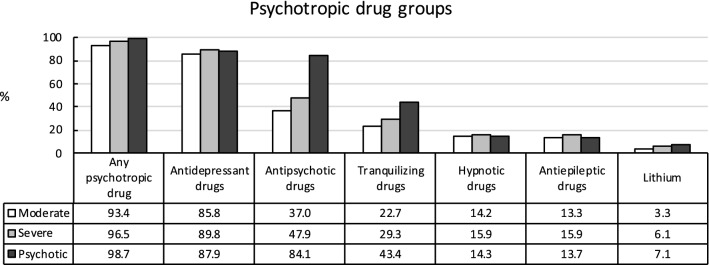
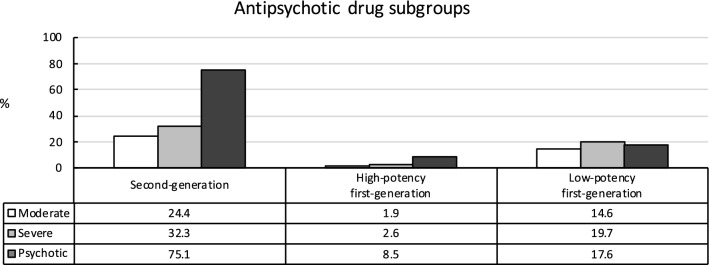
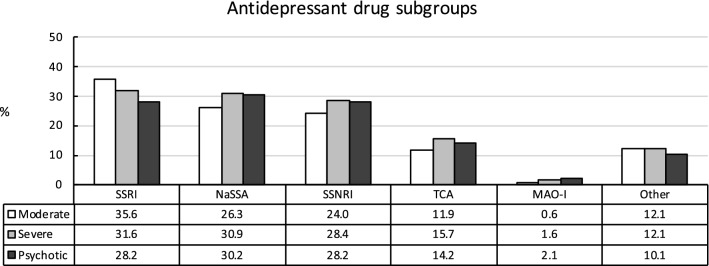
The International Classification of Diseases (10 Version) categorizes major depressive disorder (MDD) according to severity. Guidelines provide recommendations for the treatment of MDD according to severity. Aim of this study was to assess real-life utilization of psychotropic drugs based on severity of MDD in psychiatric inpatients. Drug utilization data from the program "Drug Safety in Psychiatry" (German: Arzneimittelsicherheit in der Psychiatrie, AMSP) were analyzed according to the severity of MDD. From 2001 to 2017, 43,868 psychiatric inpatients with MDD were treated in participating hospitals. Most patients were treated with ≥ 1 antidepressant drug (ADD; 85.8% of patients with moderate MDD, 89.8% of patients with severe MDD, and 87.9% of patients with psychotic MDD). More severely depressed patients were more often treated with selective serotonin-norepinephrine reuptake inhibitors and mirtazapine and less often with selective serotonin reuptake inhibitors (p < 0.001 each). Use of antipsychotic drugs (APDs), especially second-generation APDs, increased significantly with severity (37.0%, 47.9%, 84.1%; p < 0.001 each). APD + ADD was the most used combination (32.8%, 43.6%, 74.4%), followed by two ADDs (26.3%, 29.3%, 24.9%). Use of lithium was minimal (3.3%, 6.1% ,7.1%). The number of psychotropic drugs increased with severity of MDD-patients with psychotic MDD had the highest utilization of psychotropic drugs (93.4%, 96.5%, 98.7%; p < 0.001). ADD monotherapy was observed to a lesser extent, even in patients with non-severe MDD (23.2%, 17.1%, 4.4%). Findings reveal substantial discrepancies between guideline recommendations and real-life drug utilization, indicating that guidelines may insufficiently consider clinical needs within the psychiatric inpatient setting.
《国际疾病分类》(第 10 版)根据严重程度对重度抑郁症(MDD)进行分类。指南根据严重程度为 MDD 提供了治疗建议。本研究的目的是根据 MDD 的严重程度评估精神科住院患者使用精神药物的真实情况。根据 MDD 的严重程度,分析了来自“精神病学药物安全”(德语:Arzneimittelsicherheit in der Psychiatrie,AMS)计划的药物使用数据。2001 年至 2017 年,43868 名患有 MDD 的精神科住院患者在参与医院接受治疗。大多数患者接受了≥1 种抗抑郁药(ADD;中度 MDD 患者的 85.8%、重度 MDD 患者的 89.8%和精神病性 MDD 患者的 87.9%)。病情较重的患者更常接受选择性 5-羟色胺去甲肾上腺素再摄取抑制剂和米氮平治疗,而较少接受选择性 5-羟色胺再摄取抑制剂治疗(p<0.001)。抗精神病药物(APD)的使用,尤其是第二代 APD,随着严重程度的增加而显著增加(37.0%、47.9%、84.1%;p<0.001)。APD+ADD 是最常用的组合(32.8%、43.6%、74.4%),其次是两种 ADD(26.3%、29.3%、24.9%)。锂的使用量最小(3.3%、6.1%、7.1%)。随着 MDD 患者的严重程度增加,精神药物的数量也增加——精神病性 MDD 患者使用精神药物的比例最高(93.4%、96.5%、98.7%;p<0.001)。即使在非严重 MDD 患者中,ADD 单药治疗的比例也较低(23.2%、17.1%、4.4%)。研究结果表明,指南建议与现实生活中的药物使用之间存在显著差异,这表明指南可能没有充分考虑到精神病住院患者的临床需求。