CF Centre Cologne, Children's Hospital, Faculty of Medicine and University of Cologne, Kerpener Str. 62, 50937, Cologne, Germany.
Translational Experimental Pediatrics - Experimental Pulmonology, Department of Pediatric and Adolescent Medicine, Center for Molecular Medicine Cologne (CMMC), and Cologne Excellence Cluster for Stress Responses in Ageing-Associated Diseases (CECAD), Faculty of Medicine and University Hospital Cologne, University of Cologne, Cologne, Germany.
BMC Pulm Med. 2022 May 7;22(1):183. doi: 10.1186/s12890-022-01977-1.
Transforming Growth Factor-β (TGF-β) is a genetic modifier in patients with cystic fibrosis (CF). Several single nucleotide polymorphisms (SNPs) of TGF-β are associated with neutrophilic inflammation, lung fibrosis and loss of pulmonary function.
The aim of this study was to assess the relationship between genetic TGF-β polymorphisms and pulmonary disease progression in CF patients. Furthermore, the effect of TGF-β polymorphisms on inflammatory cytokines in sputum was investigated.
56 CF-patients and 62 controls were genotyped for three relevant SNPs in their TGF-β sequence using the SNaPshot® technique. Individual "slopes" in forced expiratory volume in 1 s (FEV) for all patients were calculated by using documented lung function values of the previous five years. The status of Pseudomonas aeruginosa (Pa) infection was determined. Sputum concentrations of the protease elastase, the serine protease inhibitor elafin and the cytokines IL-1β, IL-8, IL-6, TNF-α were measured after a standardized sputum induction and processing.
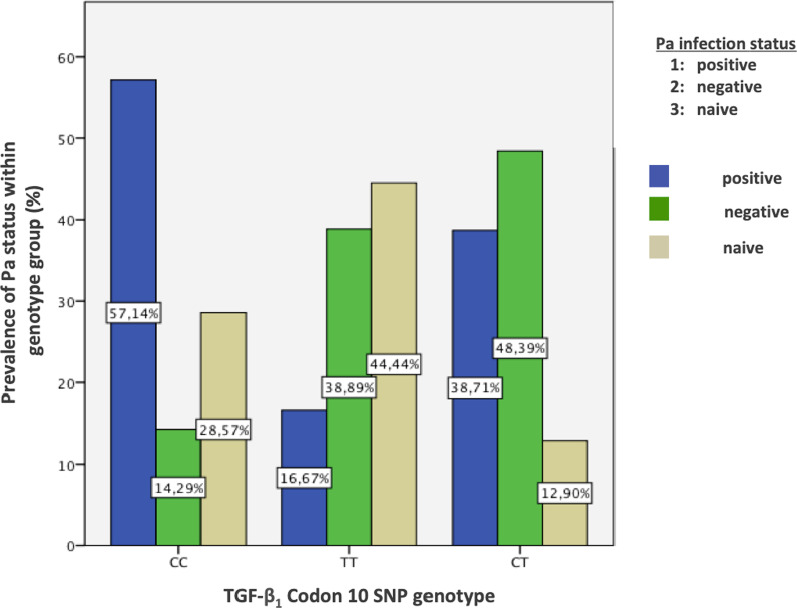
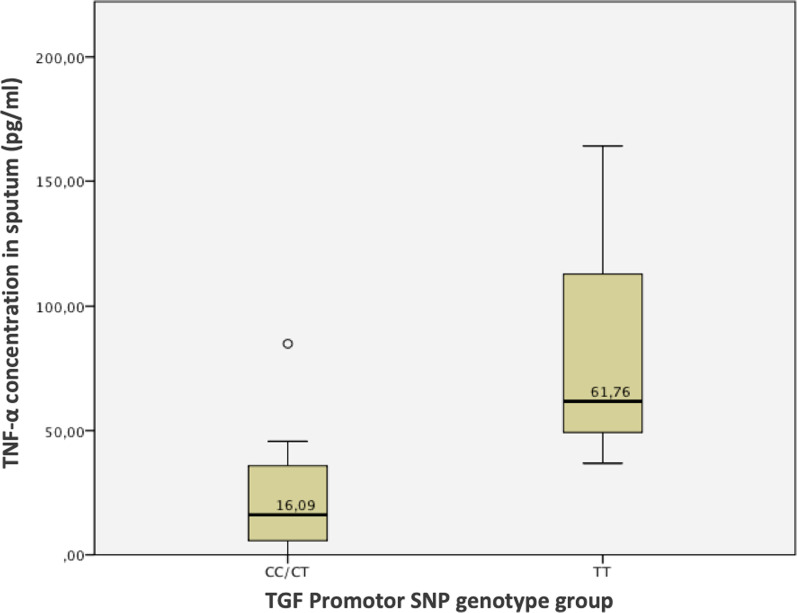
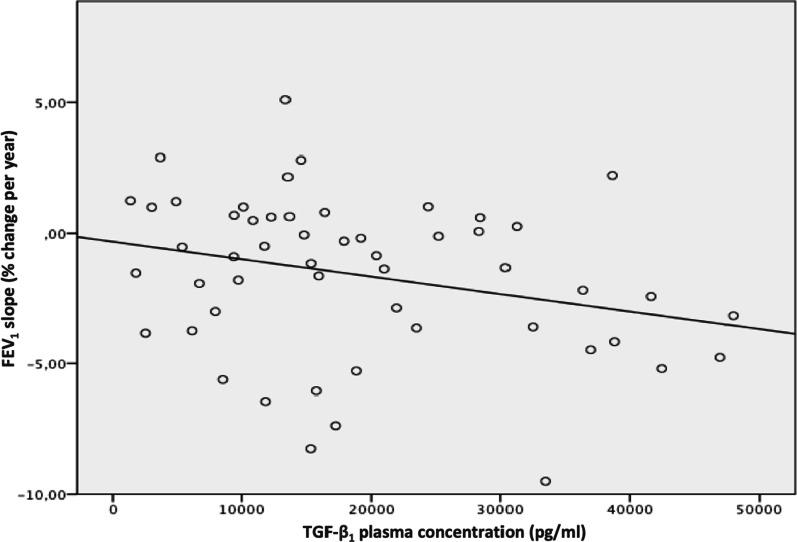
The homozygous TT genotype at codon 10 was associated with a lower rate of chronic Pa infection (p < 0.05). The heterozygous GC genotype at codon 25 was associated with lower lung function decline (p < 0.05). Patients with homozygous TT genotype at the promotor SNP showed higher levels of TNF-α (p < 0,05). Higher levels of TGF-β in plasma were associated with a more rapid FEV decline over five years (p < 0.05).
Our results suggest that polymorphisms in the TGF-β gene have an effect on lung function decline, Pa infection as well as levels of inflammatory cytokines. Genotyping these polymorphisms could potentially be used to identify CF patients with higher risk of disease progression. TGF-β inhibition could potentially be developed as a new therapeutic option to modulate CF lung disease.
转化生长因子-β(TGF-β)是囊性纤维化(CF)患者的遗传修饰因子。TGF-β 的几个单核苷酸多态性(SNP)与中性粒细胞炎症、肺纤维化和肺功能丧失有关。
本研究旨在评估 CF 患者中遗传 TGF-β 多态性与肺部疾病进展的关系。此外,还研究了 TGF-β 多态性对痰中炎症细胞因子的影响。
使用 SNaPshot®技术,对 56 名 CF 患者和 62 名对照者的 TGF-β 序列中的三个相关 SNP 进行基因分型。通过使用前五年的记录肺功能值,计算所有患者 1 秒用力呼气量(FEV)的个体“斜率”。确定铜绿假单胞菌(Pa)感染的状态。标准化痰液诱导和处理后,测量痰液中弹性蛋白酶、丝氨酸蛋白酶抑制剂 Elafin 以及细胞因子 IL-1β、IL-8、IL-6、TNF-α的浓度。
密码子 10 处的 TT 纯合子与慢性 Pa 感染的发生率较低相关(p<0.05)。密码子 25 处的杂合 GC 基因型与较低的肺功能下降相关(p<0.05)。启动子 SNP 处 TT 纯合子的患者 TNF-α 水平较高(p<0.05)。血浆中 TGF-β 水平较高与五年内 FEV 下降较快相关(p<0.05)。
我们的结果表明,TGF-β 基因多态性对肺功能下降、Pa 感染以及炎症细胞因子水平有影响。对这些多态性进行基因分型可能有助于识别 CF 患者中疾病进展风险较高的患者。TGF-β 抑制可能作为一种新的治疗选择,用于调节 CF 肺部疾病。