Gömer André, Puff Christina, Reinecke Birthe, Bracht Stephanie, Conze Maria, Baumgärtner Wolfgang, Steinmann Jörg, Feige Karsten, Cavalleri Jessika M V, Steinmann Eike, Todt Daniel
Department of Molecular and Medical Virology, Ruhr University Bochum, Bochum, Germany.
Institute of Virology, University of Veterinary Medicine Hannover, Foundation, Hannover, Germany.
One Health Outlook. 2022 May 9;4(1):9. doi: 10.1186/s42522-022-00065-y.
The Equine Hepacivirus (EqHV) is an equine-specific and liver-tropic virus belonging to the diverse genus of Hepaciviruses. It was recently found in a large donkey (Equus asinus) cohort with a similar seroprevalence (30%), but lower rate of RNA-positive animals (0.3%) compared to horses. These rare infection events indicate either a lack of adaptation to the new host or a predominantly acute course of infection.
In order to analyze the susceptibility and the course of EqHV infection in donkeys, we inoculated two adult female donkeys and one control horse intravenously with purified EqHV from a naturally infected horse. Liver biopsies were taken before and after inoculation to study changes in the transcriptome.
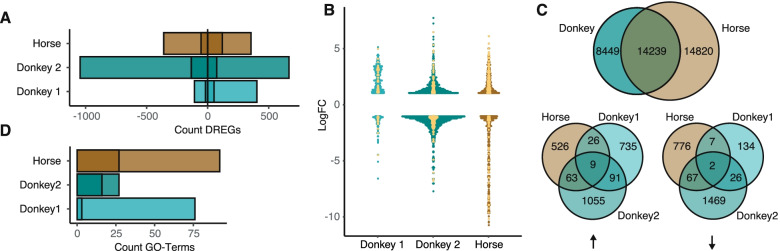
Infection kinetics were similar between the equids. All animals were EqHV PCR-positive from day three. EqHV RNA-levels declined when the animals seroconverted and both donkeys cleared the virus from the blood by week 12. Infection did not have an impact on the clinical findings and no significant histopathological differences were seen. Blood biochemistry revealed a mild increase in GLDH at the time of seroconversion in horses, which was less pronounced in donkeys. Transcriptomic analysis revealed a distinct set of differentially expressed genes, including viral host factors and immune genes.
To summarize, our findings indicate that donkeys are a natural host of EqHV, due to the almost identical infection kinetics. The different immune responses do however suggest different mechanisms in reacting to hepaciviral infections.
马肝炎病毒(EqHV)是一种马特异性且嗜肝的病毒,属于肝炎病毒属。最近在一大群驴(Equus asinus)中发现了该病毒,其血清阳性率相似(30%),但与马相比,RNA阳性动物的比例较低(0.3%)。这些罕见的感染事件表明要么是对新宿主缺乏适应性,要么是感染主要呈急性病程。
为了分析驴对EqHV感染的易感性和病程,我们给两头成年雌性驴和一匹对照马静脉注射了从自然感染马中纯化的EqHV。在接种前后进行肝脏活检以研究转录组的变化。
马属动物之间的感染动力学相似。所有动物从第三天起EqHV PCR检测呈阳性。当动物血清转化时,EqHV RNA水平下降,并且两头驴在第12周时血液中的病毒被清除。感染对临床结果没有影响,也未观察到明显的组织病理学差异。血液生化分析显示,马在血清转化时GLDH略有升高,而在驴中则不那么明显。转录组分析揭示了一组独特的差异表达基因,包括病毒宿主因子和免疫基因。
总之,我们的研究结果表明,由于感染动力学几乎相同,驴是EqHV的天然宿主。然而,不同的免疫反应表明在对肝炎病毒感染的反应中存在不同的机制。