Tahara Haruna, Yamagiwa Yoshinori, Haranosono Yu, Kurata Masaaki
Research & Development Division, Senju Pharmaceutical Co., Ltd., 6-4-3, Minatojima-Minamimachi, Chuo-Ku, Kobe, Hyogo, 650-0047, Japan.
Genes Environ. 2022 May 9;44(1):14. doi: 10.1186/s41021-022-00243-4.
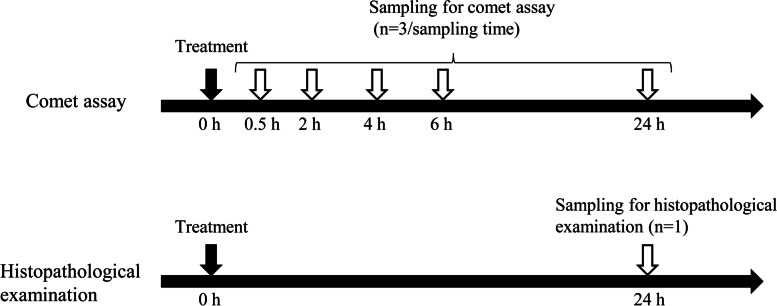
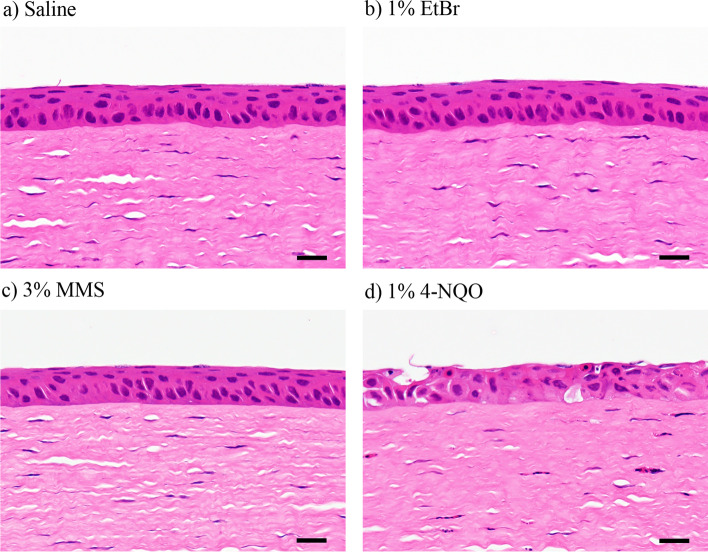
In eye-drop drug development, the additional genotoxicity tests in some cases might be necessary to assess genotoxicity in the ocular surface since the ocular surface is exposed directly to high drug concentrations. Recently, an in vivo comet assay using corneal epithelial cells in rabbits following single ocular instillation was developed as an assay to evaluate genotoxicity in ocular tissues. In this study, we investigated the time-course changes in DNA damage after ocular instillation of genotoxic compounds to evaluate the optimal sampling timing for in vivo comet assay of the ocular surface tissue. Ethidium bromide (EtBr), methyl methanesulfonate (MMS), and 4-nitroquinoline 1-oxide (4-NQO) were administered to the eyes of the rabbits. Corneas were collected at 0.5, 2, 4, 6, and 24 h after administration, and the comet assay was performed. In addition, the in vitro comet assay was performed to assess the time-course changes in DNA damage induced by short-time exposure to the genotoxic compounds.
The mean % tail DNA, which is an indicator for DNA damage, in the corneal epithelial cells treated with all compounds exhibited statistically significant increases compared with those in the negative controls of saline at 0.5, 2, 4, and 6 h. There was a difference in the DNA damage response between EtBr and the other two compounds. In the 3% MMS- and 1% 4-NQO-treated eyes, the values of the % tail DNA were the highest at 0.5 h and then decreased gradually. In contrast, in the 1% EtBr-treated eyes, the highest value was noted at 4 h. The results of the in vitro comet assay showed that the % tail DNA increased in all groups. A further increase in the % tail DNA occurred in the EtBr-treated cells even after removing the compound but not in the MMS- and 4-NQO-treated cells.
Relatively high values of the % tail DNA were maintained from 0.5 to 6 h after administration, suggesting that the optimal sampling time is any one point from 0.5 to 6 h in the comet assay of the corneal surface.
在滴眼液药物研发中,由于眼表直接暴露于高药物浓度下,某些情况下可能需要额外的遗传毒性试验来评估眼表的遗传毒性。最近,一种在兔单次眼内滴注后使用角膜上皮细胞的体内彗星试验被开发出来,作为评估眼组织遗传毒性的一种方法。在本研究中,我们研究了眼内滴注遗传毒性化合物后DNA损伤的时间进程变化,以评估眼表组织体内彗星试验的最佳采样时间。将溴化乙锭(EtBr)、甲基磺酸甲酯(MMS)和4-硝基喹啉-1-氧化物(4-NQO)滴入兔眼。给药后0.5、2、4、6和24小时收集角膜,并进行彗星试验。此外,进行体外彗星试验以评估短时间暴露于遗传毒性化合物引起的DNA损伤的时间进程变化。
与生理盐水阴性对照组相比,所有化合物处理的角膜上皮细胞中作为DNA损伤指标的平均尾DNA百分比在0.5、2、4和6小时均有统计学显著增加。EtBr与其他两种化合物之间的DNA损伤反应存在差异。在3% MMS和1% 4-NQO处理的眼中,尾DNA百分比值在0.5小时最高,然后逐渐下降。相比之下,在1% EtBr处理的眼中,最高值出现在4小时。体外彗星试验结果显示所有组的尾DNA百分比均增加。即使去除化合物后,EtBr处理的细胞中尾DNA百分比仍进一步增加,但MMS和4-NQO处理的细胞中没有。
给药后0.5至6小时维持相对较高的尾DNA百分比值,表明在角膜表面彗星试验中,最佳采样时间为0.5至6小时中的任一点。