Seritan Andreea L, Iosif Ana-Maria, Prakash Prarthana, Wang Sarah S, Eisendrath Stuart
Department of Psychiatry and Behavioral Sciences, University of California, San Francisco, CA USA.
UCSF Weill Institute for Neurosciences, San Francisco, CA USA.
J Technol Behav Sci. 2022;7(3):381-395. doi: 10.1007/s41347-022-00261-7. Epub 2022 May 2.
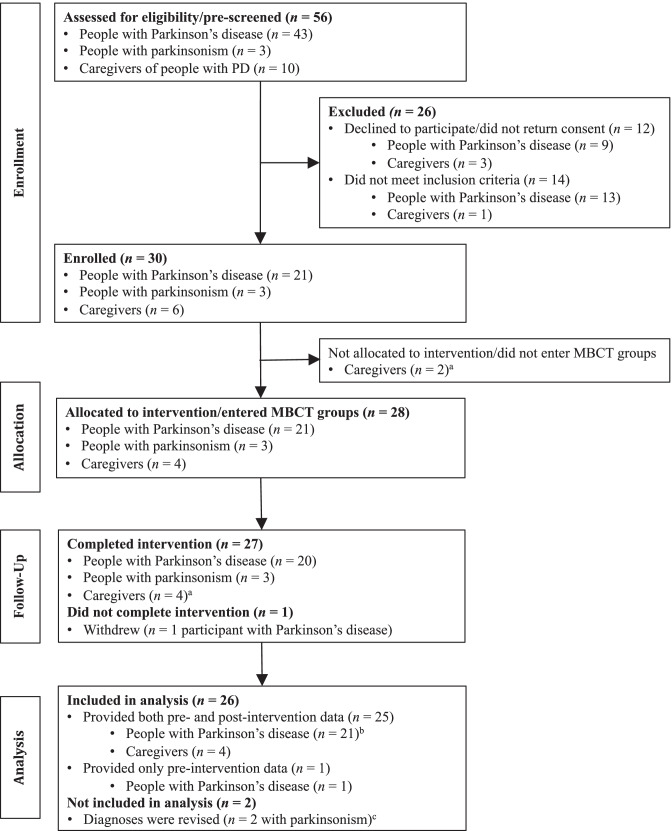
Anxiety and depression are common non-motor symptoms of Parkinson's disease (PD). Caregivers of people with PD may experience severe caregiver burden. This study explored the feasibility and potential benefits of an online mindfulness-based cognitive therapy (MBCT) intervention for improving anxiety and depressive symptoms in people with PD and their caregivers (ClinicalTrials.gov NCT04469049, 7/8/2020). People with PD or parkinsonism and anxiety and/or depressive symptoms and caregivers of people with PD participated in one of three online MBCT groups. Demographic variables, pre- and post-MBCT behavioral measures (GAD-7, PHQ-9, Five Facet Mindfulness Questionnaire - FFMQ-15, Caregiver Self-Assessment Questionnaire - CSAQ), and satisfaction surveys were collected. Descriptive statistics were used to summarize data. Pre- and post-MBCT behavioral scores were compared using mixed-effect models. Fifty-six potential participants were assessed for eligibility. Twenty-eight entered MBCT groups; all but one completed the intervention. The overall sample analyzed (22 people with PD, 4 caregivers) showed significant GAD-7 and PHQ-9 score reductions and FFMQ-15 total and observing and non-reactivity subscale score increases (all 's < 0.05). Participants with PD and anxiety symptoms ( = 14) had a significant GAD-7 score reduction; those with PD and depressive symptoms ( = 12) had a significant PHQ-9 score reduction (both 's < 0.05). Participants with PD also had a significant FFMQ-15 observing subscale score increase ( < 0.05). The caregiver sample was too small to be analyzed separately. Online MBCT is feasible (as measured by high attendance, completion rate, and participant satisfaction) and may be effective in improving anxiety and depressive symptoms in people with PD.
焦虑和抑郁是帕金森病(PD)常见的非运动症状。帕金森病患者的照料者可能会承受严重的照料负担。本研究探讨了基于正念的在线认知疗法(MBCT)干预改善帕金森病患者及其照料者焦虑和抑郁症状的可行性及潜在益处(ClinicalTrials.gov NCT04469049,2020年7月8日)。患有帕金森病或帕金森综合征且伴有焦虑和/或抑郁症状的患者以及帕金森病患者的照料者参加了三个在线MBCT组中的一组。收集了人口统计学变量、MBCT前后的行为测量指标(广泛性焦虑障碍量表-7 [GAD-7]、患者健康问卷-9 [PHQ-9]、五因素正念问卷-15项版[FFMQ-15]、照料者自我评估问卷[CSAQ])以及满意度调查。采用描述性统计来汇总数据。使用混合效应模型比较MBCT前后的行为得分。对56名潜在参与者进行了资格评估。28人进入MBCT组;除1人外,所有人均完成了干预。分析的总体样本(22名帕金森病患者,4名照料者)显示GAD-7和PHQ-9得分显著降低,FFMQ-15总分以及观察和非反应性子量表得分增加(所有P值<0.05)。有焦虑症状的帕金森病患者(n = 14)GAD-7得分显著降低;有抑郁症状的帕金森病患者(n = 12)PHQ-9得分显著降低(均P值<0.05)。帕金森病患者的FFMQ-15观察子量表得分也显著增加(P<0.05)。照料者样本量太小,无法单独进行分析。在线MBCT是可行的(以高出勤率、完成率和参与者满意度衡量),可能有效改善帕金森病患者的焦虑和抑郁症状。