Bao Cancan, Niu Qiangqiang, Chen Zi-Ang, Cao Xiaowei, Wang Hui, Lu Wenbo
Key Laboratory of Magnetic Molecules and Magnetic Information Materials (Ministry of Education), School of Chemistry and Material Science, Shanxi Normal University Linfen 041004 China
Institute of Translational Medicine, Medical College, Yangzhou University Yangzhou 225001 China.
RSC Adv. 2019 Sep 18;9(50):29474-29481. doi: 10.1039/c9ra05716a. eCollection 2019 Sep 13.
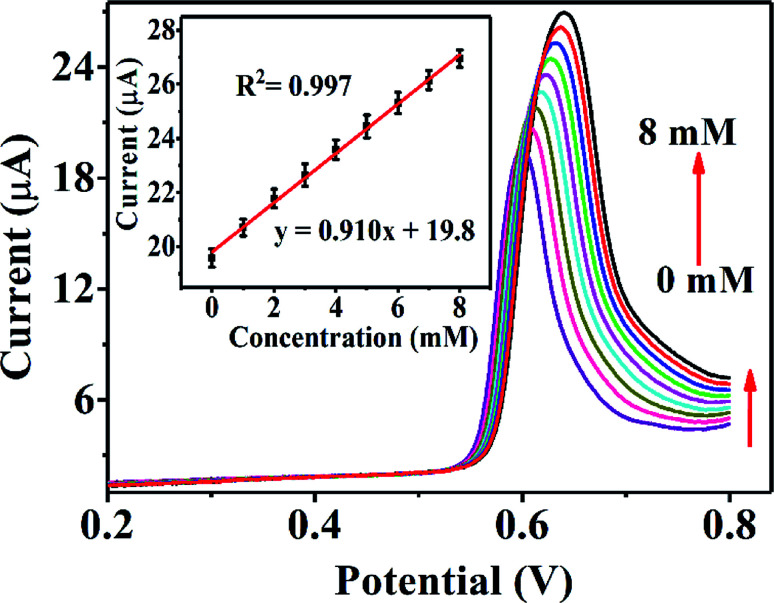
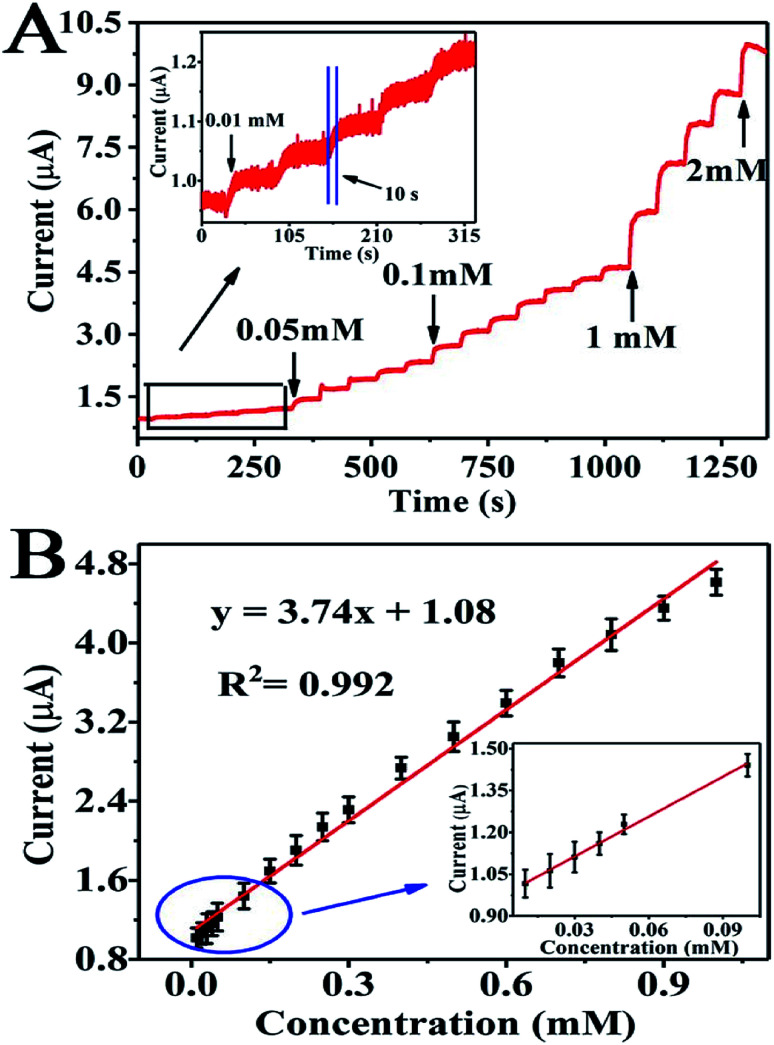
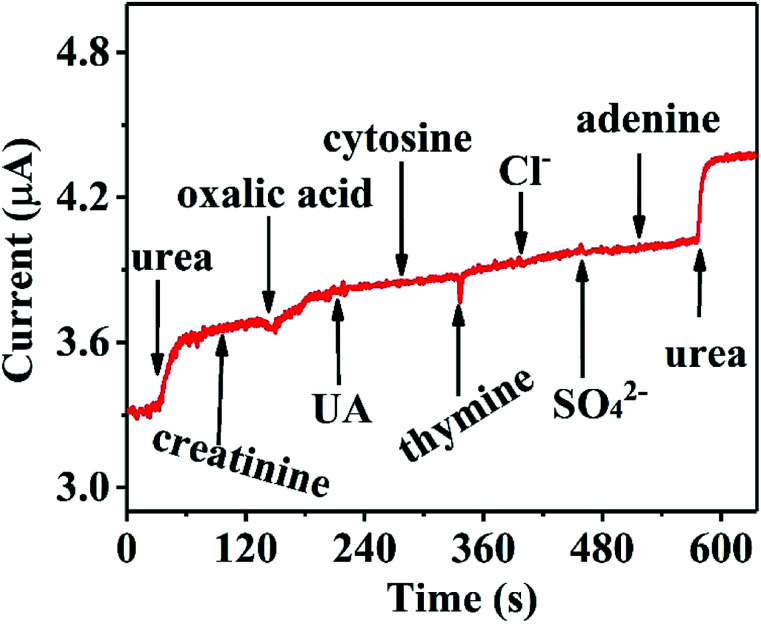
Ultrathin nickel-metal-organic framework (Ni-MOF) nanobelts, [Ni(CHO)(HO)]·40HO (Ni-MIL-77), have been exploited successfully for the fabrication of a non-enzymatic urea sensor. Ni-MOF ultrathin nanobelts in alkaline media can be used as an efficient catalyst for urea electrooxidation. As a non-enzymatic urea sensor, Ni-MOF ultrathin nanobelts exhibit a high sensitivity of 118.77 μA mM cm, wide linear range of 0.01-7.0 mM, and low detection limit of 2.23 μM (S/N = 3). The selectivity, stability and reliability of ultrathin Ni-MOF nanobelts towards urea oxidation are also investigated. Moreover, Ni-MOF ultrathin nanobelts were further used to detect urea in human body fluids. All these findings confirm that the urea sensor based on Ni-MOF ultrathin nanobelts is successfully prepared and promising for applications in medical diagnostics and environmental monitoring.
超薄镍基金属有机框架(Ni-MOF)纳米带,[Ni(CHO)(HO)]·40HO(Ni-MIL-77),已成功用于制备非酶尿素传感器。碱性介质中的Ni-MOF超薄纳米带可作为尿素电氧化的高效催化剂。作为非酶尿素传感器,Ni-MOF超薄纳米带表现出118.77 μA mM cm的高灵敏度、0.01 - 7.0 mM的宽线性范围和2.23 μM的低检测限(S/N = 3)。还研究了超薄Ni-MOF纳米带对尿素氧化的选择性、稳定性和可靠性。此外,Ni-MOF超薄纳米带进一步用于检测人体体液中的尿素。所有这些发现证实基于Ni-MOF超薄纳米带的尿素传感器已成功制备,在医学诊断和环境监测中具有应用前景。