Benea Lidia, Dumitrascu Valentin
Competences Center: Interfaces-Tribocorrosion-Electrochemical Systems (CC-ITES), Dunarea de Jos University of Galati 47 Domneasca Street RO-800008 Galati Romania
RSC Adv. 2019 Aug 12;9(43):25056-25063. doi: 10.1039/c9ra05702a. eCollection 2019 Aug 8.
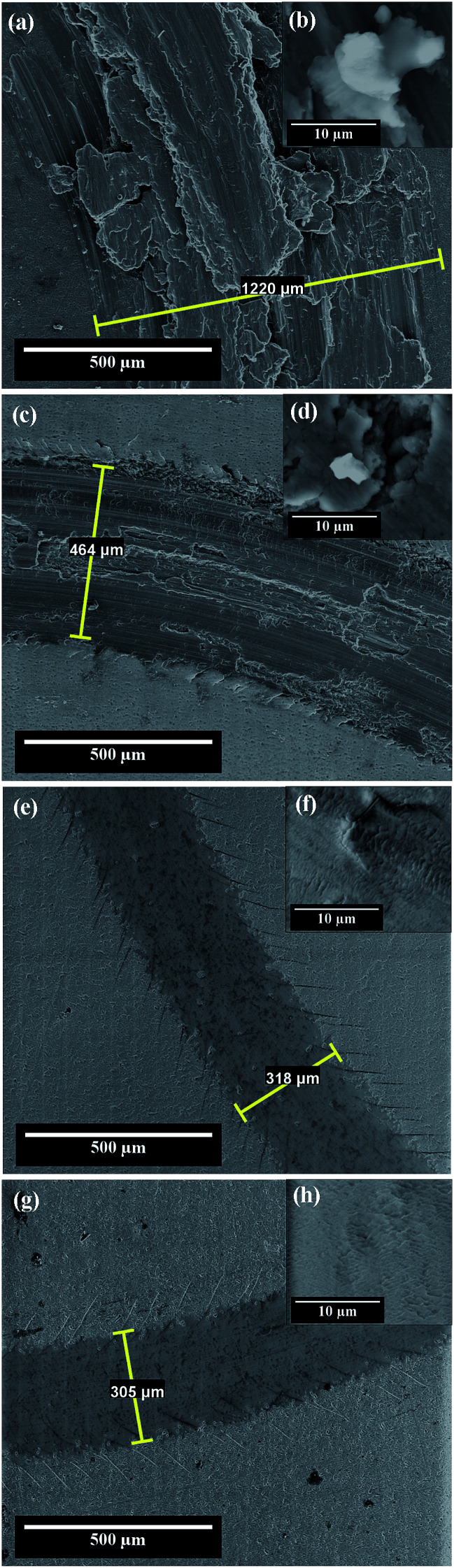
The primary purpose of this study is to investigate the effect of the electrochemical parameters required in the anodic oxidation process on the friction and wear resistance of the obtained nanoporous aluminum oxide films. The wear resistance of the aluminum oxide films and the electrochemically polished Al1050 alloy were tested using a ball-on-disc tribometer having a corundum ball as counterbody in dry conditions. The friction coefficient graphs were recorded during wear tests at a 5 N normal force simulating the application of nanoporous aluminum oxide films in industrial areas requesting moderate wear resistance. The wear tracks formed on the tested surfaces were analyzed both qualitatively and quantitatively. Higher wear resistance is showed by nanoporous aluminum oxide films as compared with electro polished Al1050 alloy substrate.
本研究的主要目的是研究阳极氧化过程中所需的电化学参数对所得纳米多孔氧化铝膜的摩擦和耐磨性的影响。使用以刚玉球为配对体的球盘摩擦磨损试验机在干燥条件下测试氧化铝膜和电化学抛光的Al1050合金的耐磨性。在磨损试验期间,以5 N的法向力记录摩擦系数图,模拟纳米多孔氧化铝膜在要求中等耐磨性的工业领域中的应用。对测试表面上形成的磨损轨迹进行了定性和定量分析。与电化学抛光的Al1050合金基体相比,纳米多孔氧化铝膜表现出更高的耐磨性。