Plüisch Claudia Simone, Bössenecker Brigitte, Dobler Lukas, Wittemann Alexander
Colloid Chemistry, Department of Chemistry, University of Konstanz Universitaetsstrasse 10 D-78464 Konstanz Germany
Particle Analysis Center, Department of Chemistry, University of Konstanz Universitaetsstrasse 10 D-78464 Konstanz Germany.
RSC Adv. 2019 Sep 2;9(47):27549-27559. doi: 10.1039/c9ra05140f. eCollection 2019 Aug 29.
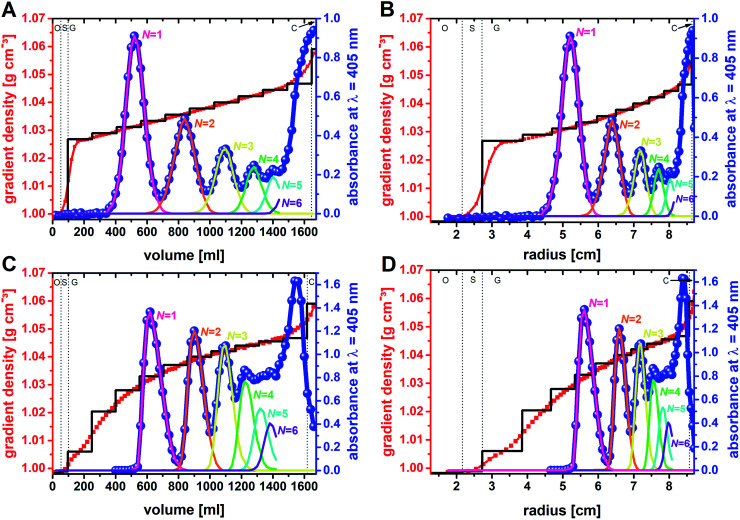
Density gradient centrifugation is an effective method for the isolation and purification of small particles. Hollow rotors capable of hosting density gradients replace the need for centrifuge tubes and therefore allow separations at large scales. So far, zonal rotors have been used for biological separations ranging from the purification of whole cells down to serum proteins. We demonstrate that the high-resolution separation method opens up exciting perspectives apart from biology, namely in sorting mixtures of synthetic nanoparticles. Loading and unloading, while the rotor is spinning, avoids perturbations during acceleration and deceleration periods, and thus makes a vital contribution to sorting accuracy. Nowadays one can synthesize nanoscale particles in a wide variety of compositions and shapes. A prominent example for this are "colloidal molecules" or, generally speaking, defined assemblies of nanoparticles that can appear in varying aggregation numbers. Fractionation of such multimodal colloids plays an essential role with regard to their organization into hierarchical organized superstructures such as films, mesocrystals and metamaterials. Zonal rotor centrifugation was found to be a scalable method of getting "colloidal molecules" properly sorted. It allows access to pure fractions of particle monomers, dimers, and trimers, just as well as to fractions that are essentially rich in particle tetramers. Separations were evaluated by differential centrifugal sedimentation, which provides high-resolution size distributions of the collected nanoparticle fractions. The performance achieved in relation to resolution, zone widths, sorting efficiencies and recovery rates clearly demonstrate that zonal rotor centrifugation provides an excellent solution to the fractionation of nanoparticle mixtures.
密度梯度离心是分离和纯化小颗粒的有效方法。能够容纳密度梯度的空心转子取代了离心管的需求,因此可以进行大规模分离。到目前为止,区带转子已用于从全细胞纯化到血清蛋白的生物分离。我们证明,这种高分辨率分离方法除了在生物学领域外,在合成纳米颗粒混合物的分选方面也开辟了令人兴奋的前景。在转子旋转时进行加载和卸载,避免了加速和减速期间的干扰,从而对分选精度做出了至关重要的贡献。如今,可以合成各种组成和形状的纳米级颗粒。一个突出的例子是“胶体分子”,或者一般来说,是定义的纳米颗粒组装体,其聚集数可能不同。这种多峰胶体的分级分离对于将它们组织成诸如薄膜、介晶和超材料等层次有序的超结构起着至关重要的作用。发现区带转子离心是一种可扩展的方法,可以正确分选“胶体分子”。它可以获得颗粒单体、二聚体和三聚体的纯级分,以及基本上富含颗粒四聚体的级分。通过差示离心沉降对分离进行评估,差示离心沉降可提供所收集纳米颗粒级分的高分辨率尺寸分布。在分辨率、区带宽度、分选效率和回收率方面所取得的性能清楚地表明,区带转子离心为纳米颗粒混合物的分级分离提供了一个出色的解决方案。