Luo Jiefeng, Yang Mengting, Zeng Linan, Pan Xiangcheng, Liu Dan, Diao Sha, Huang Liang, Chen Ting, Jia Zhi-Jun, Cheng Guo, Yu Qin, Zhang Lingli
West China School of Pharmacy, Sichuan University, Chengdu, China.
Department of Pharmacy, West China Second University Hospital, Sichuan University, Chengdu, China.
Evid Based Complement Alternat Med. 2022 Apr 27;2022:2229735. doi: 10.1155/2022/2229735. eCollection 2022.
To systematically evaluate the safety and effectiveness of different dosages of recombinant human interferon 1b (IFN1b) inhaled for bronchiolitis in children.
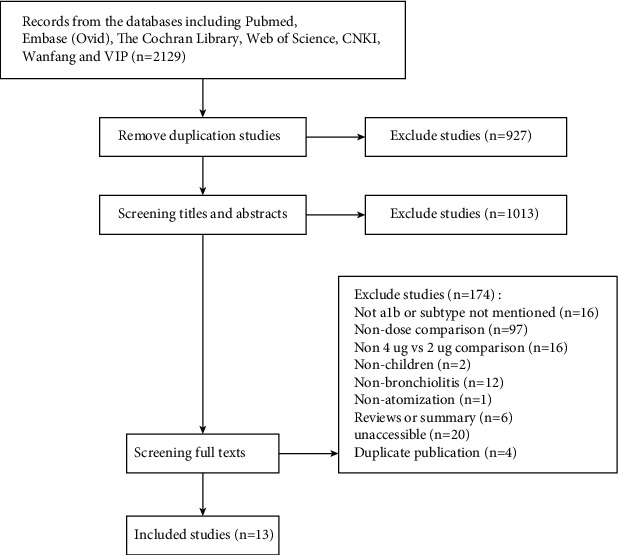
7 databases, including PubMed, EMBASE, Cochrane Library, Web of Science, CNKI, Wanfang Database, and VIP, were searched. The search time was from their inception dates to March 28, 2022. A randomized controlled trial (RCT) of 2 g/kg IFN1b (low dosage group) monotherapy or in combination with other drugs vs. 4 g/kg IFN1b (high dosage group) monotherapy or in combination with the other drugs was included. The risk of bias 2.0 evaluated the RCT's quality, and the grading of recommendations assessment, development and evaluation (GRADE) tool was used for evaluating the overall quality of the evidence. Then, a meta-analysis was performed by RevMan 5.4.
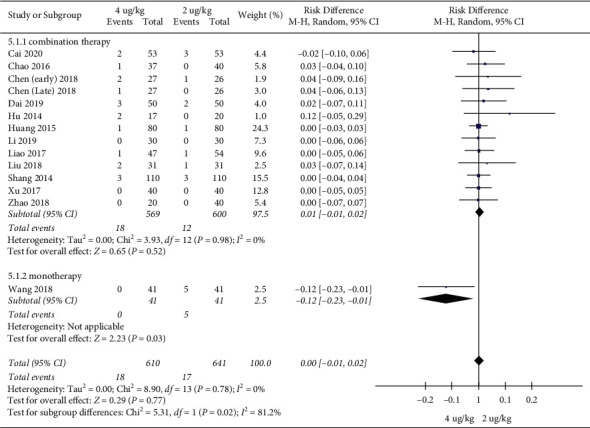
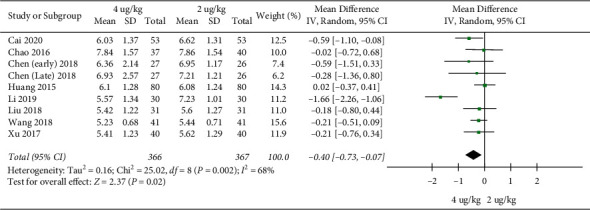
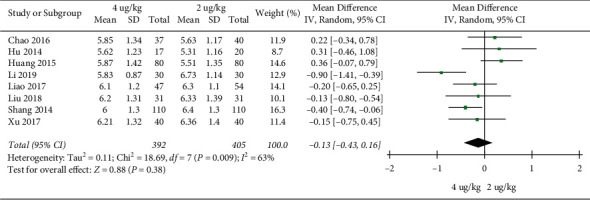
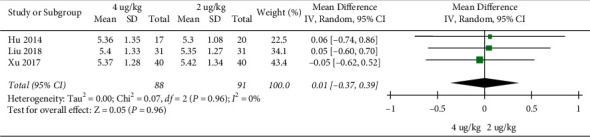
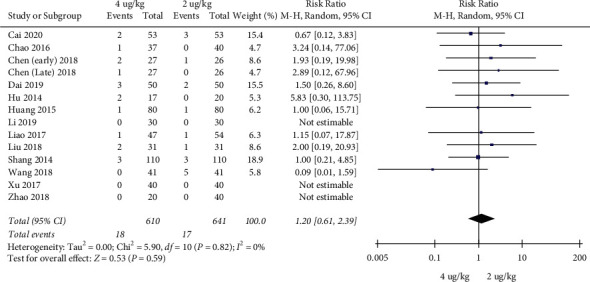
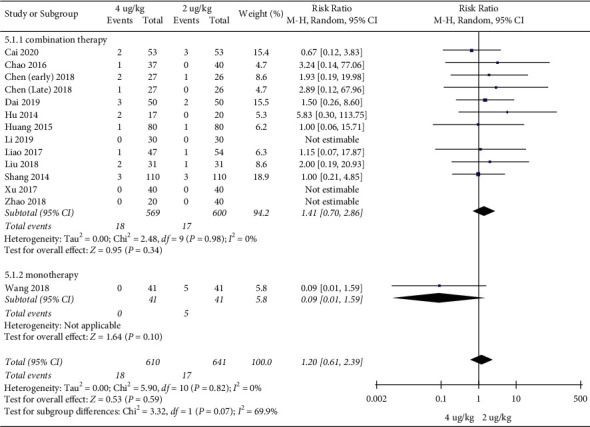
A total of 13 RCTs with 1719 children were included. The meta-analysis results showed that the high dosage group was significantly shorter than the low dosage group of the duration of hospital stays (MD = -0.40, 95%CI (-0.73, -0.07), = 0.02) (low quality), three depressions sign disappearing time (MD = -0.60, 95%CI (-1.05, -0.14), = 0.010) (low quality), and wheeze disappearing time (MD = -0.62, 95%CI (-1.17, -0.06), = 0.03) (low quality). There was no significant difference between the two groups in coughing disappearing time, pulmonary rales disappearing time, wheezing sound disappearing time, or adverse event rates.
Compared with low dosage IFN1b, high dosage IFN1b reduces the duration of hospital stays, the disappearance time of the three depression signs, and the disappearance time of wheeze in the treatment of bronchiolitis in children. Limited by the low quality of the evidence, the conclusions still need to be supported by high-quality studies.
系统评价不同剂量吸入重组人干扰素1b(IFN1b)治疗儿童毛细支气管炎的安全性和有效性。
检索了7个数据库,包括PubMed、EMBASE、Cochrane图书馆、Web of Science、中国知网、万方数据库和维普数据库。检索时间从各数据库建库日期至2022年3月28日。纳入2μg/kg IFN1b(低剂量组)单药治疗或与其他药物联合治疗对比4μg/kg IFN1b(高剂量组)单药治疗或与其他药物联合治疗的随机对照试验(RCT)。偏倚风险2.0评估RCT的质量,推荐分级评估、制定与评价(GRADE)工具用于评估证据的整体质量。然后,采用RevMan 5.4进行荟萃分析。
共纳入13项RCT,涉及1719名儿童。荟萃分析结果显示,高剂量组在住院时间(MD = -0.40,95%CI(-0.73,-0.07),P = 0.02)(低质量)、三凹征消失时间(MD = -0.60,95%CI(-1.05,-0.14),P = 0.010)(低质量)和喘息消失时间(MD = -0.62,95%CI(-1.17,-0.06),P = 0.03)(低质量)方面均显著短于低剂量组。两组在咳嗽消失时间、肺部啰音消失时间、哮鸣音消失时间或不良事件发生率方面无显著差异。
与低剂量IFN1b相比,高剂量IFN1b在治疗儿童毛细支气管炎时可缩短住院时间、三凹征消失时间和喘息消失时间。受证据质量低的限制,这些结论仍需高质量研究的支持。