Schütze Sandra, Döpke Anika, Kellert Benedikt, Seele Jana, Ballüer Melissa, Bunkowski Stephanie, Kreutzfeldt Mario, Brück Wolfgang, Nau Roland
Institute of Neuropathology, University Medical Center Göttingen, Göttingen, Germany.
Department of Geriatrics, Neurogeriatric Section, AGAPLESION Frankfurter Diakonie Kliniken, Frankfurt, Germany.
J Alzheimers Dis Rep. 2022 Mar 8;6(1):101-114. doi: 10.3233/ADR-210049. eCollection 2022.
In patients with Alzheimer's disease (AD), bacterial infections are often associated with a cognitive decline. Animal models of genuine acute infections with viable bacteria which induce deterioration of neurodegenerative diseases are missing.
We assessed the effect of an intracerebral infection with in a mouse model of AD.
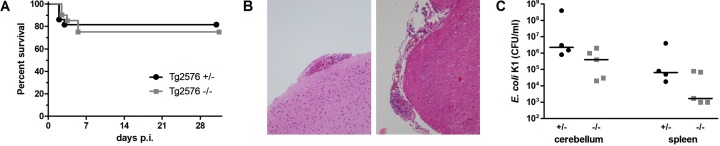
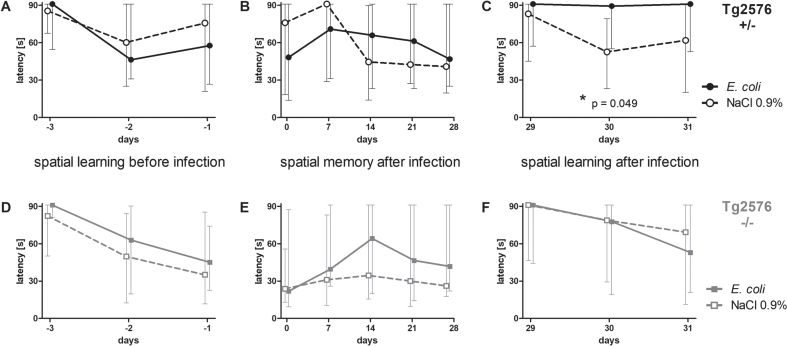
13-month-old Tg2576 +/- mice and transgene negative littermates (Tg2576 -/-) received an intracerebral injection with K1 or saline followed by treatment with ceftriaxone starting 41 h post infection (p.i.) for 5 days. For 4 weeks, mice were monitored for clinical status, weight, motor functions, and neuropsychological status using the Morris water maze. ELISAs, stainings, and immunohistochemistry in brains were performed at the end of the experiment.
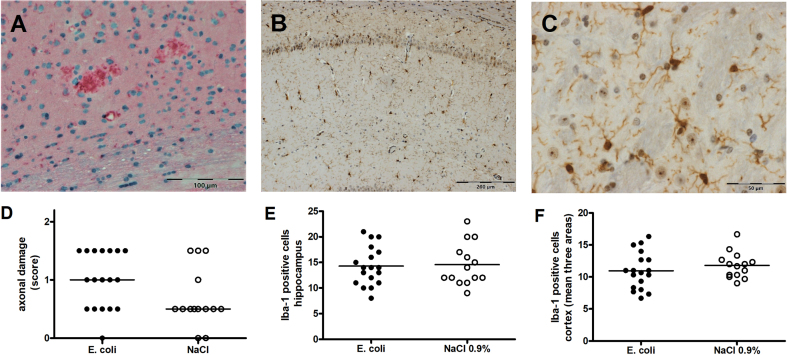
Mortality of the infection was approximately 20%. After 4 weeks, spatial learning of infected Tg2576 +/- mice was compromised compared to non-infected Tg2576 +/- mice ( < 0.05). infection did not influence spatial learning in Tg2576 -/- mice, or spatial memory in both Tg2576 +/- and -/- mice within 4 weeks p.i.. Necrosis of hippocampal neurons was induced in infected compared to non-infected Tg2576 +/- mice 4 weeks p.i., whereas brain concentrations of Aβ, Aβ, and phosphoTau as well as axonal damage and microglia density were not altered.
Here, we proved in principle that a genuine acute bacterial infection can worsen cognitive functions of AD mice. Mouse models of subacute systemic infections are needed to develop new strategies for the treatment of bacterial infections in patients with AD in order to minimize their cognitive decline.
在阿尔茨海默病(AD)患者中,细菌感染常与认知功能下降相关。目前缺乏能诱导神经退行性疾病恶化的活菌引发的真正急性感染的动物模型。
我们在AD小鼠模型中评估了脑内感染[具体细菌名称未给出]的影响。
13月龄的Tg2576 +/-小鼠和转基因阴性同窝小鼠(Tg2576 -/-)接受脑内注射[具体细菌名称未给出] K1或生理盐水,感染后41小时(p.i.)开始用头孢曲松治疗5天。持续4周,使用莫里斯水迷宫监测小鼠的临床状态、体重、运动功能和神经心理状态。实验结束时对大脑进行酶联免疫吸附测定(ELISAs)、染色和免疫组织化学检测。
感染的死亡率约为20%。4周后,与未感染的Tg2576 +/-小鼠相比,感染的Tg2576 +/-小鼠的空间学习能力受损(<0.05)。在感染后4周内,[具体细菌名称未给出]感染不影响Tg2576 -/-小鼠的空间学习,也不影响Tg2576 +/-和 -/-小鼠的空间记忆。感染后4周,与未感染的Tg2576 +/-小鼠相比,感染的Tg2576 +/-小鼠海马神经元出现坏死,而脑内β淀粉样蛋白(Aβ)、Aβ以及磷酸化tau蛋白的浓度以及轴突损伤和小胶质细胞密度均未改变。
在此,我们原则上证明了真正的急性细菌感染可使AD小鼠的认知功能恶化。需要建立亚急性全身感染的小鼠模型,以开发治疗AD患者细菌感染的新策略,从而尽量减少其认知功能下降。