Neuroinfection Laboratory, Institute for Infectious Diseases, University of Bern, Friedbühlstrasse 51, 3001, Bern, Switzerland.
Graduate School for Cellular and Biomedical Sciences (GCB), University of Bern, Freiestrasse 1, 3012, Bern, Switzerland.
J Neuroinflammation. 2018 Aug 21;15(1):233. doi: 10.1186/s12974-018-1272-8.
Pneumococcal meningitis is associated with high mortality and morbidity rates. Up to 50% of survivors show neurologic sequelae including hearing loss, cognitive impairments and learning disabilities, being particularly detrimental in affected infants and children where adjuvant therapy with dexamethasone has no proven beneficial effect. We evaluated the effect of concomitantly targeting specific pathophysiological mechanisms responsible for brain damage-i.e. matrix-metalloproteinase (MMP) activity and the exacerbated cerebral inflammation provoked through antibiotic-induced bacterial lysis. Here, we combined adjunctive therapies previously shown to be neuroprotective when used as single adjuvant therapies.
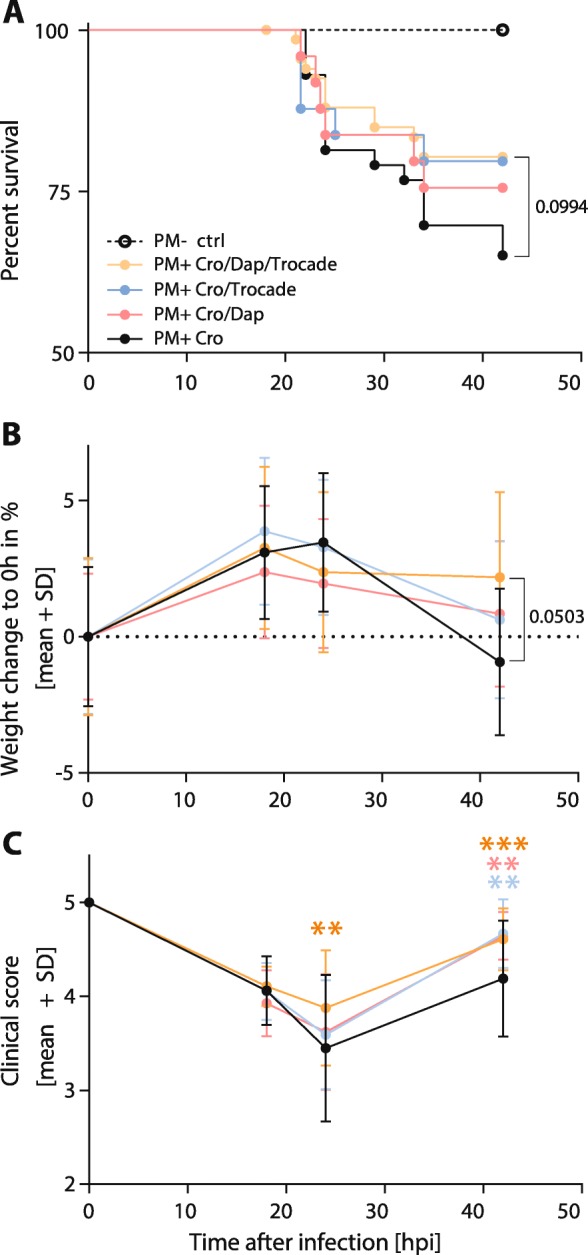
Eleven-day-old Wistar rats were infected intracisternally with 6.44 ± 2.17 × 10 CFU Streptococcus pneumoniae and randomised for treatment with ceftriaxone combined with (a) single adjuvant therapy with daptomycin (n = 24), (b) single adjuvant therapy with Trocade (n = 24), (c) combined adjuvant therapy (n = 66) consisting of daptomycin and Trocade, or (d) ceftriaxone monotherapy (n = 42). Clinical parameters and inflammatory CSF cytokine levels were determined during acute meningitis. Cortical damage and hippocampal apoptosis were assessed 42 h after infection. Morris water maze and auditory brainstem responses were used to assess neurofunctional outcome 3 weeks after infection.
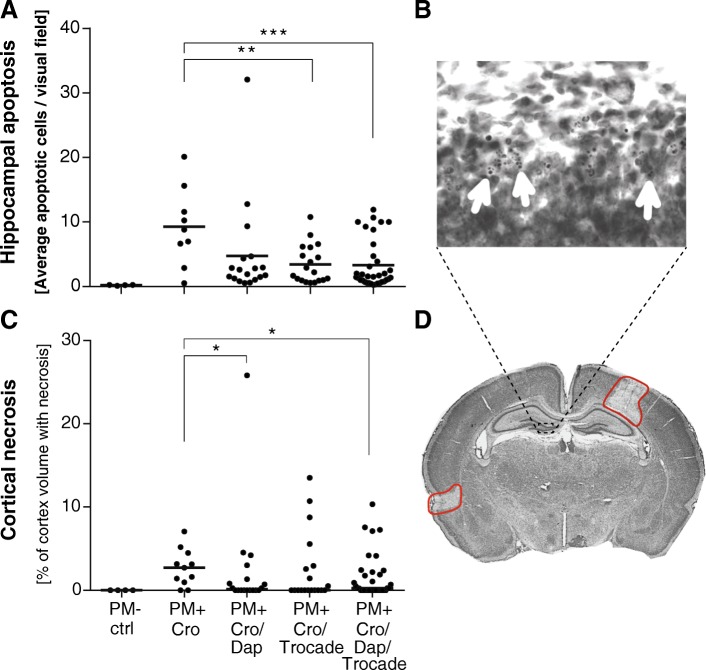
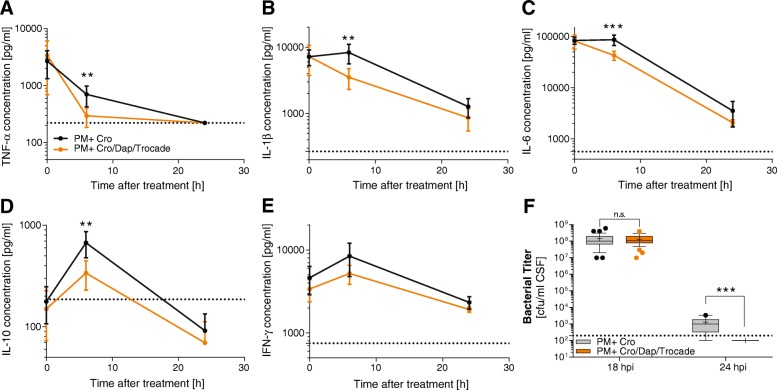
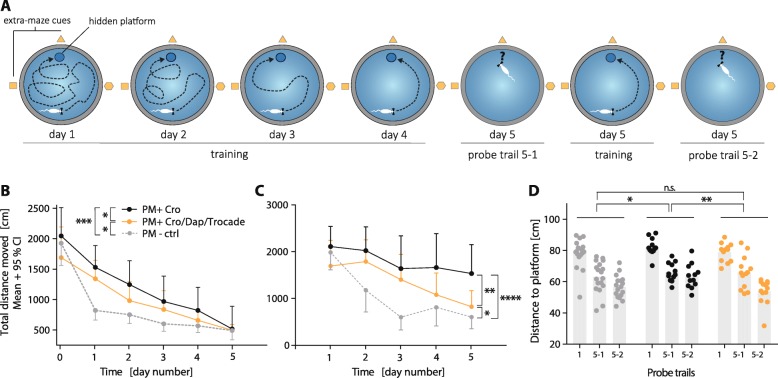
We found significantly reduced apoptosis in the hippocampal subgranular zone in infant rats receiving adjuvant Trocade (p < 0.01) or combined adjuvant therapy (p < 0.001). Cortical necrosis was significantly reduced in rats treated with adjuvant daptomycin (p < 0.05) or combined adjuvant therapy (p < 0.05) compared to ceftriaxone monotherapy. Six hours after treatment initiation, CSF cytokine levels were significantly reduced for TNF-α (p < 0.01), IL-1β (p < 0.01), IL-6 (p < 0.001) and IL-10 (p < 0.01) in animals receiving combined adjuvant intervention compared to ceftriaxone monotherapy. Importantly, combined adjuvant therapy significantly improved learning and memory performance in infected animals and reduced hearing loss (77.14 dB vs 60.92 dB, p < 0.05) by preserving low frequency hearing capacity, compared to ceftriaxone monotherapy.
Combined adjuvant therapy with the non-bacteriolytic antibiotic daptomycin and the MMP inhibitor Trocade integrates the neuroprotective effects of both single adjuvants in experimental paediatric pneumococcal meningitis by reducing neuroinflammation and brain damage, thereby improving neurofunctional outcome. This strategy represents a promising therapeutic option to improve the outcome of paediatric patients suffering from pneumococcal meningitis.
肺炎球菌性脑膜炎与高死亡率和发病率相关。多达 50%的幸存者出现神经后遗症,包括听力损失、认知障碍和学习障碍,在受影响的婴儿和儿童中尤其不利,因为辅助用皮质类固醇治疗没有证明有有益的效果。我们评估了同时针对导致脑损伤的特定病理生理机制的效果,即基质金属蛋白酶(MMP)活性和抗生素诱导的细菌裂解引起的加剧的脑炎症。在这里,我们结合了以前被证明作为单一辅助治疗时具有神经保护作用的联合治疗。
11 天大的 Wistar 大鼠经脑室内感染 6.44±2.17×10 CFU 肺炎链球菌,并随机接受头孢曲松联合(a)单一辅助治疗用达托霉素(n=24)、(b)单一辅助治疗用 Trocade(n=24)、(c)联合辅助治疗(n=66,包括达托霉素和 Trocade)或(d)头孢曲松单药治疗(n=42)。在急性脑膜炎期间确定临床参数和炎症性 CSF 细胞因子水平。感染后 42 小时评估皮质损伤和海马细胞凋亡。感染后 3 周使用 Morris 水迷宫和听觉脑干反应评估神经功能结局。
我们发现接受辅助 Trocade(p<0.01)或联合辅助治疗(p<0.001)的婴儿大鼠海马亚颗粒区的细胞凋亡明显减少。与头孢曲松单药治疗相比,接受辅助达托霉素(p<0.05)或联合辅助治疗(p<0.05)的大鼠皮质坏死明显减少。治疗开始后 6 小时,与头孢曲松单药治疗相比,接受联合辅助干预的动物的 CSF 细胞因子 TNF-α(p<0.01)、IL-1β(p<0.01)、IL-6(p<0.001)和 IL-10(p<0.01)水平显著降低。重要的是,与头孢曲松单药治疗相比,联合辅助治疗通过保留低频听力能力显著改善了感染动物的学习和记忆表现,并降低了听力损失(77.14dB 对 60.92dB,p<0.05)。
非裂解性抗生素达托霉素和 MMP 抑制剂 Trocade 的联合辅助治疗通过减少神经炎症和脑损伤,整合了两种单一辅助剂在实验性小儿肺炎球菌性脑膜炎中的神经保护作用,从而改善神经功能结局。这种策略代表了改善患有肺炎球菌性脑膜炎的儿科患者结局的有希望的治疗选择。