Liu Chao, Wang Peiliang, Sun Yi, Dou Xue, Hu Xiaoyu, Zou Wenxue, Sun Yanlai, Hu Qinyong, Yue Jinbo
Department of Oncology, Renmin Hospital of Wuhan University, Wuhan, China.
Department of Radiation Oncology, Shandong Cancer Hospital and Institute, Shandong First Medical University and Shandong Academy of Medical Sciences, Jinan, China.
Front Oncol. 2022 Apr 21;12:756811. doi: 10.3389/fonc.2022.756811. eCollection 2022.
We aimed to investigate clinical implications of specific soluble immune checkpoint molecules (sICMs) in locally advanced rectal cancer (LARC) patients treated with neoadjuvant chemoradiotherapy (nCRT).
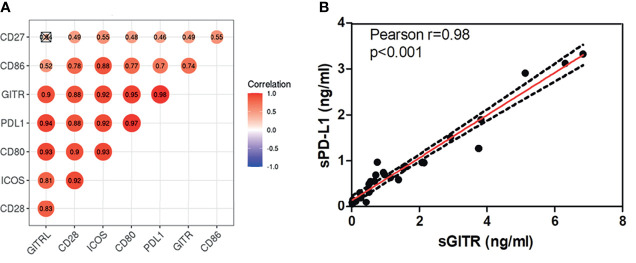
We prospectively enrolled 30 LARC patients treated with nCRT and collected blood samples from them before, during, and after nCRT for prospective studies. Immune checkpoints often refer to T cell surface molecules influencing the immune response. Immune checkpoints, in the form of a soluble monomeric form, is widely present in blood. In the study, eight immune checkpoint-related plasma proteins, including programmed death-ligand 1 (PD-L1), CD80, CD86, CD28, CD27, glucocorticoid-induced tumor necrosis factor receptor (GITR), GITR ligand (GITRL), and inducible T-cell costimulator (ICOS), were measured using the Luminex platform. Two independent pathologists categorized patients as the good responders and the poor responders according to Dworak tumor regression grade (TRG).
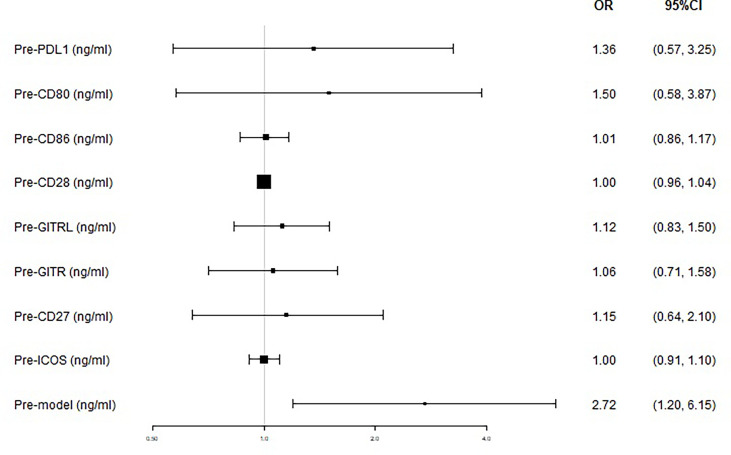
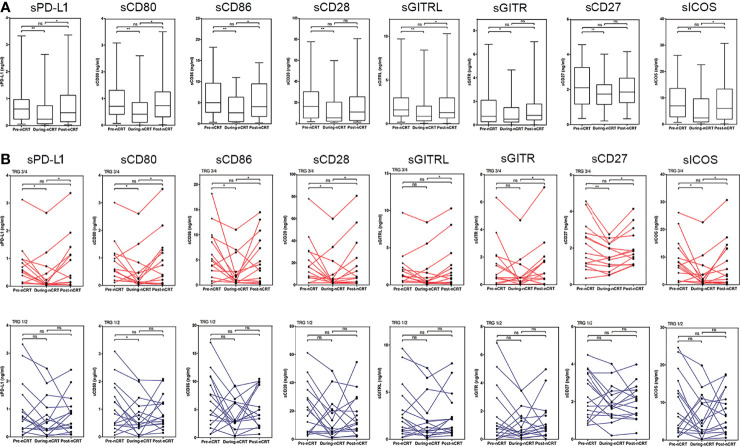
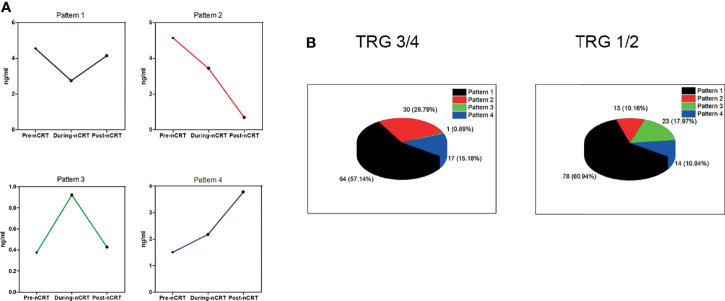
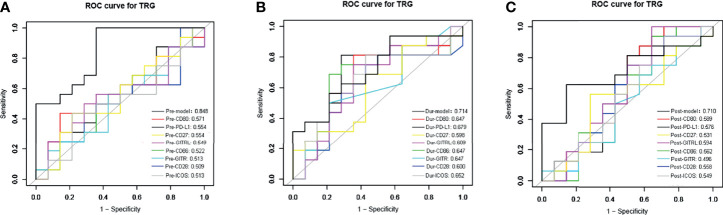
Of the 30 patients, the levels of sPD-L1, sCD80, sCD86, sCD28, sGITR, sGITRL, sCD27, and sICOS decreased during nCRT (Pre-nCRT vs. During-nCRT, all 0.05) but were restored after nCRT treatment (Pre-nCRT vs. Post-nCRT, all 0.05). In the 14 good responders, the levels of sICMs, other than sGITR (0.081) and sGITRL (0.071), decreased significantly during nCRT (Pre-nCRT vs. During-nCRT, 0.05), but they were all significantly increased after nCRT (During-nCRT vs. Post-nCRT, all 0.05). In the 16 poor responders, only sCD80 was significantly reduced during nCRT (Pre-nCRT vs. During-nCRT, p<0.05), and none was significantly increased after nCRT (During-nCRT vs. Post-nCRT, all p<0.05). High levels of sICMs before nCRT were associated with poor response (all OR≥1). The Pre-model that incorporated the 8 sICMs before nCRT yielded a good predictive value (AUC, 0.848) and was identified as an independent predictor of treatment response (OR, 2.62; 95% CI, 1.11-6.18; 0.027).
Our results suggest chemoradiotherapy could influence the change of sPD-L1, sCD80, sCD86, sCD28, sGITR, sGITRL, sCD27, and sICOS in patients with LARC. The levels of the majority of soluble immune checkpoint molecules were reduced during nCRT and then restored at the end of nCRT, particularly in patients who responded well to nCRT. Combined baseline sICMs can be developed to predict treatment response.
我们旨在研究特定可溶性免疫检查点分子(sICMs)在接受新辅助放化疗(nCRT)的局部晚期直肠癌(LARC)患者中的临床意义。
我们前瞻性纳入了30例接受nCRT的LARC患者,并在nCRT前、期间和之后采集他们的血样用于前瞻性研究。免疫检查点通常指影响免疫反应的T细胞表面分子。免疫检查点以可溶性单体形式广泛存在于血液中。在本研究中,使用Luminex平台检测了8种与免疫检查点相关的血浆蛋白,包括程序性死亡配体1(PD-L1)、CD80、CD86、CD28、CD27、糖皮质激素诱导的肿瘤坏死因子受体(GITR)、GITR配体(GITRL)和诱导性T细胞共刺激分子(ICOS)。两名独立病理学家根据德沃拉克肿瘤消退分级(TRG)将患者分为良好反应者和不良反应者。
30例患者中,nCRT期间sPD-L1、sCD80、sCD86、sCD28、sGITR、sGITRL、sCD27和sICOS水平下降(nCRT前与nCRT期间比较,均P<0.05),但nCRT治疗后恢复(nCRT前与nCRT后比较,均P<0.05)。在14例良好反应者中,除sGITR(P=0.081)和sGITRL(P=0.071)外,sICMs水平在nCRT期间显著下降(nCRT前与nCRT期间比较,P<0.05),但nCRT后均显著升高(nCRT期间与nCRT后比较,均P<0.05)。在16例不良反应者中,仅nCRT期间sCD80显著降低(nCRT前与nCRT期间比较,P<0.05),nCRT后均无显著升高(nCRT期间与nCRT后比较,均P<0.05)。nCRT前sICMs水平高与反应不良相关(所有OR≥1)。纳入nCRT前8种sICMs的预模型具有良好的预测价值(AUC为0.848),并被确定为治疗反应的独立预测因素(OR为2.62;95%CI为1.11-6.18;P=0.027)。
我们的结果表明,放化疗可影响LARC患者sPD-L1、sCD80、sCD86、sCD28、sGITR、sGITRL、sCD27和sICOS的变化。大多数可溶性免疫检查点分子水平在nCRT期间降低,然后在nCRT结束时恢复,尤其是对nCRT反应良好的患者。联合基线sICMs可用于预测治疗反应。