Ahmed Sakir, Handa Rohini
Department of Clinical Immunology & Rheumatology, Kalinga Institute of Medical Sciences (KIMS), KIIT University, Bhubaneswar, India.
Indraprastha Apollo Hospitals, New Delhi, India.
Curr Pulmonol Rep. 2022;11(3):86-98. doi: 10.1007/s13665-022-00290-w. Epub 2022 May 3.
This review aims to collate current evidence on the screening, diagnosis, and treatment of various connective tissue disease (CTD)-associated interstitial lung diseases (CTD-ILD) and present a contemporary framework for the management of such patients. It also seeks to summarize treatment outcomes including efficacy and safety of immunosuppressants, anti-fibrotics, and stem cell transplantation in CTD-ILD.
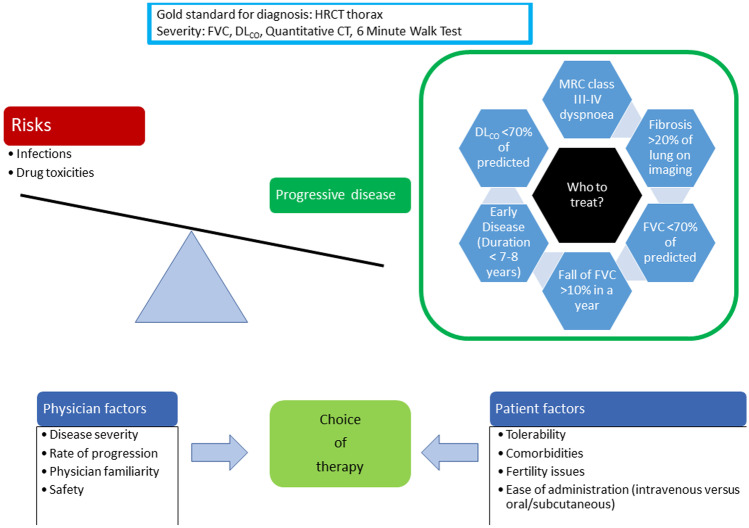
Screening for ILD has been augmented by the use of artificial intelligence, ultra-low dose computerized tomography (CT) of the chest, and the use of chest ultrasound. Serum biomarkers have not found their way into clinical practice as yet. Identifying patients who need treatment and choosing the appropriate therapy is important to minimize the risk of therapy-related toxicity. The first-line drugs for systemic sclerosis (SSc) ILD include mycophenolate and cyclophosphamide. Nintedanib, an anti-fibrotic tyrosine kinase inhibitor, is approved for use in SSc-ILD. The US Food and Drug Administration (FDA) has recently approved tocilizumab subcutaneous injection for slowing the rate of decline in pulmonary function in adult patients with SSc-ILD. Autologous stem cell transplantation may have a role in select cases of SSc-ILD.
CTD-ILD is a challenging area with diverse entities and variable outcomes. High-resolution CT is the investigative modality of choice. Treatment decisions need to be individualized and are based on patient symptoms, lung function, radiologic abnormalities, and the risk of disease progression. Precision medicine may play an important role in determining the optimal therapy for an individual patient in the future.
本综述旨在整理有关各种结缔组织病(CTD)相关间质性肺疾病(CTD-ILD)筛查、诊断和治疗的当前证据,并为这类患者的管理提供一个当代框架。它还试图总结治疗结果,包括免疫抑制剂、抗纤维化药物和干细胞移植在CTD-ILD中的疗效和安全性。
人工智能、胸部超低剂量计算机断层扫描(CT)以及胸部超声的应用增强了ILD的筛查。血清生物标志物尚未进入临床实践。识别需要治疗的患者并选择合适的治疗方法对于将治疗相关毒性风险降至最低很重要。系统性硬化症(SSc)ILD的一线药物包括霉酚酸酯和环磷酰胺。尼达尼布,一种抗纤维化酪氨酸激酶抑制剂,已被批准用于SSc-ILD。美国食品药品监督管理局(FDA)最近批准了托珠单抗皮下注射用于减缓成年SSc-ILD患者肺功能下降速度。自体干细胞移植可能在某些SSc-ILD病例中发挥作用。
CTD-ILD是一个具有挑战性的领域,疾病种类多样,预后各异。高分辨率CT是首选的检查方式。治疗决策需要个体化,基于患者症状、肺功能、影像学异常以及疾病进展风险。精准医学可能在未来为个体患者确定最佳治疗方案中发挥重要作用。