Jin Yan, Liu Cheng-Lin, Song Xing-Fu, Yu Jian-Guo
National Engineering Research Center for Integrated Utilization of Salt Lake Resource, East China University of Science and Technology Shanghai 200237 China
Resource Process Engineering Research Center for Ministry of Education, East China University of Science and Technology Shanghai China.
RSC Adv. 2019 Oct 9;9(55):32034-32046. doi: 10.1039/c9ra06706j. eCollection 2019 Oct 7.
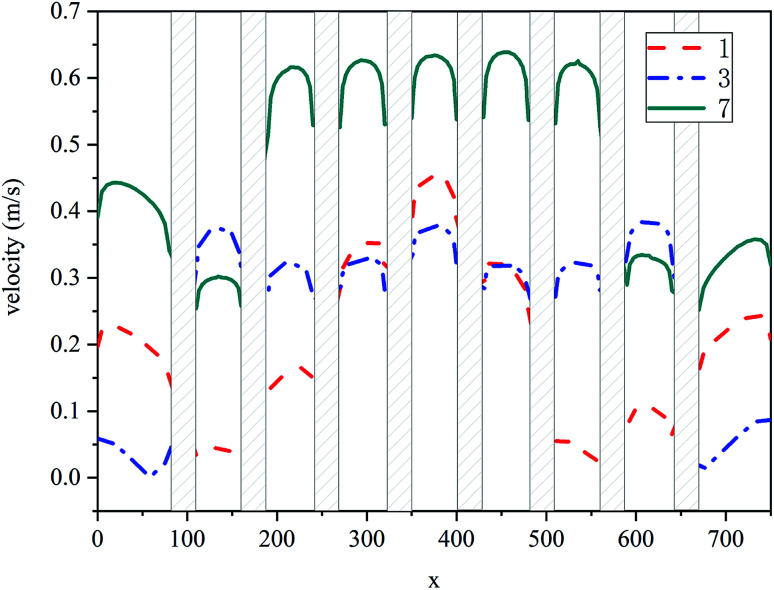
The hydrodynamic properties and shear stresses experienced by a membrane bioreactor (MBR) are directly related to its rate of membrane fouling. In this study, computational fluid dynamic models have been combined with cold model PIV experimental studies to optimize the performance properties of MBRs. The effects of membrane module height, number of aeration tubes and membrane spacing on liquid phase flow rates, gas holdup and shear stresses at the membrane surface have been investigated. It has been found that optimal MBRs experience the greatest shear forces on their surfaces at a distance of 250 mm from the aeration tube, around the 7 aeration tubes used to introduce gas and at the 40 mm spacings between the membrane sheets. Use of an aeration intensity of between 0.02 and 0.47 m min generated shear stresses that were 50-85% higher than the original MBR for the same aeration intensity, thus affording optimal membrane performance that minimizes membrane fouling.
膜生物反应器(MBR)所经历的流体动力学特性和剪切应力与其膜污染速率直接相关。在本研究中,计算流体动力学模型已与冷模型粒子图像测速(PIV)实验研究相结合,以优化MBR的性能特性。研究了膜组件高度、曝气管数量和膜间距对液相流速、气体滞留率以及膜表面剪切应力的影响。研究发现,最佳的MBR在距曝气管250毫米处、围绕用于引入气体的7根曝气管以及在膜片之间40毫米的间距处,其表面承受着最大的剪切力。使用0.02至0.47米/分钟之间的曝气强度所产生的剪切应力比相同曝气强度下的原始MBR高出50 - 85%,从而提供了使膜污染最小化的最佳膜性能。