Jin Ning, Jin Li, Wang Shuya, Li Jinwu, Liu Fanhong, Liu Zeci, Luo Shilie, Wu Yue, Lyu Jian, Yu Jihua
College of Horticulture, Gansu Agricultural University, Lanzhou, China.
Gansu Provincial Key Laboratory of Arid Land Crop Science, Gansu Agricultural University, Lanzhou, China.
Front Microbiol. 2022 Apr 21;13:863325. doi: 10.3389/fmicb.2022.863325. eCollection 2022.
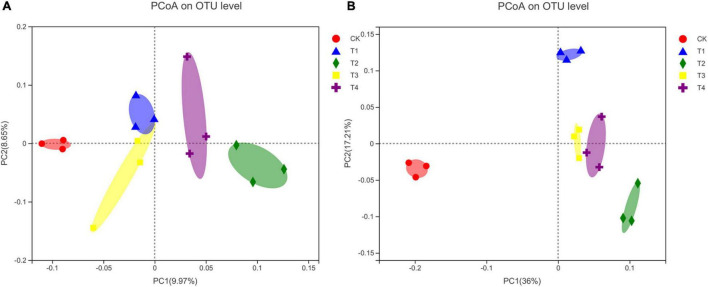
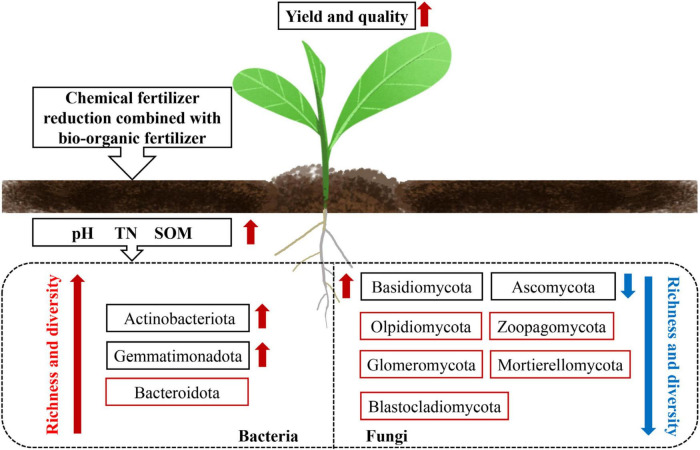
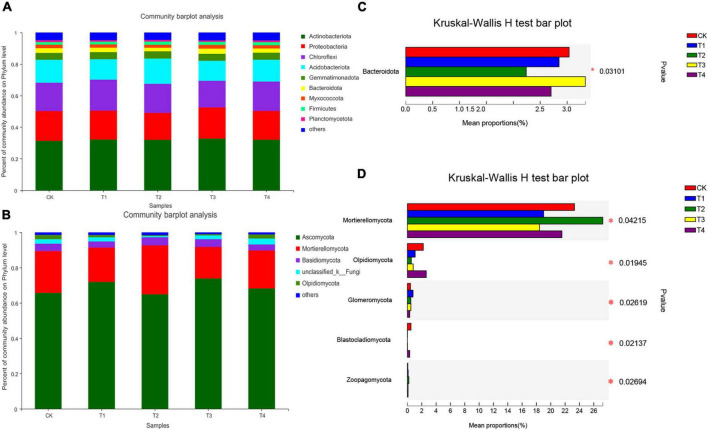
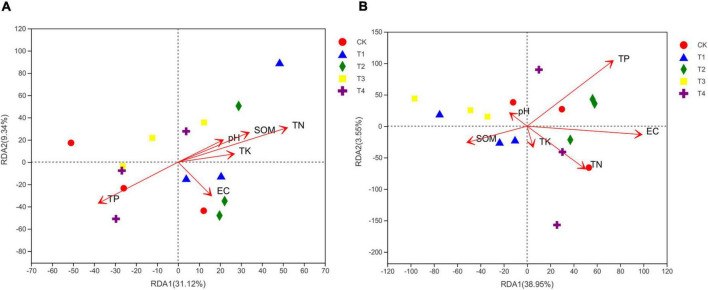
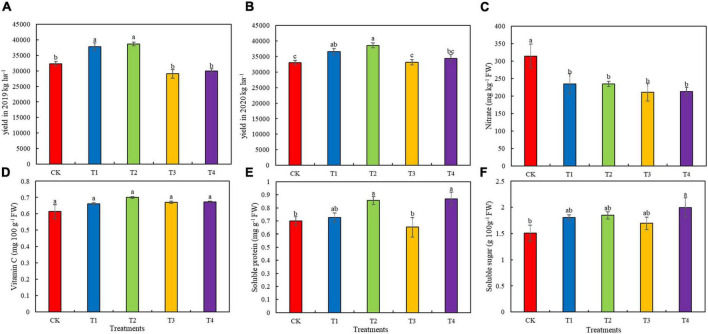
Reducing chemical fertilizers in combination with bio-organic fertilizers can limit the use of chemical fertilizers while maintaining soil fertility. However, the effects of combined fertilization on soil chemical properties, microbial community structure, and crop yield and quality are unknown. Using high-throughput sequencing, we conducted field experiments using lettuce plants subjected to five fertilization treatments: chemical fertilizer with conventional fertilization rate (CK), chemical fertilizer reduction by 30% + 6,000 kg ha bio-organic fertilizer (T1), chemical fertilizer reduction by 30% + 9,000 kg ha bio-organic fertilizer (T2), chemical fertilizer reduction by 40% + 6,000 kg ha bio-organic fertilizer (T3), and chemical fertilizer reduction by 40% + 9,000 kg ha bio-organic fertilizer (T4). Compared with CK, the T1-T4 had significantly higher soil pH and soil organic matter (SOM) and showed increased richness and diversity of the bacterial community, and decreased richness and diversity of the fungal community. Principal coordinate analysis evidenced that the bacterial and fungal communities of CK and T1-T4 were distinctly separated. The Kruskal-Wallis -test demonstrated that the fungal community was more sensitive than the bacterial community to chemical fertilizer reduction combined with bio-organic fertilizer. Among the soil chemical parameters measured, only TN (total nitrogen) was significantly correlated with bacterial and fungal community composition. The T1 and T2 increased lettuce yield. Moreover, T1-T4 characterized reduced nitrate content and increased levels of soluble sugars and vitamin C in lettuce. Overall, the combined application of reduced chemical fertilizer and bio-organic fertilizer effectively improved soil fertility, microbial community structure, and lettuce yield and quality. These findings have valuable implications for vegetable safety and long-term environmental sustainability.
减少化肥用量并结合生物有机肥可以在保持土壤肥力的同时限制化肥的使用。然而,联合施肥对土壤化学性质、微生物群落结构以及作物产量和品质的影响尚不清楚。我们利用高通量测序技术,对生菜进行了田间试验,设置了五种施肥处理:常规施肥量的化肥(CK)、化肥减量30%+6000 kg/ha生物有机肥(T1)、化肥减量30%+9000 kg/ha生物有机肥(T2)、化肥减量40%+6000 kg/ha生物有机肥(T3)、化肥减量40%+9000 kg/ha生物有机肥(T4)。与CK相比,T1-T4处理的土壤pH值和土壤有机质(SOM)显著更高,细菌群落的丰富度和多样性增加,真菌群落的丰富度和多样性降低。主坐标分析表明,CK与T1-T4的细菌和真菌群落明显分离。Kruskal-Wallis检验表明,真菌群落比细菌群落对化肥减量结合生物有机肥更敏感。在所测量的土壤化学参数中,只有全氮(TN)与细菌和真菌群落组成显著相关。T1和T2提高了生菜产量。此外,T1-T4处理的生菜硝酸盐含量降低,可溶性糖和维生素C含量增加。总体而言,减少化肥与生物有机肥的联合施用有效改善了土壤肥力、微生物群落结构以及生菜产量和品质。这些发现对蔬菜安全和长期环境可持续性具有重要意义。