Xiao Xuemei, Li Ju, Lyu Jian, Feng Zhi, Zhang Guobin, Yang Haixing, Gao Chengfei, Jin Li, Yu Jihua
College of Horticulture, Gansu Agricultural University, Lanzhou, China.
State Key Laboratory of Aridland Crop Science, Gansu Agricultural University, Lanzhou, China.
Front Microbiol. 2022 Jul 27;13:922149. doi: 10.3389/fmicb.2022.922149. eCollection 2022.
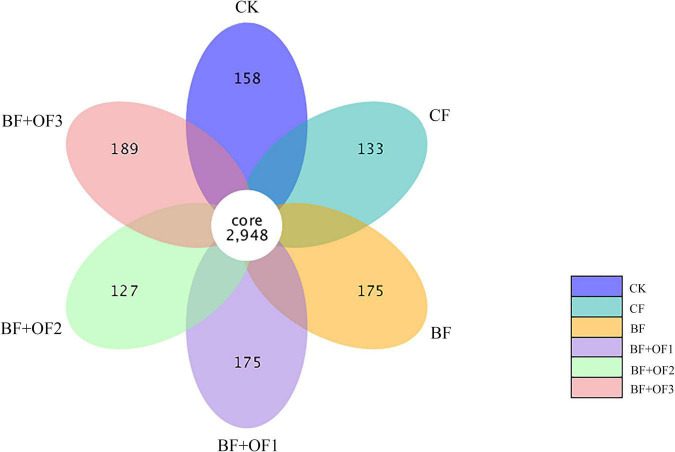
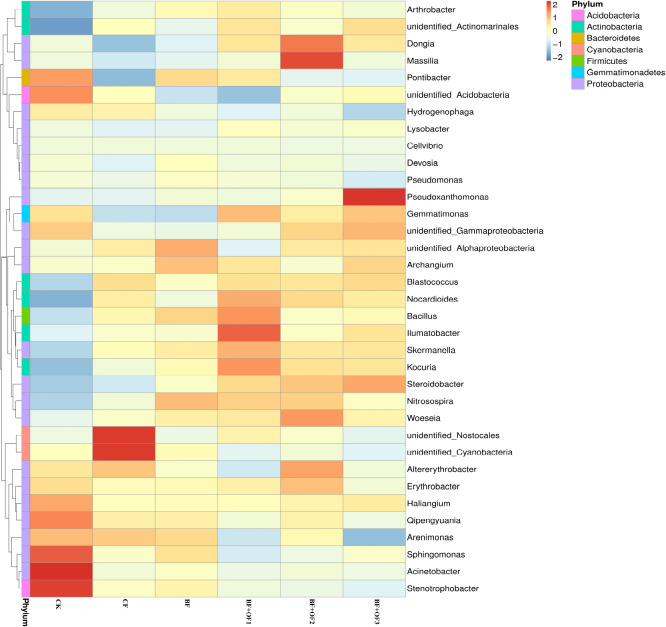
The continuous application of chemical fertilizers in vegetable cropping has led to deterioration of the soil environment and reduced yield and quality. The objective of this study was to evaluate the effect of combining chemical and bio-organic fertilizers on cauliflower yield, soil biochemical properties, and the bacterial community. Six treatments were established: no fertilizer (CK, control), chemical fertilizers (CF, conventional dosage for this region), balanced fertilization (BF, 30% reduction of chemical fertilizers), and balanced fertilization plus 3,000, 6,000, or 12,000 kg.ha bio-organic fertilizer (Lvneng Ruiqi Biotechnology Co., Ltd., Gansu, China) (BF + OF1, BF + OF2, BF + OF3, respectively). A two-season field experiment with cauliflower was conducted under the different fertilizer treatments in irrigation districts along the Yellow River, Northwest China. The results indicate that the yield, soil organic matter, total potassium content, and enzyme activity under the bio-organic treatments were generally higher than those under the CF treatment. Compared with the CF treatment, the BF treatment increased soil organic matter content, enzyme activity and soil bacterial relative abundance. Moreover, the bacterial alpha-diversity were higher than those of conventional fertilization. The predominant phyla, including Proteobacteria, Actinobacteria, Gemmatimonadetes, and Chloroflexi, were the main contributors to the microbiome shift, as demonstrated by their remarkable enrichment in the soil under BF + OF2 and BF + OF3 treatments. Furthermore, Pearson correlation analyses show significant correlations among the soil organic matter, available P and K, electrical conductivity, and relative abundance of potentially beneficial microbial groups, such as the genera , , and . Overall, this study suggests that balanced fertilization and the application of bio-organic fertilizers are essential to ensure soil fertility and long-term sustainable green productivity.
在蔬菜种植中持续施用化肥导致土壤环境恶化,产量和品质下降。本研究的目的是评估化肥与生物有机肥配施对花椰菜产量、土壤生化特性和细菌群落的影响。设置了6种处理:不施肥(CK,对照)、施用化肥(CF,该地区常规用量)、平衡施肥(BF,化肥用量减少30%)以及平衡施肥加3000、6000或12000 kg·ha生物有机肥(甘肃绿能瑞奇生物科技有限公司,中国)(分别为BF + OF1、BF + OF2、BF + OF3)。在中国西北黄河灌区不同施肥处理下进行了两季花椰菜田间试验。结果表明,生物有机肥处理下的产量、土壤有机质、全钾含量和酶活性普遍高于CF处理。与CF处理相比,BF处理提高了土壤有机质含量、酶活性和土壤细菌相对丰度。此外,细菌α多样性高于常规施肥处理。优势菌门,包括变形菌门、放线菌门、芽单胞菌门和绿弯菌门,是微生物群落变化的主要贡献者,在BF + OF2和BF + OF3处理的土壤中显著富集。此外,Pearson相关性分析表明,土壤有机质、有效磷和钾、电导率与潜在有益微生物类群(如属、属和属)的相对丰度之间存在显著相关性。总体而言,本研究表明平衡施肥和施用生物有机肥对于确保土壤肥力和长期可持续绿色生产力至关重要。