Department of Medicine (Austin Health), University of Melbourne, Melbourne, Victoria.
Department of Endocrinology, Austin Health, Melbourne, Victoria.
Am J Med Genet A. 2022 Sep;188(9):2637-2641. doi: 10.1002/ajmg.a.62770. Epub 2022 May 9.
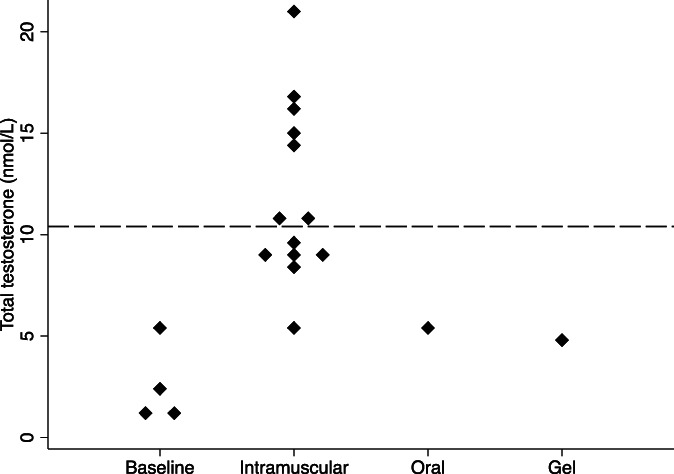
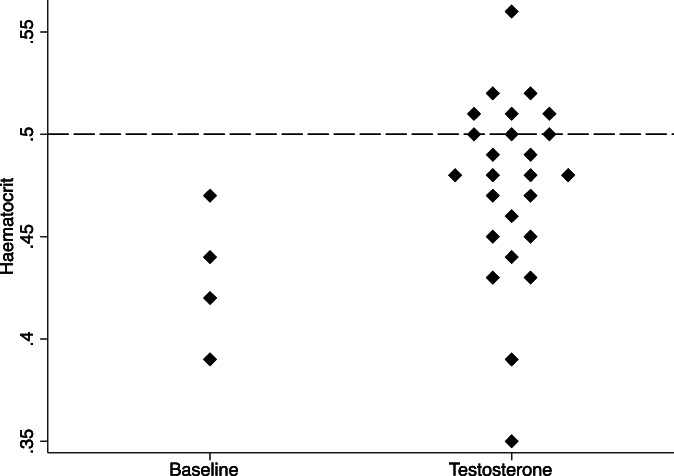
Hypogonadism is the most frequent hormonal deficiency in individuals with Prader-Willi syndrome (PWS). This often necessitates testosterone treatment, but limited data are available to guide testosterone treatment in adult men with PWS. We aimed to evaluate the serum testosterone concentrations and adverse effects of testosterone treatment in individuals with PWS attending a specialist obesity management service. A retrospective audit was undertaken at Austin Health, Melbourne between January 2010 and April 2021. Main outcome measures were testosterone formulation and dose, serum total testosterone concentration, and prevalence of polycythemia and behavioral disturbance. Data were available for eight individuals with median baseline age 19 years (range, 19-42) and BMI 37 kg/m (range, 27-71). Six men had obstructive sleep apnea; none were smokers. Baseline testosterone concentration was 1.8 nmol/L (IQR, 1.1-3.3) with hematocrit 0.43. Testosterone formulations were intramuscular testosterone undecanoate (TU) 1000 mg (n = 5), transdermal testosterone gel 50 mg daily (n = 1), and oral TU 80-120 mg daily (n = 2). Median total testosterone concentration was 9.7 nmol/L (IQR, 8.5-14.7). Nine of 25 (36%) hematocrit results in six patients measured >0.50 (range, 0.50-0.56). Intramuscular TU was well tolerated and was the only formulation to achieve serum total testosterone concentrations in the adult male reference range. Worsening behavioral disturbance resulted in treatment discontinuation in one individual. Our experience reinforces the need to regular monitoring of hematocrit in men with PWS treated with testosterone. However, a worsening of behavior problems was uncommon in this series.
低促性腺激素性性腺功能减退症是普拉德-威利综合征(PWS)患者最常见的激素缺乏症。这通常需要进行睾酮治疗,但目前可用的数据有限,无法为 PWS 成年男性的睾酮治疗提供指导。我们旨在评估接受专门肥胖管理服务的 PWS 患者的血清睾酮浓度和睾酮治疗的不良反应。在 2010 年 1 月至 2021 年 4 月期间,在墨尔本的奥斯汀健康中心进行了一项回顾性审计。主要观察指标是睾酮制剂和剂量、血清总睾酮浓度以及红细胞增多症和行为障碍的发生率。共有 8 名个体的数据可用,中位基线年龄为 19 岁(范围,19-42),BMI 为 37kg/m(范围,27-71)。6 名男性患有阻塞性睡眠呼吸暂停;无吸烟者。基线睾酮浓度为 1.8nmol/L(IQR,1.1-3.3),红细胞压积 0.43。睾酮制剂为肌内注射十一酸睾酮(TU)1000mg(n=5)、每日外用睾酮凝胶 50mg(n=1)和每日口服 TU 80-120mg(n=2)。中位总睾酮浓度为 9.7nmol/L(IQR,8.5-14.7)。在 6 名患者的 25 次红细胞压积检测中,有 9 次(36%)测量值>0.50(范围,0.50-0.56)。肌内 TU 耐受性良好,是唯一能使血清总睾酮浓度达到成年男性参考范围的制剂。一名患者因行为障碍恶化而停止治疗。我们的经验证实,需要定期监测接受睾酮治疗的 PWS 男性的红细胞压积。然而,在本系列中,行为问题恶化并不常见。