Technical University of Munich, Chair of Nutrition and Immunology, Freising-Weihenstephan, Germany.
Technical University of Munich, ZIEL Institute for Food & Health, Freising-Weihenstephan, Germany.
Mucosal Immunol. 2022 Apr;15(4):595-604. doi: 10.1038/s41385-022-00514-x. Epub 2022 May 9.
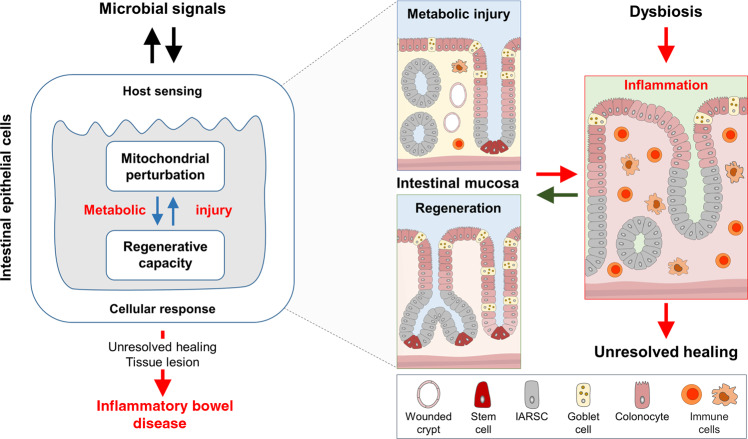
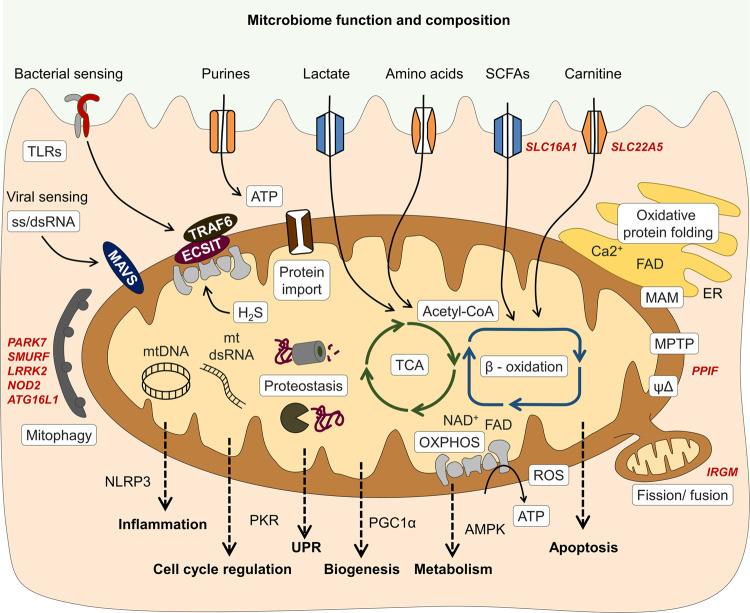
The intestinal epithelium represents the most regenerative tissue in the human body, located in proximity to the dense and functionally diverse microbial milieu of the microbiome. Episodes of tissue injury and incomplete healing of the intestinal epithelium are a prerequisite for immune reactivation and account for recurrent, chronically progressing phenotypes of inflammatory bowel diseases (IBD). Mitochondrial dysfunction and associated changes in intestinal epithelial functions are emerging concepts in the pathogenesis of IBD, suggesting impaired metabolic flexibility of epithelial cells affects the regenerative capacity of the intestinal tissue. Next to rendering the intestinal mucosa susceptible to inflammatory triggers, metabolic reprogramming of the epithelium is implicated in shaping adverse microbial environments. In this review, we introduce the concept of "metabolic injury" as a cell autonomous mechanism of tissue wounding in response to mitochondrial perturbation. Furthermore, we highlight epithelial metabolism as intersection of microbiome, immune cells and epithelial regeneration.
肠道上皮组织代表了人体内最具再生能力的组织,它位于微生物组中密集且功能多样的微生物环境附近。肠道上皮组织的损伤和不完全愈合是免疫重新激活的前提,也是炎症性肠病(IBD)反复发作、慢性进展的表型基础。线粒体功能障碍和相关的肠道上皮功能变化是 IBD 发病机制中的新兴概念,表明上皮细胞代谢灵活性受损会影响肠道组织的再生能力。除了使肠道黏膜易受炎症触发因素的影响外,上皮细胞的代谢重编程也与不良的微生物环境有关。在这篇综述中,我们引入了“代谢损伤”这一概念,作为一种细胞自主的组织损伤机制,以响应线粒体的扰动。此外,我们还强调了上皮细胞代谢作为微生物组、免疫细胞和上皮细胞再生的交汇点。