The Koret School of Veterinary Medicine, The Hebrew University of Jerusalem, P. O. Box 12, 761001, Rehovot, Israel.
Parasit Vectors. 2022 May 10;15(1):147. doi: 10.1186/s13071-022-05272-0.
Three species of Leishmania cause disease in humans in Israel and are endemic in the Middle East: Leishmania infantum, Leishmania tropica and Leishmania major. These species infect dogs and cats, but little is known about their prevalence in pet populations and their clinical manifestations. A study on dog and cat Leishmania infection was conducted in a focus of human L. tropica infection in central Israel with the aim of getting insight on leishmaniosis in pets in an area where human infection is highly prevalent.
Blood, demographic and clinical data were collected from dogs and cats brought for veterinary care in a focus of human L. tropica infection during 2018-2020. kDNA PCR and internal transcribed spacer1 high-resolution melt analysis PCR (ITS1 HRM PCR) with DNA sequencing were performed for the detection of Leishmania and species determination.
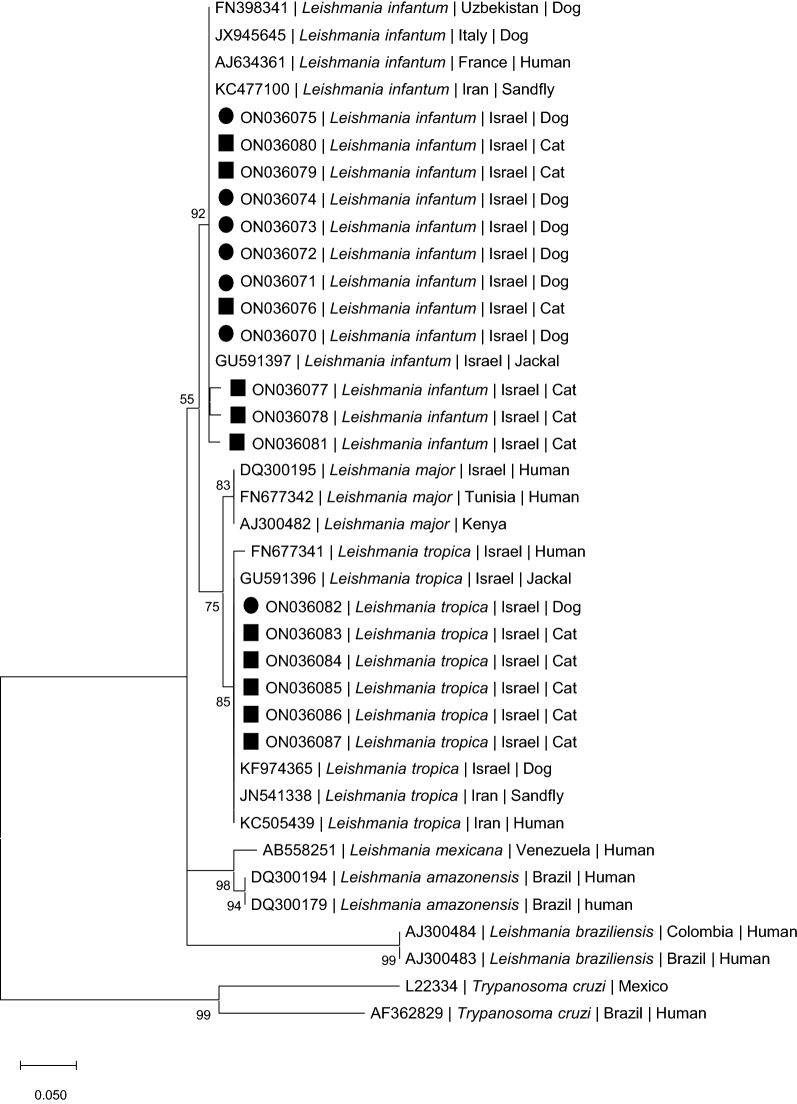
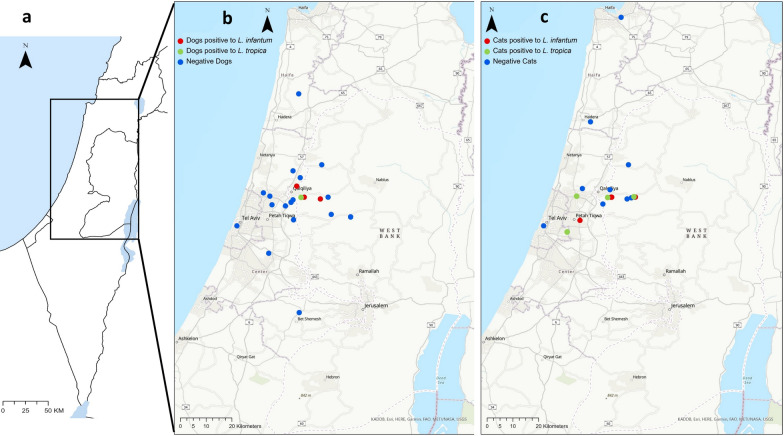
Forty-three of 189 dogs (22.8%) and 44 of 152 cats (28.9%) were positive for Leishmania spp. infection by kDNA PCR. The ITS1 HRM PCR detected six dogs (3.3%) infected with L. infantum and one (0.5%) with L. tropica, whereas six cats (3.9%) were found infected by L. infantum and five (3.3%) by L. tropica. Four of the five L. tropica-positive cats suffered from weight loss, four had azotemia, two with mild and two with severe azotemia and progressive renal disease. Three cats had gingivostomatitis; three had skin lesions with abscess and ulcers in two and scales and hair loss in another cat, which was also FIV +. This is the first report of feline L. tropica infection in Israel. Clinical information on cats with this infection from previous studies elsewhere is scarce.
A high rate of Leishmania spp. infection, mostly estimated as sub-clinical, was found in dogs and cats admitted for veterinary care in an L. tropica focus. Among the animals in which infection could be characterized to the species level, more dogs were infected with L. infantum than with L. tropica while 5 of 11 cats were infected with L. tropica and had signs of systemic and skin disease not described before in feline L. tropica infection.
在以色列,有三种利什曼原虫会导致人类患病,且在中东地区流行:婴儿利什曼原虫、热带利什曼原虫和硕大利什曼原虫。这些物种会感染狗和猫,但对于宠物种群中的流行率及其临床表现知之甚少。在以色列中部一个热带利什曼原虫感染的人类聚焦点进行了一项关于狗和猫利什曼原虫感染的研究,旨在深入了解在人类感染率极高的地区宠物中的利什曼病。
从 2018 年至 2020 年期间,在人类热带利什曼原虫感染的聚焦点接受兽医护理的狗和猫中收集血液、人口统计学和临床数据。使用 kDNA PCR 和内部转录间隔区 1 高分辨率熔解分析 PCR(ITS1 HRM PCR)结合 DNA 测序进行利什曼原虫检测和种属鉴定。
通过 kDNA PCR,189 只狗中有 43 只(22.8%)和 152 只猫中有 44 只(28.9%)被检测为利什曼原虫属感染阳性。ITS1 HRM PCR 检测到 6 只狗(3.3%)感染了婴儿利什曼原虫,1 只(0.5%)感染了热带利什曼原虫,而 6 只猫(3.9%)感染了婴儿利什曼原虫,5 只(3.3%)感染了热带利什曼原虫。5 只热带利什曼原虫阳性猫中有 4 只患有体重减轻,4 只有氮血症,2 只有轻度氮血症和 2 只有严重氮血症和进行性肾病。3 只猫患有牙龈口腔炎;3 只猫有皮肤病变,其中 2 只猫有脓肿和溃疡,另一只猫有鳞屑和脱发,同时它也是 FIV 阳性。这是以色列首次报告猫感染热带利什曼原虫。关于其他地方感染这种寄生虫的猫的临床信息很少。
在热带利什曼原虫聚焦点接受兽医护理的狗和猫中,发现了高比例的利什曼原虫属感染,大多数估计为亚临床感染。在所鉴定到的物种水平的动物中,感染婴儿利什曼原虫的狗多于感染热带利什曼原虫的狗,而 11 只猫中有 5 只感染了热带利什曼原虫,并出现了以前在猫热带利什曼原虫感染中未描述过的全身性和皮肤疾病的迹象。