Shi Hongshuo, Wu Zixuan, Wang Dan, Dong Chengda, Liu Pulin, Si Guomin, Liu Ting
Shandong University of Traditional Chinese Medicine, Jinan, China.
Guangzhou University of Chinese Medicine, Guangzhou, China.
Cardiol Res Pract. 2022 Apr 30;2022:4891729. doi: 10.1155/2022/4891729. eCollection 2022.
Tai Chi (TC) is a potential complementary treatment for essential hypertension (EH). This overview systematically summarizes and evaluates the existing evidence of TC in the therapy of EH.
Systematic reviews (SRs)/meta-analyses (MAs) on TC interventions for EH were comprehensively searched in seven databases. Methodological quality, risk of bias, reporting quality, and quality of evidence were assessed by means of the Assessment of Multiple Systematic Reviews 2 (AMSTAR-2), the Risk of Bias in Systematic (ROBIS) scale, the list of Preferred Reporting Items for Systematic Reviews and Meta-Analysis (PRISMA), as well as the Grading of Recommendations Assessment, Development, and Evaluation (GRADE) system.
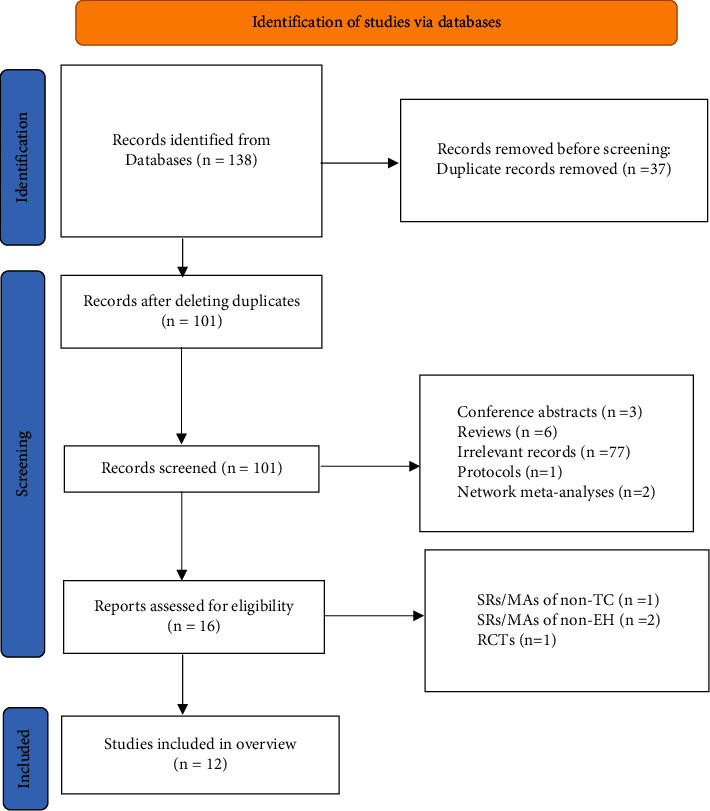
Twelve published SRs/MAs were included in our study. According to the results of the AMSTAR-2, ROBIS, PRISMA, and GRADE assessment, only 1 SR/MA was assessed as high quality and only 1 SR/MA was assessed as low risk of bias. Only 2 SRs/MAs have been fully reported on the checklist. In addition to that, the quality of evidence was assessed for a total of 69 outcome indicators extracted from the SRs/MAs included in this overview, and only 3 items were assessed as high quality.
TC may be an effective and safe complementary treatment for EH. However, this conclusion must be approached with caution, as the quality of the evidence provided by the SRs/MAs is usually low.
太极拳(TC)是原发性高血压(EH)一种潜在的辅助治疗方法。本综述系统地总结并评估了太极拳在治疗原发性高血压方面的现有证据。
在七个数据库中全面检索关于太极拳干预原发性高血压的系统评价(SRs)/荟萃分析(MAs)。通过多重系统评价评估2(AMSTAR - 2)、系统评价中的偏倚风险(ROBIS)量表、系统评价和荟萃分析的首选报告项目清单(PRISMA)以及推荐分级评估、制定和评价(GRADE)系统,对方法学质量、偏倚风险、报告质量和证据质量进行评估。
本研究纳入了12篇已发表的SRs/MAs。根据AMSTAR - 2、ROBIS、PRISMA和GRADE评估结果,只有1篇SR/MA被评估为高质量,只有1篇SR/MA被评估为低偏倚风险。只有2篇SRs/MAs在清单上有完整报告。此外,对从本综述中纳入的SRs/MAs提取的总共69个结局指标的证据质量进行了评估,只有3项被评估为高质量。
太极拳可能是原发性高血压一种有效且安全的辅助治疗方法。然而,由于SRs/MAs提供的证据质量通常较低,得出这一结论时必须谨慎。